



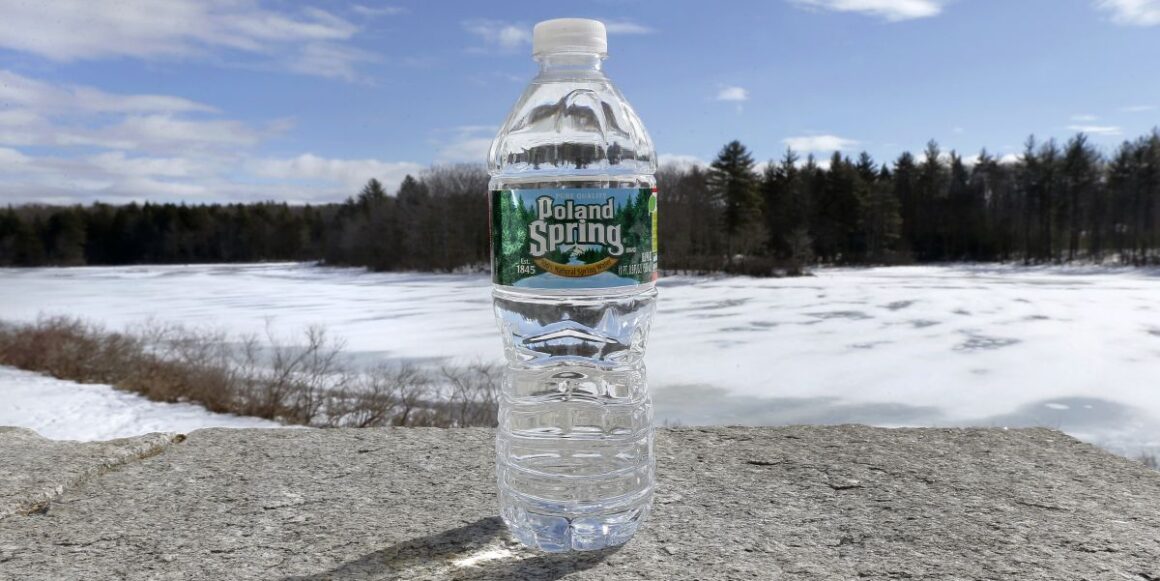
DENMARK — The Denmark Select Board held the third in a series of extended public hearings last week on Poland Spring Water Co.’s extraction permit renewal, scheduling a fourth meeting to evaluate public comments and the company’s responses.
The Select Board held public hearings on the permit renewal Aug. 11 and Aug. 18. Though originally scheduled for Sept. 8, the third hearing was postponed to Sept. 23 and then to Oct. 13 after the bottler requested additional time.
When the third hearing convened last week, Poland Spring’s hydrogeologist and others said that in the 16 years since extraction began at Cold Spring, extraction has caused no adverse effects on the aquifer.
The town’s hydrogeologist pushed back, saying no adverse effects does not mean there is no reason for concern.
During the two August hearings, several residents urged the Select Board to reject Poland Spring’s permit renewal request. They raised concerns about Long Pond, groundwater supplies, and private wells while calling for closer scrutiny of extraction alarms and alerts.
The hearings and submitted written comments produced 83 questions for the town and Poland Spring.
Poland Spring is seeking a five-year renewal to continue withdrawing water from the Cold Spring site in Denmark, where the company began extracting spring water June 1, 2010.
The board took no new public comments at last week’s hearing. Instead, representatives from the bottling company, along with the town’s technical consultants and attorney, presented answers to previously submitted questions.
The hearing is scheduled to continue Oct. 27, when the board plans to begin evaluating the information and possibly decide whether Poland Spring meets performance standards for renewal.
Mark Dubois, a hydrogeologist for Poland Spring, testified that the aquifer remains stable and precipitation-driven. He noted that extraction accounts for only about 2.4 percent of precipitation in the 3,400-acre watershed — rising to about 3.5 percent during a drought year — and said data shows no negative trend in the aquifer or Long Pond.
Denmark adopted local extraction regulations in 2005 that exceed state groundwater standards, adding measures to safeguard reserves. Since then, officials have tracked extraction amounts, along with snowfall and rainfall totals, and posted the data on the town’s website.
In his presentation to the board, Dubois contrasted the Denmark data with the Ogallala Aquifer in Kansas, which has declined about 120 feet since 1960. He showed historical aerial photos of Long Pond from drought years in 1968, 1980 and 2002, noting that low water levels and wide beaches occurred long before Poland Spring began extracting water there.
Matt Reynolds, a hydrogeologist with Drumlin Environmental, explained that Long Pond lacks an outlet and that groundwater at the southern end sits below the lakebed, causing water to drain out through the muck. He argued that extraction does not affect the northern end, where water levels are controlled, noting that even under an extreme 180-day drought projection without aquifer recharge, the zone of influence barely reaches the southern end.
Reynolds also confirmed that Poland Spring no longer seeks to lower action and alert thresholds for monitoring wells in Zone 3 and Zone 11 — a key point of concern for board members.
Rick Vandenberg, the town’s hydrogeologist and vice president of operations at Credere Associates in Westbrook, struck a different tone.
“Just because there’s not an adverse effect doesn’t mean there’s not a reason to be concerned,” Vandenberg said.
Vandenberg said his primary concern is how the aquifer behaves during severe droughts, when lower water levels can force the zone of influence to expand. He noted that the initial 2008 pumping test occurred during an unusually wet period with roughly 46 inches of excess precipitation in the system. He added that the test drew only 1.4 million gallons — a fraction of the 105 million gallons allowed under the permit.
He also raised a key technical point: As an aquifer’s saturated thickness decreases, its transmissivity drops, forcing the zone of influence to broaden to maintain extraction rates.
“Do I know how much bigger it is? Nope,” Vandenberg said. “But it needs to be looked at.”
Vandenberg emphasized that he has seen no data directly linking extraction to Long Pond levels or issues with private wells.
“No data has been presented that directly shows Poland Spring’s extraction operation has adversely impacted domestic wells and Long Pond,” he said.
Vandenberg noted, however, that uncertainty remains regarding the true size of the zone of influence during droughts, adding that a comprehensive groundwater model is needed to provide definitive answers.
Vandenberg recommended that the board freeze action and alert levels at current thresholds or roll them back to 2025 standards. He also advised accepting Poland Spring’s offer to develop a three-dimensional numerical flow model.
Matt Arsenault, an ecologist with engineering firm Stantec, presented findings on the wetland monitoring program. After 16 years of post-extraction data, Arsenault said the operation has caused no adverse impacts on local wetland communities, noting that native plant species remain consistent with pre-extraction baseline data and control sites.
Lawyer Meredith Scott, the town’s legal counsel, addressed questions regarding the process, clarifying why the board is reviewing the permit as a renewal rather than a new application following Poland Spring’s 2024 ownership change.
Scott explained that under the town ordinance, a change in ownership requires transferring at least 50 percent ownership to another legal entity. In the 2024 merger between BlueTriton Brands and Primo Water Corp., the existing ownership group retained roughly 57 percent of the new parent company, meaning Poland Spring does not qualify as a new applicant.
Addressing questions about a host community fee tied to extraction volumes, Scott said imposing new fees at this stage would constitute impermissible retroactive application. She added that any per-gallon fee must directly relate to the impacts of the regulated activity. Otherwise, it would be classified as an unauthorized tax.
Scott said the town retains authority, however, to recover application review costs and impose impact fees tied to identifiable municipal expenses.
Under the town’s water extraction ordinance, the company is permitted to draw up to 432,000 gallons per day, or 105.1 million gallons annually. Last year, Poland Spring withdrew 82,736,625 gallons, peaking in October with a monthly total of 7,982,230 gallons.
According to Drumlin Environmental’s latest monitoring report posted on the town’s website, the drought index was moderate from early May through the week ending Aug. 15, before dropping to severe the following week. While July precipitation was low, August levels returned to near normal, keeping groundwater above thresholds that would trigger extraction alerts or actions.
The town also tracks monthly precipitation, recording 32.11 inches of rainfall last year at Eastern Slopes Regional Airport. That compares with a 30-year normal average of 46.91 inches recorded at the same location between 1991 and 2020.
The precipitation recorded at Cold Spring was slightly less, at 31.42 inches last year. According to the Maine Department of Agriculture, Conservation and Forestry, 42 inches of rainfall is equivalent to 24 trillion gallons of water, half of which — about 12 trillion gallons — runs off the landscape into streams and rivers.
The hearing on the extraction permit renewal is scheduled to continue at 6 p.m. Tuesday, Oct. 27, when the board plans to begin discussing the evidence and moving toward decisions.