


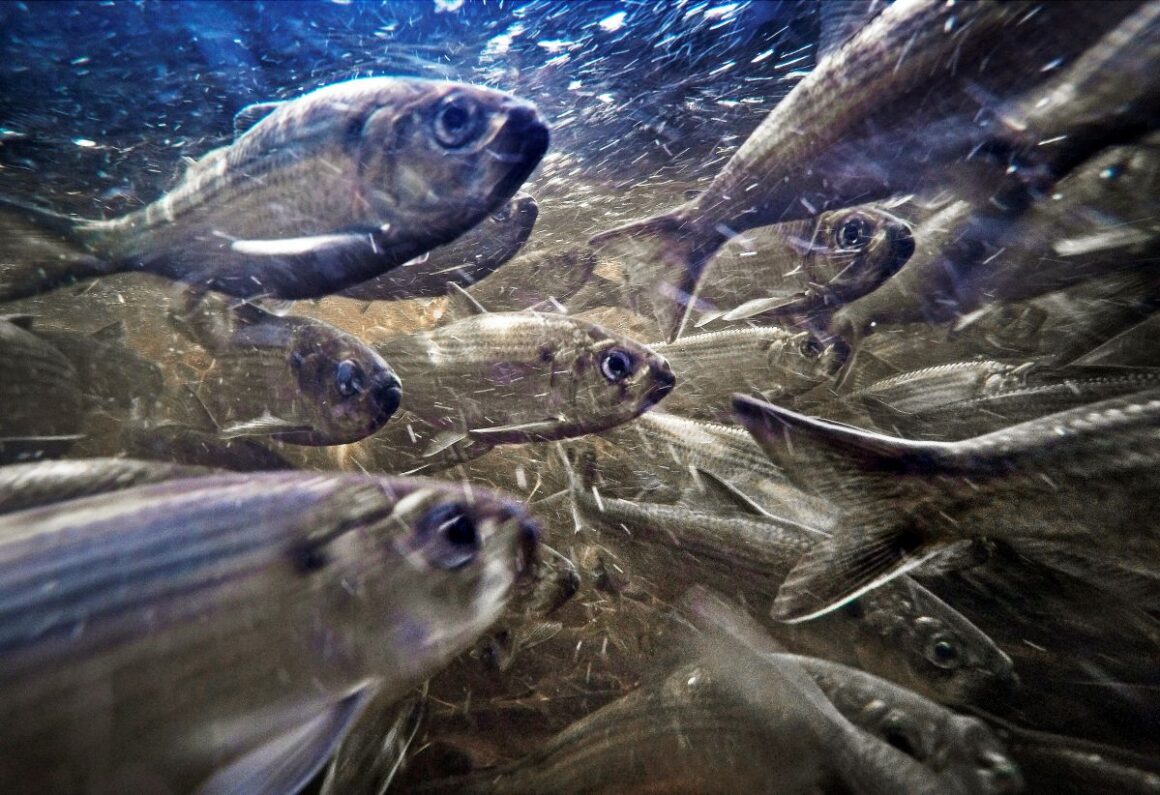
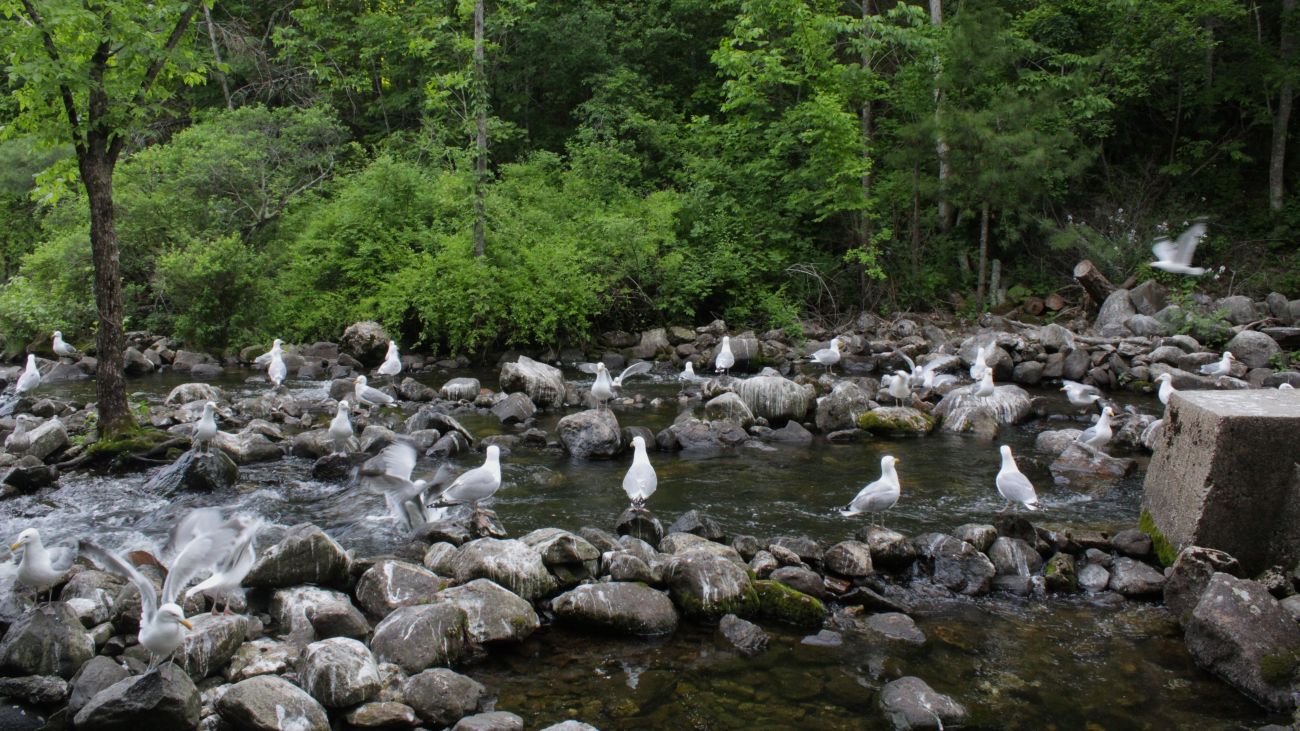
By June 10 the fish were supposed to have come and gone already, but there they were. At first, they looked like a shadow in the water. On closer inspection, the dark blob resolved into hundreds, maybe thousands, of small silvery fish.
They swam against the current of the Damariscotta River, braving a large gathering of gulls looking for dinner. Just ahead, the fish faced an uphill climb through dozens of small stone pools built to facilitate their passage from the ocean to Damariscotta Lake.
Alewives and blueback herring, which look very similar and are known together as river herring, spend most of the year at sea. But each spring, they return to the inland waters of their birth to spawn the next generation.
“This year was an odd year,” said Mark Becker, the fish agent for the towns of Newcastle and Nobleboro, who oversees the two towns’ commercial harvest of river herring. The fish are sold to lobster fishermen to use as bait.
In Maine, alewives generally appear in May. But this year, their spring run got off to a slow start. At the Damariscotta Mills fish ladder, which straddles both Newcastle and Nobleboro, Becker declared the harvest over by May 31 because there weren’t enough fish. But a week later, they finally arrived, and big groups kept running up the fish ladder until mid-June.
The fish agent didn’t know what exactly was behind this unusual run.
“Every year they prove to you that, well, you don’t know quite what they’re thinking or why they do things,” Becker said.
Alewives are, however, sensitive to weather extremes and sudden changes, and prefer moderation in both rainfall and water temperature, he said.
Some experts are concerned that these fish, which have been a conservation success story in recent decades, are now threatened by a changing climate.
Maine’s river herring population is smaller than it was historically, but it has been growing steadily since the early 2000s, after a severe decline in the 1980s and 1990s.
This rebound is in large part thanks to widespread efforts to restore the fish’s natural habitat. Throughout the 19th and 20th centuries, impassable dams cut off access to spawning grounds. Now, some of those dams have started to come down. At others, fish ladders and other passageways are being built or improved.
“We are very excited about the progress that we’ve made. It’s all in the right direction, although they still face a number of challenges,” said Mike Brown, a scientist at the Maine Department of Marine Resources who manages the commercial river herring harvest statewide.
One of those challenges is climate change.
If there’s too little rain, alewives can become trapped inland as water levels fall. If there’s too much rain, some fish passages through dams stop operating. Sea level rise poses a similar threat to fish passageways.
The climate has “a really direct impact” on the fish, Brown said, and “what we see now are some pretty dramatic swings in our climate.”
At an online meeting of the Gulf of Maine River Herring Network last week, conservationists who track river herring from New Brunswick down to Connecticut reported that their spring runs were a mixed bag.
Like the Damariscotta River, some smaller bodies of water on the coast had later and more sparse runs. At Walker Pond on the Bagaduce River in Hancock County, the run was “total trash,” Sarah O’Malley, a professor of marine biology at Maine Maritime Academy, said at the meeting. One very early theory is that weather conditions in 2022, when most of these fish were born, were not favorable, but “we haven’t really nailed anything down yet,” she said.
On larger rivers in Maine, this year’s runs appeared to be good, at least anecdotally, according to Brown.
Dam removals and fish passageway projects on the Kennebec and Penobscot rivers over the past two decades have brought approximately 6 million river herring a year back to each river. Brown said he expected this year’s numbers to be similar, although data is still being reported.
The Maine Department of Marine Resources counts alewives and blueback herring together, and tracks their populations in three ways. The department conducts trawl surveys in the ocean, and it also compiles counts of fish swimming up the state’s largest rivers in the spring. But the most definitive sources of data, according to Brown, will be reports from commercial fishermen, which are due in August.
Overall, the state’s river herring are certainly faring much better than they were 30 years ago. In the years ahead, however, conservation and management strategies for these fish — including how fish passageways across dams are built and operated — will need to adapt, Brown said. Exactly how is still uncertain.
“We’re not really sure where we’re headed,” he said. “We’re sort of driving forward but looking in the rearview mirror.”
Back at Damariscotta Mills, Becker, the fish agent, said he believes that this year’s numbers will end up being OK, although they won’t be close to the million alewives that swam up the Damariscotta River four years ago to spawn this year’s run.
The fish ladder there, originally built in 1807, underwent a $1 million renovation from 2007 to 2017.
“There’s no question that the work to restore the fish ladder and the ongoing work to keep it working have made a huge difference,” Becker said.
Alewives are among the more resilient sea-run fish in Maine, and even the smallest efforts to help them can pay off, he added.
“Every time somebody fixes a culvert in the state, every time somebody opens up a stream, it seems like alewives just kind of don’t have any problem adapting to those areas and turning them into spawning ground,” he said.