



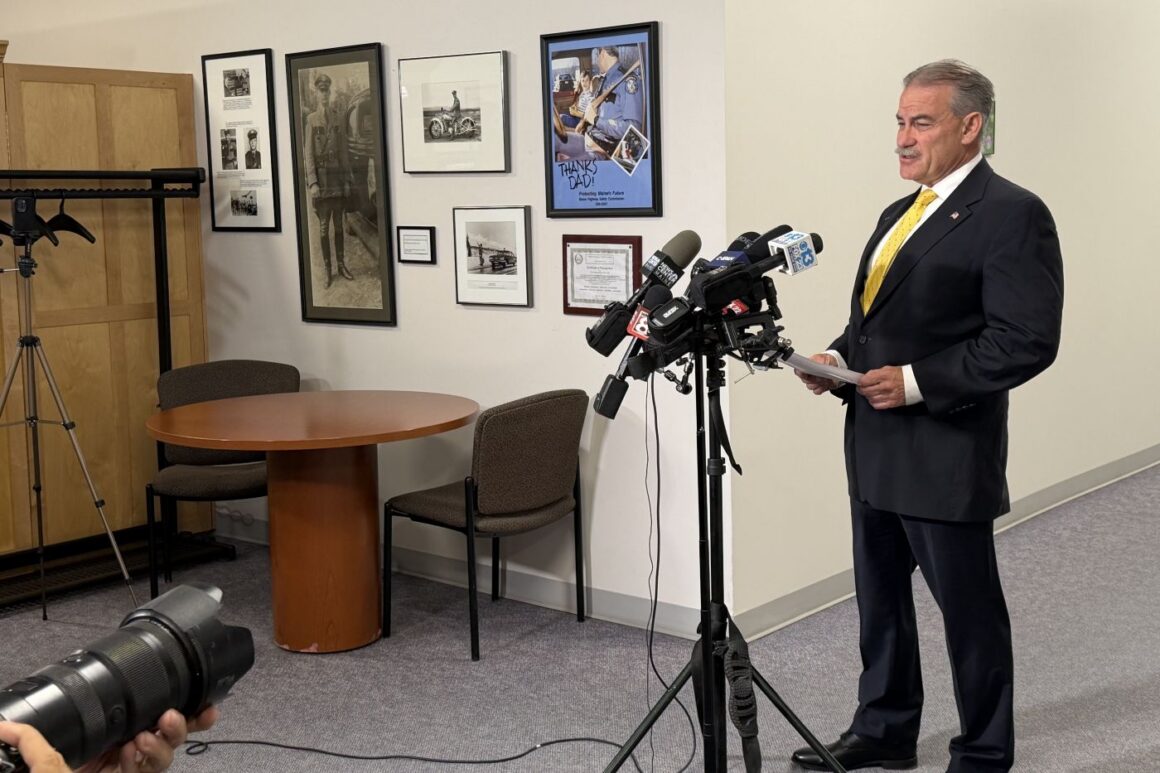
Republican Bobby Charles claims he has released his personal financial disclosure as he continues his campaign to be Maine’s next governor.
But in reality, Charles’ campaign has declined to provide the same level of information that is typically included in a financial disclosure statement for state officials. The campaign said two weeks ago that it would send his financial disclosure to The Maine Monitor but never did.
Personal financial statements are required for Maine lawmakers, legislative candidates and top executive branch officials as a way to help identify potential conflicts of interest. In an apparent loophole of Maine campaign finance law, however, the statements are not required for candidates running for governor.
The Maine Ethics Commission is proposing that state lawmakers address the discrepancy after The Monitor and other media outlets asked about it.
The Charles campaign has not provided details or answered questions about the income sources of his immediate family at the same time that he is using family financial connections as a political attack against one of his opponents. And after challenging his opponents to forgo state lobbyist money, his campaign wouldn’t clarify whether he still owns or generates income from his federally focused lobbying and consulting firm.
The Charles campaign provided some personal financial information to Maine-based TV station WMTW, including his taxable income and his property value for 2025, which the station published last week. But that report did not include certain financial details for Charles, including information about any debt and any income from his spouse. Charles’ campaign did not answer questions from The Monitor about those missing details.
Charles took to social media after the WMTW story published on Oct. 1 and credited himself for transparency.
“My financial disclosure: released. Epstein files: I said release them. Corruption in both parties: I’ve called it out,” Charles said on Facebook that day.
In a comment responding to his own post, Charles added, “I am transparent and will continue to be.”
Charles did not mention that his campaign has declined to provide his full personal financial information to The Monitor since this summer.
The Monitor started asking Charles and the two other candidates on the ballot for Maine governor, Democrat Hannah Pingree and independent Rick Bennett, about their personal finances in early July.
Candidates for governor are not legally required to provide their personal financial information until the race is over, and only the winning candidate has to submit it to the ethics commission. So The Monitor asked them all to provide it voluntarily.
Bennett’s information was already available because he is a sitting state senator. He answered several clarifying questions about his existing financial disclosure, which shows he is involved in a collection of businesses and has multiple rental properties. Bennett clarified that he did not provide income for his wife in his disclosure because she is retired.
Bennett confirmed that he derives “passive rental income from a retail cannabis business.” A review of state, county and municipal documents connected that income to a Mechanic Falls property, the ownership of which he and his wife transferred to a limited liability company.
Pingree’s campaign sent The Monitor her personal financial details in a format that matched the various requirements in state statute for top executive branch employees. Pingree had not previously had to file a personal financial disclosure statement despite serving for several years as the head of Gov. Janet Mills’ Office of Policy Innovation and the Future. She said she would support updating state law to make sure her former role falls under the financial disclosure requirement.
Pingree had no recent individual sources of income aside from her state job. The information provided by her campaign showed that she and her husband derive rental income from a property they own together, and they generate interest and capital gains income from assets managed by The Vanguard Group. Her husband has individual income from his role as executive director of North Haven Sustainable Housing and multiple ventures as a documentary filmmaker.
One liability, a home mortgage, was listed in Pingree’s financial statement provided to The Monitor.
Charles was the only one of the three major candidates for governor who declined to share his personal financial information in July, saying that he did “not see the value of adding personal finances to the campaign discussion at this time.”
More recently, he appeared to see value in highlighting the personal finances of Pingree and her family. Charles has launched attacks on Pingree and her husband, Jason Mann, for their shared professional connections to the Island Institute, a Rockland-based nonprofit that aims to support island and coastal communities in Maine.
Charles raised questions and lobbed accusations related to Mann’s documentary filmmaking work for the Island Institute, along with Pingree’s former role on the organization’s board of trustees and a $37,458 state climate change-related grant that the institute received through the Office of Policy Innovation and the Future while Pingree led that state agency. Charles called on Pingree and others to release records related to that grant process.
Both Pingree and the Island Institute have pushed back. The Democratic nominee called Charles’ attack “completely made up.” The organization similarly called it false and said that no state or federal dollars were used to fund its series of films that Mann was involved with, as reported by Maine Public.
Given that Charles made personal finances and family connections a point of attack in the campaign, and because the Maine Ethics Commission is poised to recommend legislation that would require gubernatorial candidates to file personal financial statements in the future, The Monitor reached out to Charles in late September to see if his previous stance on not releasing his personal financial information had changed.
“Thanks for following up. Bobby does plan to release his personal financial disclosure,” said Charles’ campaign manager, Dale Crafts Jr., in a Sept. 23 email. “We can get this for you next week.”
However, the Charles campaign never sent a financial disclosure to The Monitor. The campaign did send some financial information to WMTW, but it was not the full slate of information that has to be included in official state financial disclosure filings.
The Monitor asked the campaign five times for his financial disclosure information over seven days. In addition to not providing it, the campaign did not answer questions from The Monitor about whether Charles has any debts or liabilities from the previous calendar year, if he currently owns or generates income from his lobbying firm, or why the information in the WMTW story did not include income sources for his immediate family.
Financial disclosures for other state officials must divulge any sources of income equal to or greater than $2,000 for spouses. Charles and his wife held leadership positions together for years at The Charles Group, a lobbying and consulting firm in the Washington, D.C., area. Information from the firm’s since-deleted website, available on an internet archive site, shows Marina Charles listed as The Charles Group’s senior vice president of operations in August 2025.
It remains unclear whether Bobby or Marina Charles continue to retain ownership or generate income from The Charles Group now that he is running for governor. This uncertainty raises questions about whether the Republican candidate’s immediate family would continue to generate income from lobbying and government consulting activities at the federal level after the election. If elected governor, he would legally have to disclose spousal sources of income over $2,000 within 30 days of his election.
The Charles campaign did outline to WMTW that Charles earned nearly $165,000 in taxable income — all from The Charles Group — in 2025, and that his property was valued at more than $600,000.
By specifying dollar figures, that is one case where Charles provided more information than is usually included in the financial statements for lawmakers and executive branch leaders, which require sources of income to be listed but not total numbers. But in other areas, Charles has not met the same standard of disclosure.
“We have fully complied with all relevant state laws for personal financial disclosure,” Crafts, the campaign manager, told The Monitor in an Oct. 7 email. “For more than 16 months, Bobby has been sacrificing personally and professionally to run for Governor to turn around Maine after eight years of disastrous policy decisions from Janet Mills and Hannah Pingree. Bobby deeply loves Maine and believes turning it around is worth fighting for. And when he’s elected Governor, he will turn our state around for taxpayers, families and small businesses.”
The statement from Charles’ campaign that he is complying with state personal financial disclosure laws hinges on the fact that state statute does not require gubernatorial candidates to file such disclosures. But that could change next year if lawmakers take advice from the ethics commission.
“We’ve gotten inquiries from the media this year and four years ago: If legislative candidates file this statement, why don’t candidates for governor file the statement?” said Jonathan Wayne, the executive director of the ethics commission, at the Sept. 30 meeting when commission members voted to recommend the change to lawmakers. “After all, candidates that would be elected governor can touch all aspects of state government.”
Ethics commission chairman Bill Schneider, a Republican who previously served as Maine’s attorney general, offered the lone comment from the panel during the overview from Wayne.
“Good question,” Schnieder responded, before the commission unanimously advanced the package of proposed changes.