




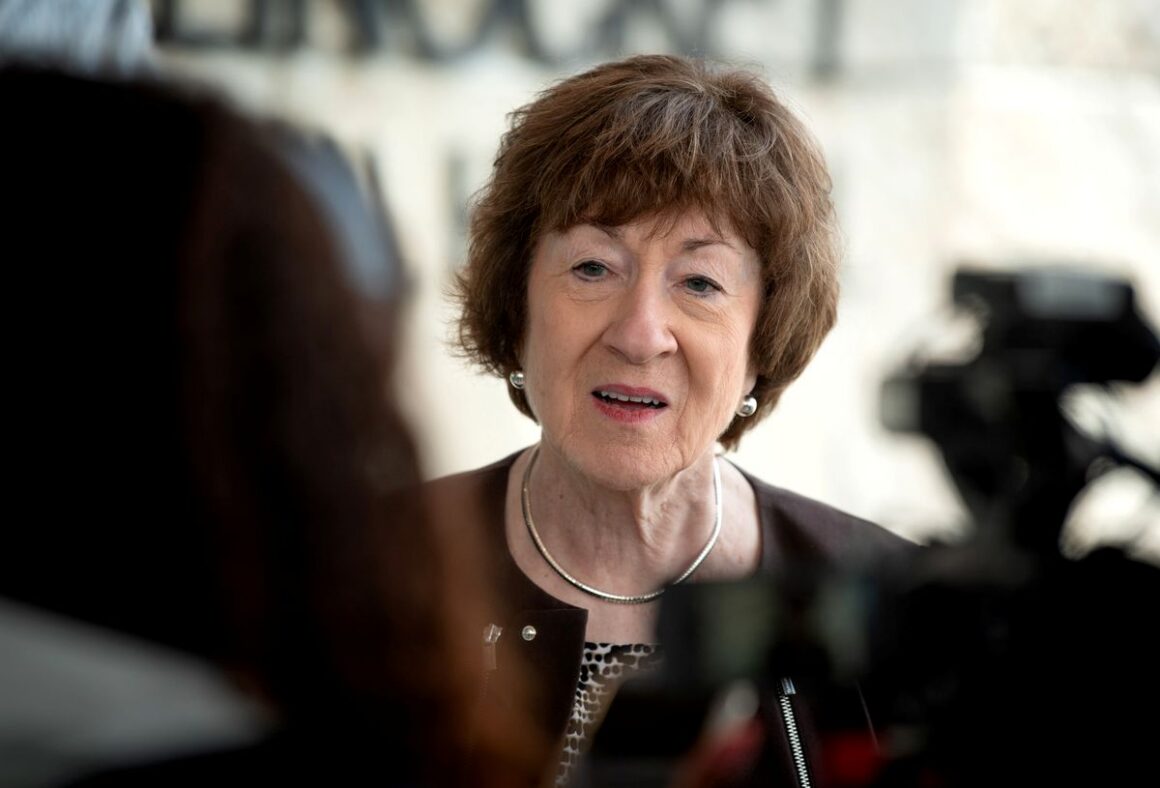
SKOWHEGAN — U.S. Sen. Susan Collins said Monday she is seeking more details on how a proposed $300 billion fund for Iran could be used and that she will review a new Pentagon request for tens of billions of dollars tied to President Donald Trump’s war.
Speaking to reporters after an event at the Sappi paper mill in Skowhegan, Collins said she is worried that money laid out in a memorandum of understanding signed last week by the Republican president could undercut U.S. goals if it goes toward Iran’s military capacity.
“I’ve been very concerned that the memorandum of understanding says that Iran would receive $300 billion and it’s not clear who or what country that money would come from,” Collins said. “If it can be used to rebuild the ballistic missiles, or to enrich more uranium, or restore Iran’s navy, then the progress that has been made through this conflict would be done away with.”
The Maine Republican’s stance has put her under fire from both directions. Last week, Trump branded her as being among a group of “losers” within the party for backing an effort to curb his authority. Democrat Graham Platner has made the conflict a centerpiece of his campaign against her in one of the nation’s biggest 2026 elections with Senate control up for grabs.
Collins said a briefing earlier in the day from Secretary of State Marco Rubio allayed one concern: He “made very clear that there would be no American taxpayer dollars involved in that $300 billion,” she said. Officials have said the money would largely come from private investment led by Gulf nations.
The price tag of the war and the deal to end it face growing pushback in both parties. The fund is far larger than the $1.7 billion that President Barack Obama returned to Iran under a 2015 nuclear agreement. The Pentagon is now seeking roughly $80 billion in supplemental funding, mostly for the Iran war, on top of a request for $1.5 trillion in total defense spending this year.
Collins, the top Senate appropriator, said she is not ready to endorse that supplemental package. She said the request she is reviewing is “a different amount of money than I was originally told a couple of months ago” and now includes disaster relief and assistance for specialty crops such as Maine’s wild blueberry industry alongside war-related costs.
“We’re still going through it with a fine-tooth [comb],” Collins said. “We don’t have all the details yet, so I do anticipate that I will hold a public hearing on this supplemental.”
Her new comments deepen a stance she has been sharpening for weeks as the 70-day-old conflict remains under a partial ceasefire. In May, Collins said Congress should authorize the military action in Iran or end it, rejecting the White House’s claim that the ceasefire paused a 60‑day clock for Trump to seek authorization under the War Powers Act.
On Monday, she reiterated that interpretation, saying the law gives the president “widespread authority” as commander in chief for the first 60 days of a conflict but requires congressional approval after that.
Collins was one of four Republicans who joined Democrats this month in passing a war powers resolution aimed at limiting Trump’s authority in Iran. The Senate’s 50-48 vote marked the first time it has approved such a measure on this war.
Trump responded on his social media platform by calling Collins and the other Republicans who backed it “losers” and saying they had “made my job more difficult,” even as his administration presses Congress to approve the Iran deal and the supplemental funding that goes with it.
Platner has attacked Collins from the other side, casting her as too deferential to the administration on the conflict and calling her “spineless” last month she pressed a military official, but not Defense Secretary Pete Hegseth, on whether the U.S. anticipated Iran’s closure of the Strait of Hormuz, a move that drove up fuel prices.