


KINGFIELD — A committee studying whether Kingfield should withdraw from Maine School Administrative District 58 outlined a tentative budget and a plan Tuesday that would use multiage classrooms throughout the school.
The committee also addressed audience questions and reactions, including both support and concerns.
Along with Kingfield, Strong and Phillips are considering leaving MSAD 58. Only Avon has voted to remain.
The Kingfield committee has reached Step 8 of a 22‑step process the state requires for withdrawing from a school district. The major component of Step 8 is negotiating a withdrawal agreement with the district. Strong is slightly ahead of Kingfield and has reportedly begun negotiations with MSAD 58.
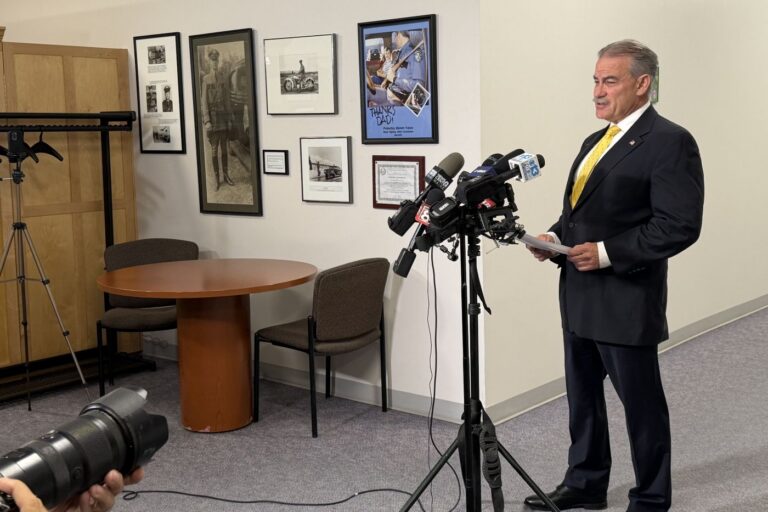
“We’re in the process of setting up negotiations with MSAD 58,” Martha Witham, adviser to the committee, told the audience.
Witham, a former superintendent of Maine School Administrative District 13 (Bingham and Moscow), has advised committees both forming and leaving school districts. She also chairs the Augusta Board of Education.
The committee’s tentative budget for the 2026‑27 school year shows Kingfield spending about $527,000 less in its first year as an independent unit than its current share of the MSAD 58 budget — $2,537,368 compared with $2,010,172.
The committee compared the proposed school spending in Kingfield with that of Stratton School in the village of Stratton, part of the town of Eustis. A stand‑alone Kingfield school would have about the same enrollment as Stratton — 102 students compared with Stratton’s 103.
In several categories, projected spending in Kingfield would be lower than in Stratton. Regular instruction, for example, is projected at $1,056,374 for Kingfield, while Stratton is spending $1,354,032 this year — a difference of $297,658. The figures include salary, benefits and retirement plan payments.
Kingfield would also spend $57,807 less on system and school administration — $265,900 compared with $323,707.
Kingfield’s projected cost for special education would be nearly double Stratton’s — $408,749 compared with $226,642. Kingfield would also spend $90,037 more on transportation than Stratton.
Committee members repeatedly told the audience that the comparison numbers are soft. It was not possible to determine, for example, exactly what special education services Kingfield would need to provide or what services Stratton provides.
“It’s an affordable plan,” committee member Mathias Ringle said. “There’s just so much that we don’t know” because of the difficulty of determining program‑by‑program spending.
He added, “We don’t have the Stratton budget (as a reference), so we don’t know why these differences are there.”
He noted that overall spending is similar for each school.
The tentative budget shows seven classrooms, with prekindergarten and kindergarten each having a teacher. Prekindergarten would have a half‑time educational technician, and kindergarten a full‑time ed tech. The budget projects eight students in prekindergarten and seven in kindergarten.
After that, each two grades would be combined. First and second grades would share a teacher and a full‑time ed tech for 20 pupils — 16 from Kingfield and four from unorganized territories who attend Kingfield’s school on county‑paid tuition.
The other classrooms would be grades 3‑4, with a teacher and a full‑time ed tech for 23 pupils (17 from Kingfield); grades 5‑6, with a teacher and a half‑time ed tech for 20 pupils (14 from Kingfield); and grades 7‑8, with a teacher for 14 students (11 from Kingfield).
A teacher and two educational technicians would serve 10 special education pupils. Music, art and physical education would be taught by a two‑fifths‑time teacher in each specialty.
In addition, the budget proposes a full‑time social worker, a half‑time school nurse, a full‑time principal, a full‑time office administrator, a one‑fifth‑time superintendent, a half‑time IT specialist and a half‑time library‑media specialist.
The business manager and special education director would be contract positions.
“What we’re trying to do here is come up with a plan that would give Kingfield even better education and at a lower cost,” Ringle said.
Virtually all of the 49 people in the audience stayed for the entire 110‑minute meeting. The second half was mostly public statements about what residents like about the withdrawal plan and what concerns them.
Ringle and committee Chair Kathy Houston posted the likes and concerns on a storyboard. In the end, the audience registered nearly a dozen likes and a dozen concerns.
The most favored element was keeping the Kingfield school open. MSAD 58 has discussed closing the school and busing pupils out of town.
“It allows us to keep our school open,” said Dorrie Robinson, an alternate member of the committee.
Through 2021‑22, Kingfield served pupils from kindergarten through eighth grade. It now serves prekindergarten through fourth grade.
Kimberly Jordan, a committee member who also sits on the Kingfield Board of Selectmen, said the withdrawal process began when the board learned the town’s share of the MSAD 58 budget would increase by $228,000.
“The select board said, ‘That’s just too much,’ and started the process to organize the committee,” she said.
Jordan is also a former school director in MSAD 58.
Speakers noted — and the committee’s paperwork confirmed — that Kingfield has 20 percent of MSAD 58’s students but pays 39.6 percent of the local tax burden.
Several speakers also stressed that withdrawing from MSAD 58 would give Kingfield local control of the school.
“If we had our own board, Kingfield can make all the decisions about curriculum and about what we need for our school,” Julie Talmage said. “With MSAD 58, we have four of 14 (board) members, and we can’t control what happens.”
One speaker said she was concerned about the use of multiage classrooms, but resident Claudia Diller told the audience that one of her family members teaches in a multiclass setting in Washington state.
“The teacher loves it,” she said, “and the kids have no problem with it at all.”
Among other benefits, supporters said students in multiage classes have the same teacher for two years before moving on. The potential change in Kingfield’s long relationship with Mt. Abram Regional High School in Salem Township was also a concern, but Ringle said Kingfield’s students would still attend Mt. Abram.
“They could also go to Mt. Blue (in Farmington) on superintendents’ agreements,” he said.
The Regional School Unit 9 board of directors voted this month to accept students from MSAD 58 at Mt. Blue High School. At the time, Superintendent Christian Elkington said Mt. Blue has the capacity to take Mt. Abram students.
Witham said that once the committee and MSAD 58 negotiate an agreement, which would cover issues such as whether Kingfield would have to buy the school building and the buses that transport its students, the plan would be submitted to the commissioner of the Maine Department of Education, who could approve it or send it back for revision. She said that must be done by June 30.
After revisions are finalized, a public hearing would be held, likely in August.
The plan would then return to the commissioner of education for approval and a second public hearing, which must be held by Oct. 24.
After that, the plan would go to voters Nov. 3. Witham said passage requires a two‑thirds vote.