




FAIRFIELD — The Town Council voted unanimously Wednesday evening to adopt a new downtown economic development plan that outlines recommendations for revitalizing Fairfield’s downtown district.
Garvan Donegan, president and CEO of the Central Maine Growth Council, presented the 2026 Fairfield Downtown Revitalization Plan, a 175-page document that analyzes downtown assets, foot traffic and community survey results.
The plan’s major recommendations include capitalizing on existing foot traffic along Main Street and updating and expanding the downtown tax increment financing, or TIF, district.
Town Councilor Stephanie Thibodeau said Fairfield needs a new development framework because the town has changed significantly over the past 12 years. Thibodeau, who chaired Fairfield’s Economic & Community Development Committee, helped develop the plan. She said far fewer downtown commercial properties are available for sale than a decade ago.
“It’s no longer just Main Street,” she said. “Basically, the only building up for sale is where Batey’s (TV & Appliance) is. Everything else is owned. So the market isn’t really there for new businesses to come in,” other than in a few select locations.
Thibodeau said attracting visitors to local businesses is critical.
According to the plan, Fairfield received roughly 600,000 visitors annually over the past three years, with 83 percent coming from outside the town.
Donegan briefly explained how the Growth Council calculated the number of visitors.
The Growth Council used software to analyze anonymous cellphone data linked to visitors’ ZIP codes. The software counted visits lasting 10 minutes or longer to calculate the total number of downtown visitors. For example, 38 percent of all visitors came to Fairfield from Waterville, according to the data.
Donegan said the goal is to measure the number of people who visit downtown, including Fairfield residents.
Although downtown has pockets of high activity, the plan states that pedestrian engagement remains “critically low” near major assets such as the Kennebec River and Water Street. Community surveys also show that residents want more riverfront signage, bicycle lanes and parking.
Donegan said capitalizing on downtown visitors would support other development goals.
“Think about how walkable infrastructure makes infill housing viable. Housing products and investment produce foot traffic,” he said, adding that foot traffic creates enticing storefronts that can increase the tax revenue available to the town.
Donegan called the foot traffic a “data gold mine.”
The development plan also recommends building a pedestrian bridge to connect Main Street with Mill Island.
“The lack of a dedicated, high-capacity pedestrian footbridge isolates the island from the Main Street commercial district,” the plan states.
“Mill Island Park is a hidden gem,” Town Council Chair Timothy Martin said. “I love the idea of a footbridge again because I think that it connects to Main Street, but again, that’s an investment but it’s also an opportunity to keep those 600,000 people” in Fairfield for longer.
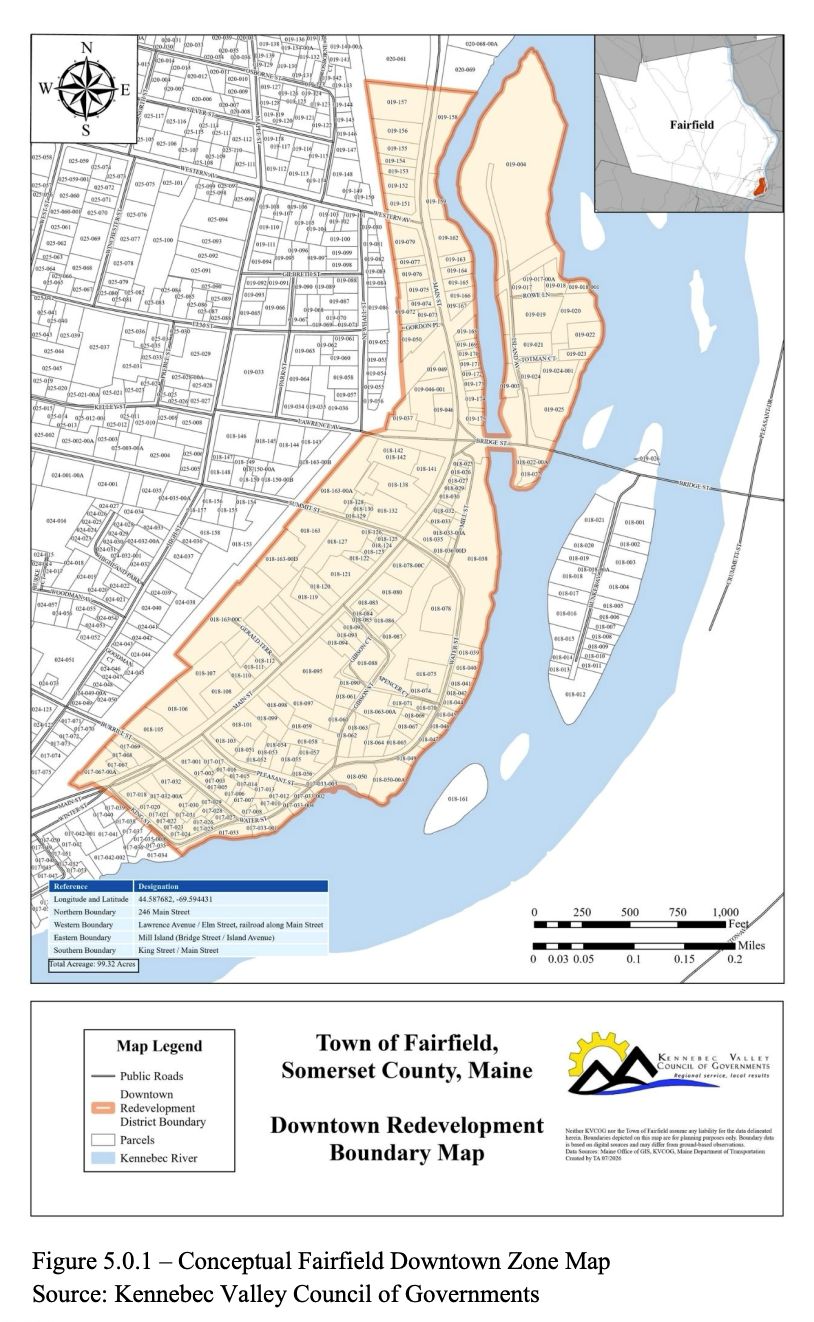
The plan also recommends renewing and expanding Fairfield’s downtown TIF district, which the town established in 2009 to support ongoing improvements.
“By establishing a downtown TIF,” the plan states, “Fairfield can shelter the incremental new assessed value resulting from private investment.”
Without a TIF district, rising property values resulting from downtown investment could reduce Fairfield’s state subsidies and increase the town’s tax payments to Somerset County, according to the plan.
The town can dissolve or renew the current downtown TIF district at its discretion, provided officials complete the required steps with the state and receive approval. The district has a maximum lifespan of 30 years.
The proposed expansion would nearly triple the district’s size to more than 112 acres, extending its boundaries from 246 Main St. to the north to King Street to the south. The expansion also would include all of Mill Island.
Town Councilor Kevin Kitchin asked about the potential impact of the expanded TIF district on residents.
Donegan said property owners in a TIF district continue to pay taxes based on their property’s current assessed value.
“It doesn’t preclude you to do anything,” he said. “It doesn’t hurt your property values. It may enhance your ability to seek investment because there’s an incentive now in place.”
Many properties are already included in the downtown TIF district, Town Manager Michelle Flewellen said. Property taxes do not change for owners whose properties are included in a TIF district.
“The taxes still work the same,” she said. “It just gives us an opportunity to be able to provide assistance and incentive to developers going forward, should there be any.”
The council voted unanimously to adopt the plan. The next steps include addressing town ordinances and organizing the plan’s recommendations into an action plan.
Martin closed the discussion by urging the Town Council to begin implementing the plan.
“It’s up to the council not only to find ways to push” the plan, he said, “but to find ways to fund it. And we’re going to constantly have to find ways to think outside the box.”
The council has scheduled a public hearing on the budget for 6:30 p.m. Wednesday, Sept. 30, and a special town budget meeting is set for 6:30 p.m. Wednesday, Oct. 14.
Kevin Mann is a Community Reporting Fellow receiving training through the Journalism New England Career Lab to do civic reporting that provides people in towns across New England with the information they need to be engaged in their community.