



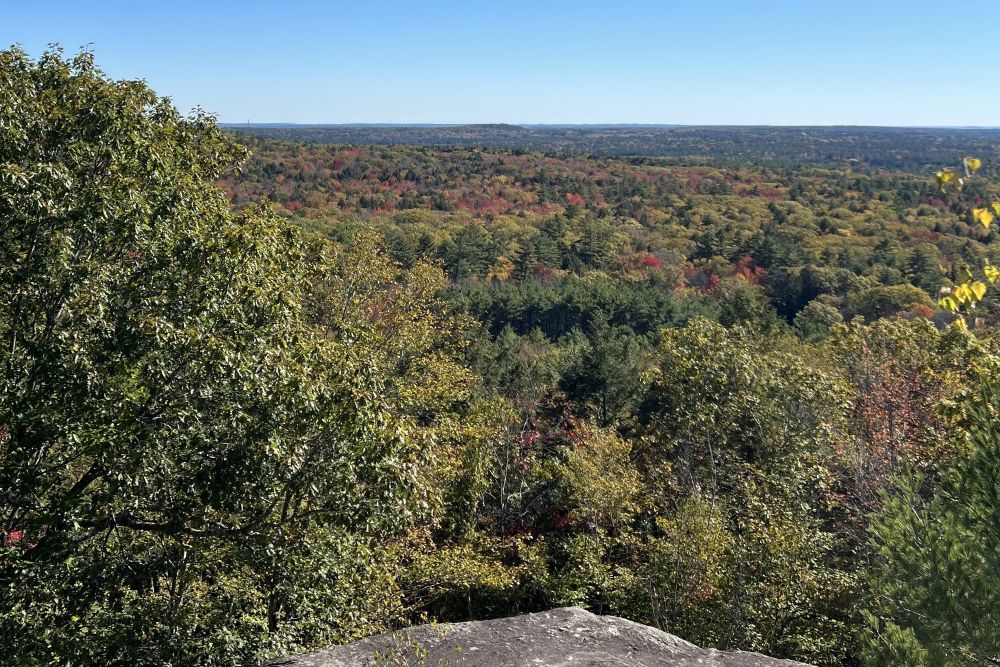
On an October 18 trip to Bradbury Mountain State Park in Pownal, I noticed something about the forest canopy overhead: The red, orange and yellow foliage that dominates this time of year seemed duller than usual.
My suspicions deepened at the viewpoint, where the panorama of fall colors looked like its saturation had been turned down a few notches.
Stephanie Spera is a professor of geography, environment and sustainability at the University of Richmond in Virginia, and she’s spent much of her career studying fall foliage in Acadia National Park. She noticed this year’s dull colors while on a research trip to Lewiston and Auburn in mid-October.
“The colors were so sad,” Spera said. “So many leaves seemed like they had fallen prematurely.”
Maine’s ongoing drought is the likely culprit behind this year’s less vibrant foliage and early leaf drop, Spera said. The U.S. Drought Monitor’s October 23 report recorded drought conditions across all of Maine, with a swath of “extreme drought,” the second-highest level on the drought intensity scale, stretching from Downeast into New Hampshire’s White Mountains region.
Trees become more stressed during a drought, which can influence their behavior as temperatures get colder.
Different types of trees have different levels of resilience to drought. Oaks tend to be among the most resilient to drought conditions, in part because their roots extend deep into the ground. And while oaks generally hang on to their leaves the longest and are the last to turn colors, the drought may explain their late-season show this year, Spera said.
Maples, on the other hand, are much more sensitive to drought conditions. Maple trees take an extra step to produce their signature red and purple pigment, called anthocyanin, to go beyond the yellow and orange hues found in the leaves of birches, beeches and oaks.
“You need extra energy to produce it, and, if a tree is stressed during a drought, it won’t spend its resources producing that red pigment,” Spera said.
This year’s drought isn’t new. Five years ago, Maine saw the driest May-to-September period since the state’s records began in the 1950s. Yet Sean Birkel, the state climatologist based at the University of Maine, said it’s unclear whether droughts that have occurred since 2020 point to a trend in increasing drought frequency or are part of a decadal scale of variability, where some 10-year periods are drier than others.
Part of the challenge with attributing specific droughts to climate change is that there are more extremes in both wet and dry years, Birkel said. In 2023, the same May-to-September period that was drought stricken in 2020 experienced the wettest conditions on record.
What is clear, Birkel said, is that higher temperatures linked to climate change are producing the conditions for more intense droughts when they do occur.
“Historically, short-term drought is relatively common in the Northeast region. With the warming climate, when weather patterns do produce a drought, the drought conditions will be exacerbated by higher temperatures,” Birkel said.
Meanwhile Maine’s climate is getting wetter, on average. Since the 1950s, Maine’s annual precipitation has increased by about 6 inches. But changing atmospheric and ocean patterns in the Northeast mean we’re more likely to swing between short bursts of heavy rainfall and prolonged periods without rainfall, when drought conditions can form, Birkel said.
And despite recent rain that’s hit much of the state, there are still hurdles to clear before the winter freeze to avoid drought conditions again in the spring.
“We need six to 10 inches of additional rainfall before the ground freezes in order to avoid the drought signal carryover in the groundwater,” Birkel said.
Over the long term, Spera has found that changing climate patterns could change when Maine sees peak colors. In 2023, Spera published research showing how peak fall foliage in Acadia now occurs two weeks later than it did in the 1950s.
By 2060, Spera projects that peak foliage could happen as late as October 30 to November 2. Yet, as was the case this year, fluctuating rainfall and drought patterns introduce some uncertainty into predicting when exactly peak will occur in a given year.
“If you look at the last 20 years, what you actually see is that it’s more variable. There’s crazy variability, and I think it’s to do with the rainfall aspect,” she said.