


FARMINGTON — Residents at a special town meeting Thursday criticized the results of the recent property revaluation, citing errors by the assessing company and questioning whether the town could hold the firm financially responsible for some of the mistakes.
Despite concerns about the revaluation’s accuracy, more than 60 residents authorized the Farmington Select Board to withdraw $700,000 from the undesignated fund balance to help close an unexpected $2.2 million budget gap and avoid a supplemental tax bill.
The expenditure is expected to reduce the town’s fund balance to about $2.5 million — less than the recommended $3 million benchmark that helps maintain a favorable bond rating — but should prevent an increase in the property tax rate to $11.70 per $1,000 of assessed valuation.
Instead, the tax rate will remain at $10.50.
The Select Board set the rate last month at $9.81, based on revaluation figures provided by KRT Appraisal. Town officials later discovered, however, that the figures were incorrect.
KRT Appraisal, based in Haverhill, Massachusetts, conducted Farmington’s first revaluation in more than 20 years. The firm was the sole bidder for the project, which cost the town about $300,000.
Town Manager Erica LaCroix said the town was told a spreadsheet from KRT Appraisal’s president contained four figures needed to calculate the property tax rate: total property value, personal property value, the homestead exemption and the business equipment exemption.
The homestead exemption figure was about 10 times higher than it should have been, meaning the board’s originally proposed rate would have raised $2.2 million less than needed to fund the town, school and county budgets approved earlier this year.
After the error was discovered Nov. 4, the Select Board unanimously voted to reset the property tax rate, also called the mill rate, at $10.50 to help close the gap. The board proposed using $600,000 from an investment fund and $700,000 from the undesignated fund balance to cover the remainder.
Thursday’s special town meeting was called to seek residents’ approval for emergency spending authority to use $700,000 from the undesignated fund balance.
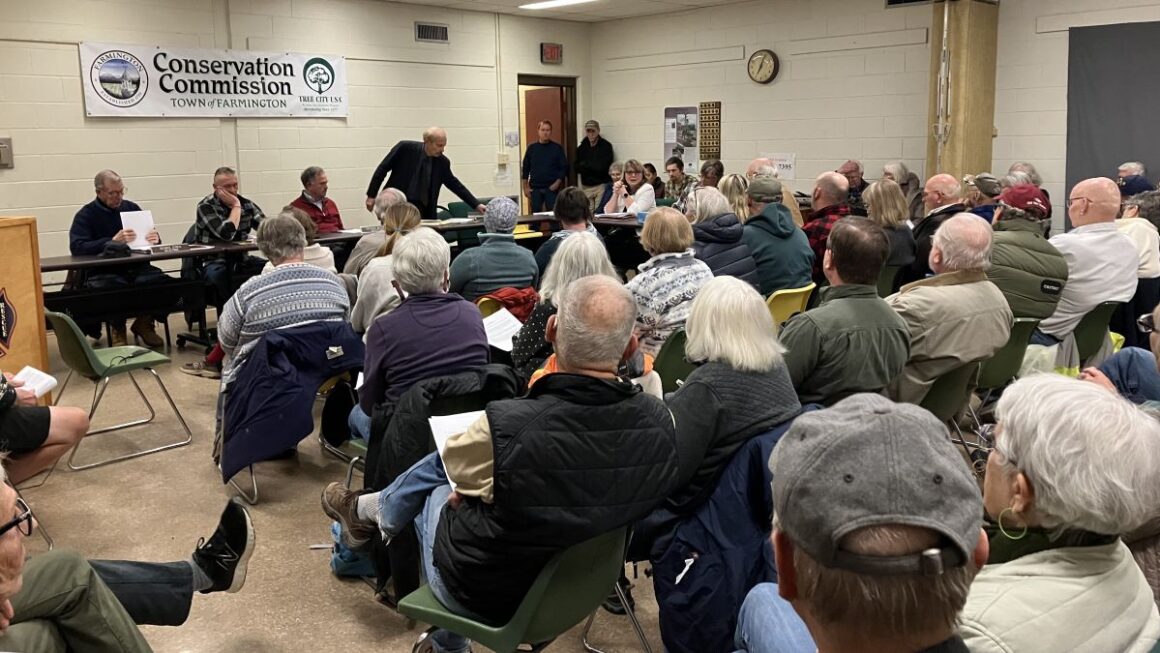
The special town meeting drew more than 60 people to the basement of the Municipal Building. While some residents asked questions about the error, more used the opportunity to raise concerns about the revaluation process.
Several speakers at the meeting complained about significant increases in land values, saying the assessments lacked nuance for features such as flood plains, wetlands and wood lots.
Others said they or family members received valuations with clear errors, including buildings that did not exist or were mistakenly attributed to their properties. Some suggested that KRT Appraisal’s field staff might not have inspected every property in person.
Town officials pointed to the abatement process as a potential source of relief for residents with specific concerns, while cautioning that applying for an abatement does not guarantee a lower tax bill. After meeting with the town assessor, taxpayers may appeal to the Board of Assessment Review, then to the county and, if necessary, to the court.
Some residents questioned whether KRT Appraisal could be held accountable if it had made errors. LaCroix said about two-thirds of the $300,000 revaluation cost has already been paid. The town has one unpaid invoice from the firm for half of the remaining balance, with the rest likely due next year.
Town officials plan to discuss the issue with KRT Appraisal, according to LaCroix, who noted the firm had a “different view of what they had done.”
“We aren’t done here,” LaCroix said of KRT. “The fact that we have a problem has not been lost on us.”
The town’s contract with KRT Appraisal requires that disputes be resolved through arbitration.
LaCroix said she instructed Town Assessor Frank Xu to visit properties where residents reported potential errors.
Resident Bill Crandall thanked the board for proposing the use of undesignated funds as a compromise between the $9.81 property tax rate and the $11.70 rate, which would have covered the town’s obligations without additional funding.
“I know this was a tough situation,” Crandall said. “I wanted to thank the selectmen for selecting an option that was more reasonable than jumping to the 11.70 (rate). But we’re going to be in this next year, and we’re still going to have this bite next year.”

Given the expected increase, Crandall suggested the town consider delaying capital expenses when possible.
Another resident, Josh Bell, suggested using the $600,000 in investment funds but not tapping the undesignated fund balance, which he likened to merely delaying the inevitable increase.
That approach would result in a mill rate between $10.50 and $11.70, requiring a secondary tax bill to cover the shortfall.
After about an hour of discussion, residents voted to approve using up to $700,000 from the undesignated fund to keep the property tax rate at $10.50. About three-quarters of those voting supported the measure.
At the $10.50 tax rate, a home valued at $300,000 would generate a tax bill of $3,150 before exemptions. That is a decrease of $132, or about 4 percent, compared to the previous bill.
Select Board member Dennis O’Neil said one of the major complicating factors was the long delay in revaluations. He noted that the delay had cost property owners money by limiting the 2024 homestead exemption to about $19,000, rather than the typical $25,000, due to the gap between the town’s valuation and the state’s assessment.
“But, I think at this point, we are disappointed at how it turned out,” O’Neil said, despite the necessity of conducting the revaluation. “It’s unfortunate.”
He added: “Thank you for coming. Stay tuned.”