


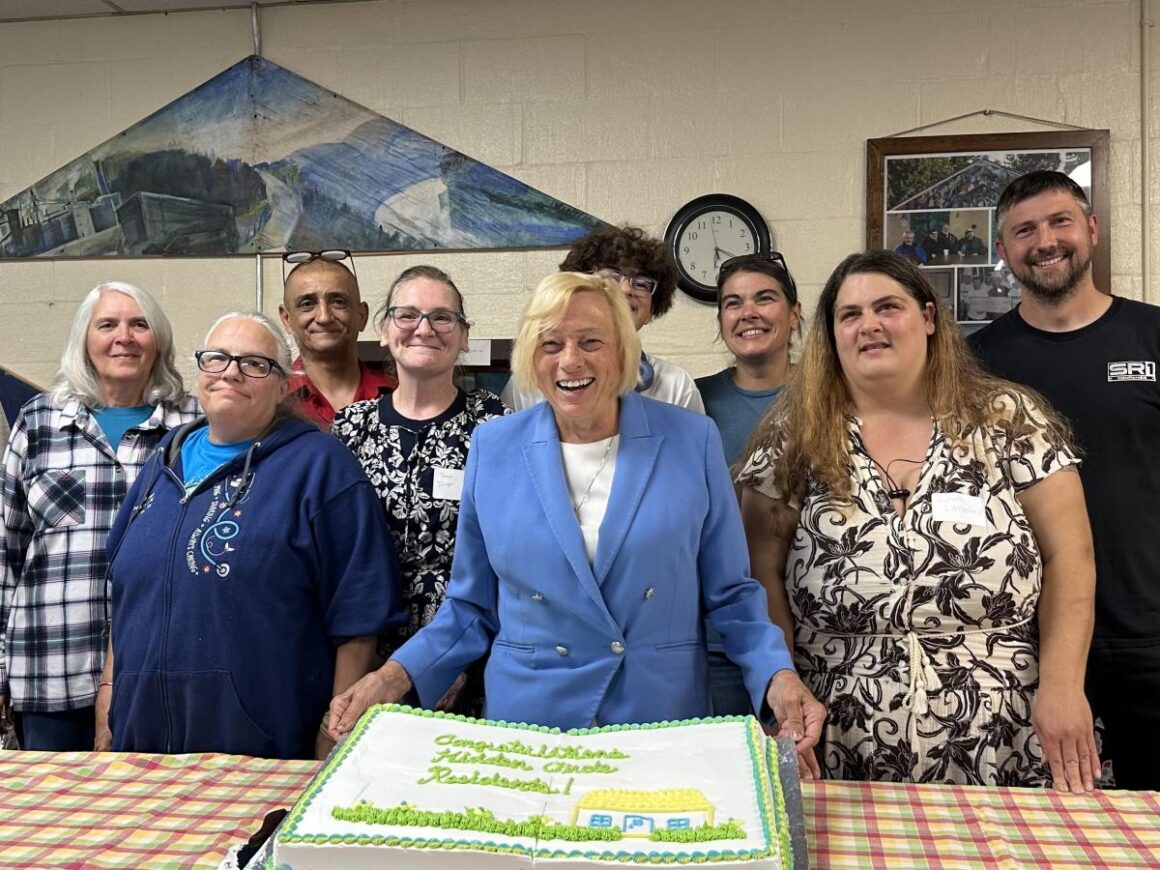
JAY — Robert Vellas was so delighted, he roasted a brisket and some chicken to share with a few neighbors and a roomful of strangers. Those strangers included Gov. Janet Mills, who joined residents of the Hidden Circle Mobile Home Park on Tuesday to celebrate their purchase of the park.
On July 30, the 31 owners of mobile homes at Hidden Circle became the first in Maine to buy their land using a new state law that gives residents the first right of refusal when a park goes up for sale.
“I love my neighbors in the park,” resident Tanya Dwyer said as she greeted nearly 30 people at the observance, “and I thank them for making this possible.”
Dwyer helped lead the drive to buy the park after learning that an owner in Florida had sold it.
Residents and supporters gathered at the Solidarity Center on Intervale Road, also known as Maine Route 140, at Main Street, also known as Routes 4 and 17.
Representatives of organizations that helped residents raise about $1.5 million attended, along with residents of Hidden Circle and residents of Sandy Bottom Estates, a mobile home park in Turner whose residents are considering purchasing their park. The organizations include the Genesis Community Loan Fund, the Maine Community Foundation, the Cooperative Development Institute and the Maine State Housing Authority.
Residents bought the park for about $1.1 million. They said they plan to use the remaining funds to repair and upgrade infrastructure they say previous owners neglected for years. The financing enabled them to form a cooperative and purchase the land.
MaineHousing provided $310,000 through what Scott Thistle, the communications director, described as a “forgivable loan.”
The previous owner, Ben Adrian, general partner of New Riverside Farms, also gave residents $61,000 to begin upgrading septic systems, Dwyer told Monitor Local.
Mills told the audience that the $310,000 came from the Mobile Home Park Preservation Fund, part of the $8 million she requested from the Legislature. She said the fund is expected to preserve more than 900 homes “across six parks from Brunswick to Bangor to Turner to Saco.”
Vellas said residents began negotiating to buy Hidden Circle in October and continued the process through the winter.
Nora Gosselin, director of resident acquisitions for the Cooperative Development Institute, told the audience: “We weathered a lot of uncertainties, including trying to find septic tanks under the snow. We are fixing up what the owners couldn’t do in eight years.”
“Congratulations,” Gosselin told the residents. “You showed what is possible.”
Garrett Strout, the property manager, said in an interview that the cooperative will begin working on five septic systems next month. Strout, principal of Multi Management Group in Bangor, manages three other mobile home parks.
Strout said some residents share septic systems, giving Hidden Circle a total of 20 to 22 systems. He said he will not know the condition of each one until he can inspect them all.
“I hope we don’t have to replace every system,” Strout said.
At a Nov. 24 rally at the Solidarity Center, Dwyer said her septic tank had been pumped twice and that the owners planned to bill her $600 for the next pumping. Living on disability income and working part time, she had also been hit with a $50‑a‑month rent increase last fall.
“I can’t move. My home is too old to be mobile,” she said at the rally. “I own my own home. I just don’t own the land it’s on.”
Liza Fleming‑Ives, executive director of the Genesis Community Loan Fund, said Monday that residents received a 10‑year loan that can be renewed. Much of the loan funding came from donors to the Maine Community Foundation. Residents will retire the loan through their monthly rent payments, which will also cover the cost of operating the park. Genesis will return the money to its revolving loan fund to support future mobile home park purchases.
An “opportunity to purchase” law passed in 2023 required mobile home park owners to allow residents to present a competitive offer when parks go up for sale. But the law did not require owners to sell to the residents, even if their offer was higher.
Fleming‑Ives said Genesis has financed four purchases under the law.
In her remarks, Mills said: “I want every person, at every stage of their life, to be confident that they can rent or buy a home that is the right size for their family and be able to stay there as long as they want. No one should be afraid that a sudden rent increase will break their budget or that someone will buy the land they live on out from under them.”
Turning to some of the Hidden Circle residents, Mills said: “Now you have control over where you live, how you live. Congratulations.”
Hidden Circle is one of three parks in Jay that were owned by New Riverside Farms. The others are Pine Haven, with 53 lots, and Lambert Street, with 13. Vellas and Dwyer said New Riverside has sold the other two to investors. Rents in the three Jay parks had risen by nearly 50 percent.
JoAn Gray, who lives at Lambert Street, told the Select Board in January that her rent had risen 75 percent — to $325 from $210 in 2014. She said more than half of that increase occurred in 2025, after New Riverside Farms bought the park.
When the Jay Select Board meets Monday, Aug. 24, it is expected to consider an ordinance for the Nov. 3 election ballot that would limit rent increases on mobile home parks.
Town Manager Shiloh LaFreniere, who attended Tuesday’s observance, has said one issue to resolve is whether rent increases should be tied to the cost of living or capped at a set percentage. She said Monday is the last day for the board to act on an ordinance for the Nov. 3 ballot.
According to a report published Monday in the Sun Journal, Genesis found that 20 of the state’s 32 largest parks are owned by large companies such as Sun Communities, Phillips International and Boa Vida. That places about a third of Maine’s mobile homes in parks owned by large investment corporations.
Resident cooperatives own fourteen mobile home parks in Maine. The Sun Journal reported that these parks tend to be much smaller, with a total of 1,046 lots.
“We still have more work to do to protect Maine people and mobile home parks from being exploited by companies who simply want to use them to extract a profit,” Mills said, “but I am proud of how we have worked together to preserve this vital housing for people in Maine.”
This story was updated August 24 to correct the “also known as” references in the fifth paragraph.