



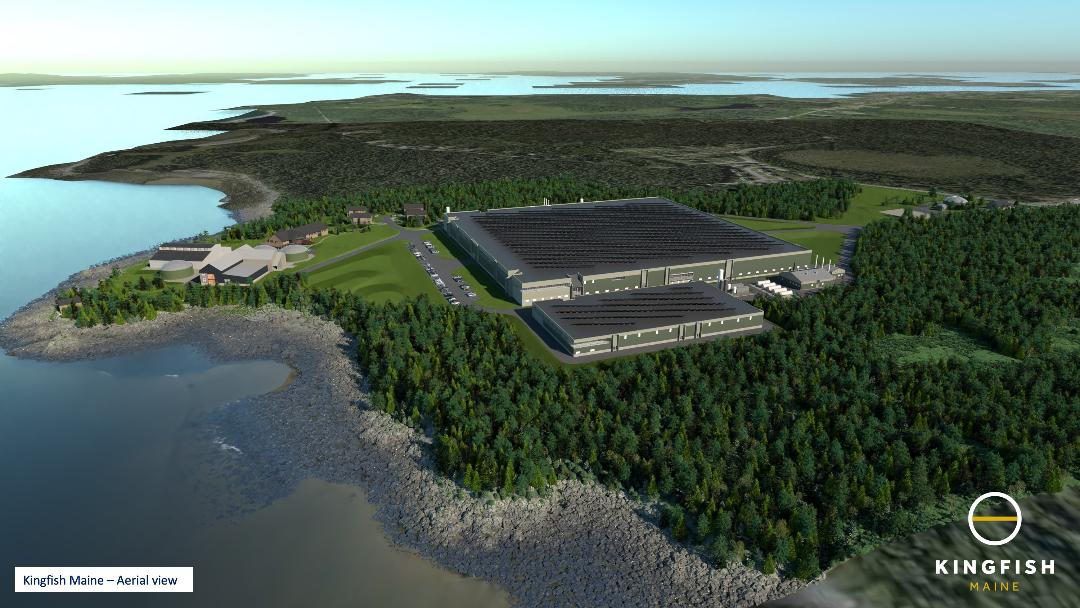
JONESPORT — The Planning Board has scheduled a public hearing to consider changes to the town’s Shoreland Zoning Ordinance that would give Kingfish Maine an additional 30 months to make a “substantial start” on its proposed $110 million aquaculture facility on Chandler Bay.
The hearing is set for 6 p.m. Wednesday, July 8, at Jonesport Elementary School.
Planning Board member Paul T. Iossa said the extension is reasonable because multiple court challenges have significantly delayed the project.
“Now they’re basically starting from scratch,” he said. “They have to rebook all the contractors. They have to redo all the estimates. The building, the project is the same, but everything that goes into it has been affected.”
In 2021, The Kingfish Co. bought 9 Dun Garvin Road — about 95 acres of oceanfront property on Chandler Bay in Jonesport — and applied to the Maine Department of Environmental Protection to build an aquaculture facility that would eventually produce 8,500 metric tons of yellowtail kingfish a year and provide between 70 and 100 jobs.
The project has since weathered multiple appeals from opponents concerned about its environmental impact.
Kingfish Maine was finally cleared to proceed in April 2025, when the Maine Supreme Judicial Court affirmed a lower court ruling that upheld a Department of Environmental Protection permit for the project.
According to the court’s ruling, the permit, which the Department of Environmental Protection issued after conditionally granting Kingfish a wastewater discharge permit for the same project, authorized the company to build its facility under the Site Location of Development Law and to install intake and outfall pipes as required by the Natural Resources Protection Act.
The amendment proposed for Jonesport’s Shoreland Zoning Ordinance, the subject of the July 8 hearing, cites those delays. It notes that in addition to the court challenges the project has faced, the Legislature in 2026 considered upgrading Chandler Bay to SA water‑quality status, the most pristine classification in Maine — a change that would have prohibited the discharge of treated water from the proposed Kingfish plant.
On April 3, L.D. 2187, An Act to Update Certain Water Quality Standards and to Reclassify Certain Waters of the State, was adopted, and Chandler Bay was not included in the reclassification.
It remains classified as SB, a less stringent water‑quality category, effectively allowing the continued build‑out of the Kingfish plant. The Jonesport board has proposed that the 30‑month period for Kingfish to show project progress begin April 3, when the law was adopted.
At the July 8 public hearing, town residents will also be asked to consider whether Kingfish’s town permits should lapse if the company has not made a “substantial start” within the proposed 30‑month period.
The Shoreland Zoning Ordinance defines “substantial start” as the “completion of thirty (30) percent of a permitted structure or use measured as a percentage of estimated total cost.”
The Planning Board is suggesting that, given the scope of the project, “substantial start” be amended — as it applies to Kingfish only — to mean “tangible evidence of physical work on the site” and “a clear progression toward fulfilling contractual and regulatory obligations.”
Opponents of the project continue to question Kingfish Maine’s financial capacity to build the proposed facility. Its Dutch parent company, The Kingfish Co., reported that its current Netherlands operation did not meet its profitability target for 2024, measured by EBITDA, a standard indicator of operating performance, and the company has yet to release its 2025 annual report, which was due at the end of March.
Unaudited figures released in a June 17 company press statement reported improved performance at the Netherlands facility, noting: “Revenue increased, gross margin per kilogram improved and the operational EBITDA loss per kilogram was significantly reduced, reflecting higher volumes, better cost absorption and continued efficiency measures.
“While farm utilisation remained below target and the ramp-up pace was slower than anticipated, the second-half performance demonstrates the positive impact of the Company’s operational improvement initiatives.”
The current target for the company’s 2025 annual report is now June 30, 2026.
In the Maine Department of Environmental Protection approval issued Nov. 12, 2021, the DEP reviewed the company’s financial capacity to build what was then estimated to be a $110 million project and approved it based on a commitment letter from Rabobank, which owned 12.5 percent of Kingfish at the time.
With its share price at record lows, The Kingfish Co. announced in May 2026 that Icelandic investor Eyrir will become its new majority shareholder as part of a broader financial restructuring.
Eyrir was founded in 2000 by Arni Oddur Thordarson, who was announced June 19 as the newest member of the Kingfish Supervisory Board.
According to the Kingfish website, Thordarson was the “Chairman and later CEO of Marel, now JBT, a global leader in advanced automation solutions for the food and beverage industry.”
Eliminating “the toughest and most monotonous jobs in salmon” was the goal of JBT Marel client Búlandstindur, a whitefish and farmed‑salmon processing plant in Djúpavogi, in eastern Iceland. The entire processing line there – from scaling to gutting to packing – is now fully automated.
“Jobs have developed into monitoring the processing and system,” writes Elís Grétarsson, general manager at Búlandstindur, on the JBT Marel website.
The Sunrise County Economic Council, a Washington County economic and community development nonprofit, supports Kingfish Maine and has advocated for it. Tom Sorby, the operational manager for Kingfish Maine, sits on SCEC’s board.
“It’s a new industry that will operate on different cycles than the existing industries we have,” Charles J. Rudelitch, executive director of the Sunrise County Economic Council, said. “Lobster fishery is a major employer, as are the industries related to the lobster fisheries in Jonesport. But this land‑based aquaculture will diversify the economic base.”
To meet the electrical needs of the Kingfish Maine fish farm and processing plant, the state of Maine awarded the company a $4 million grant in February 2024 to upgrade energy infrastructure along Route 187 through Jonesport. The grant required a $4 million match from the company and was expected to be used by the end of March 2026. The Maine Technology Institute, or MTI, is administering the grant.
Brian Whitney, MTI’s president, said the Kingfish award is being held pending completion of local and state permitting approvals.
After the July 8 public hearing, the Jonesport Planning Board is required to call for a town vote on the proposed changes to the Shoreland Zoning Ordinance. If approved by voters, the amendments would then return to DEP for review and approval, completing the regulatory sequence.