


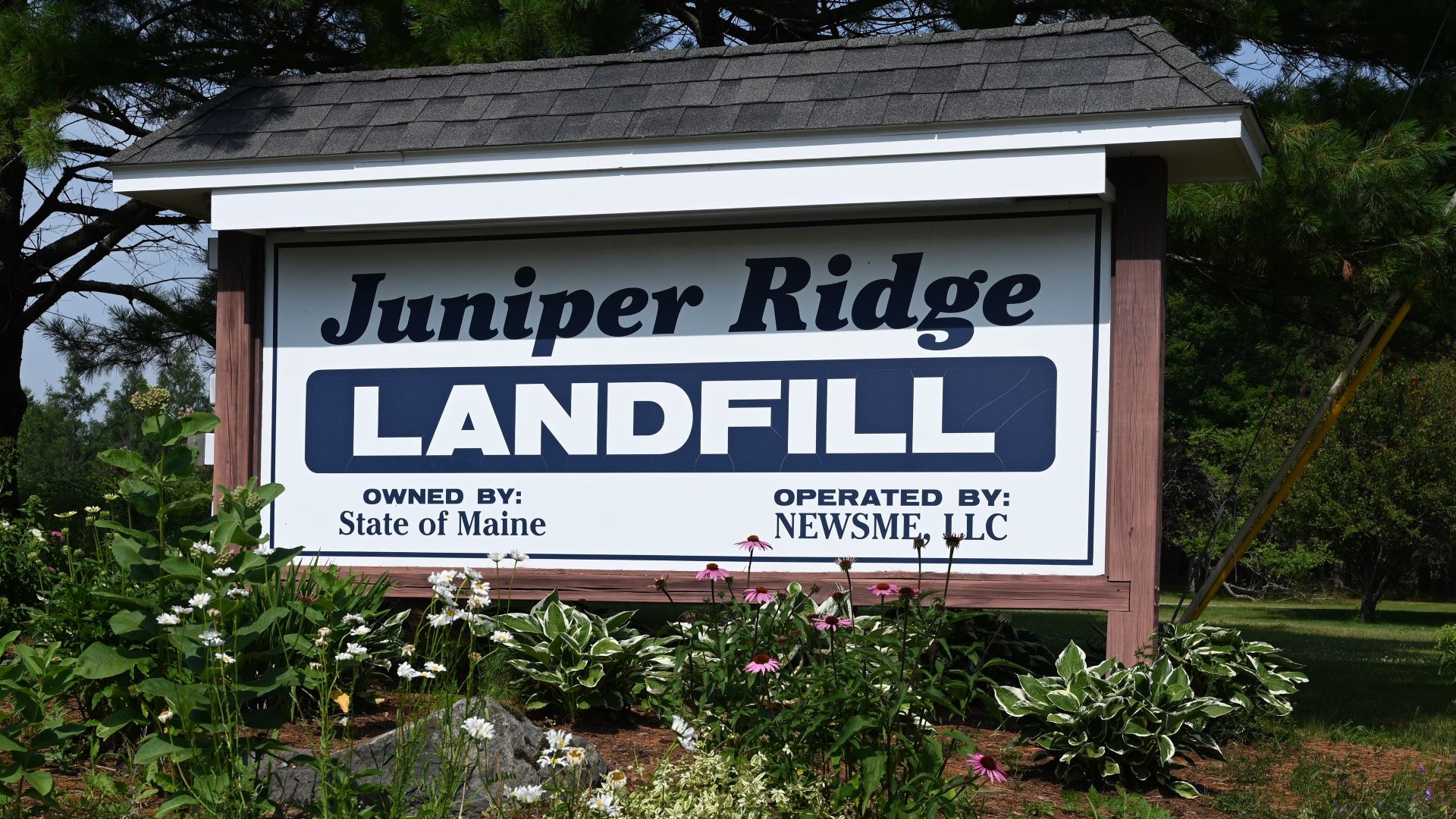
The Maine Department of Environmental Protection recertified the Juniper Ridge Landfill’s positive public benefit Monday, clearing the way for a controversial expansion of the state-owned facility — its largest since it was established in 1996.
For the second time this year, the department has taken steps to expand the Juniper Ridge Landfill — despite public outcry from Penobscot Nation.
The move marks the latest turn in a yearslong fight that opponents say shifts Maine’s growing trash burden onto the tribe and threatens the river often described as the culture’s “heart,” a phrase used by Penobscot Nation Chief Kirk E. Francis in a special report.
“I have grave concerns for the water,” Maria Girouard, a Penobscot tribal historian, wrote in a letter to the state Department of Environmental Protection this month, later published by the Sunlight Media Collective, an Indigenous-led media group that documents environmental and tribal sovereignty issues.
In early January, a Penobscot County Superior Court judge blocked the determination that a 61‑acre expansion of the Juniper Ridge Landfill serves a public benefit.
The landfill, which is in Old Town and Alton, just north of Bangor, sits a few miles from the Penobscot Reservation at Indian Island, which spans 15 towns and two unorganized territories along the Penobscot River.
A primary point of dispute is the landfill’s impact on wetlands near Birch Stream, an area within Penobscot tribal territory.
The landfill, which once accepted only about 1 million cubic yards of waste per year, was expanded in 2017 by more than 9 million cubic yards. Opponents say the latest proposal — adding another 11.9 million cubic yards of capacity near the Penobscot Reservation and its central river — poses unacceptable risks to public health.
The legal challenge earlier this year temporarily halted the Maine DEP’s progress on the expansion after the court sided with the Penobscot Nation and the Conservation Law Foundation, or CLF, ruling that the department had failed to meet required criteria in its review.
The judge found that key fact‑finding, including an assessment of environmental justice impacts, had not been adequately completed.
Juniper Ridge Landfill is operated by Casella Waste Systems, a billion‑dollar company that reported an 18 percent increase in revenues at the end of 2025.
Debate over the expansion has sharpened scrutiny of the environmental obligations Casella must meet, particularly regarding potential pollution of nearby water and air.
Among the criteria in dispute is the allegation that the state DEP failed to consider sufficient historical and cultural context about the river, which Francis has called the Nation’s “oldest citizen.”
Pollution concerns — including PFAS contamination, a class of long‑lasting industrial chemicals linked to sludge runoff from the landfill — have long been documented by local residents, some of whom rely on the nearby watershed for drinking water.
“The court couldn’t have been clearer: look at the full picture – the pollution, the history, the cumulative harm,” Nora Bosworth, a staff attorney at the Conservation Law Foundation, said in a press release Monday.
The updated determination states that the expansion of Juniper Ridge Landfill is consistent with environmental justice standards because Casella will be required to install a system for managing PFAS‑contaminated leachate, provide consultation on odor and air quality control and conduct additional scans for gas emissions.
The judgment also directed the DEP to improve communication with the tribe and surrounding communities. This comes amid complaints from the Penobscot Nation that residents’ concerns remain largely unchanged from those raised in 2015.
The new determination assigns Casella responsibility for maintaining a notification system and ensuring community concerns are reflected in its operations.
The Penobscot Nation and CLF are considering their next steps in the legal process as the determination now awaits Justice Bruce Mallonee’s signature.
“This decision does not reflect the lived reality of our people,” Francis said in a CLF press release. “Our voices and our knowledge of this place must be meaningfully considered when those in power make decisions that will impact our land and community.”
Correction: This story was corrected to reflect that a judge blocked the determination that the expansion serves a public benefit. The judge did not upheld the public benefit determination as the story incorrectly stated.
Melissa S. Razdrih is a Community Reporting Fellow receiving training through the Journalism New England Career Lab to do civic reporting that provides people across New England with information they need to be engaged in their community.