


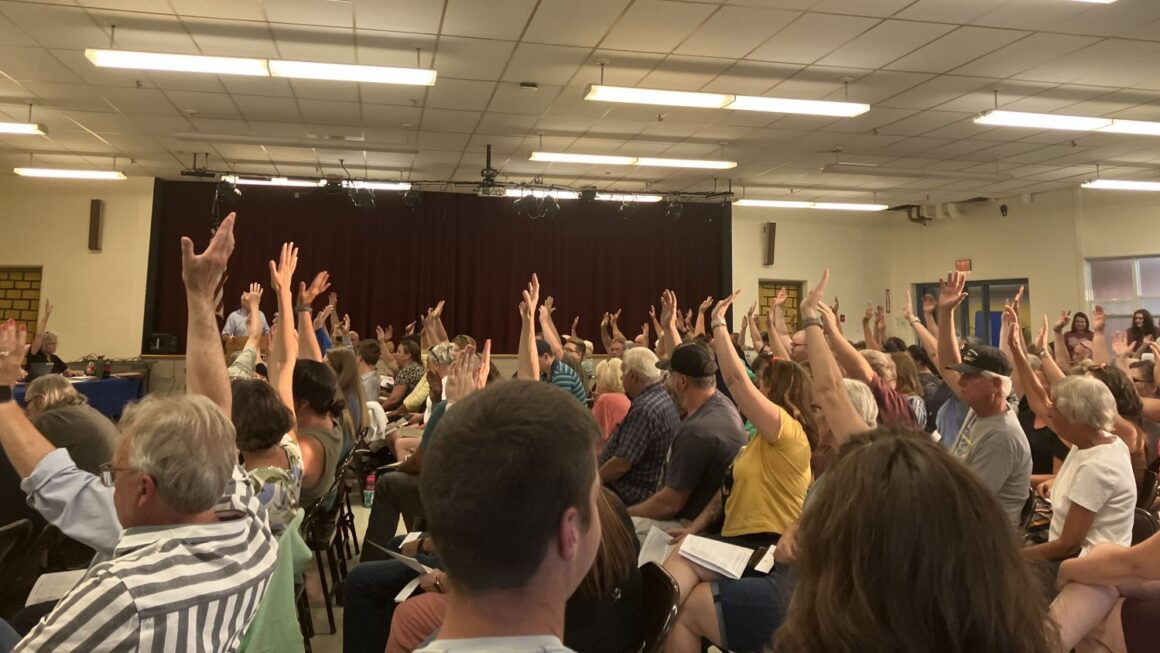
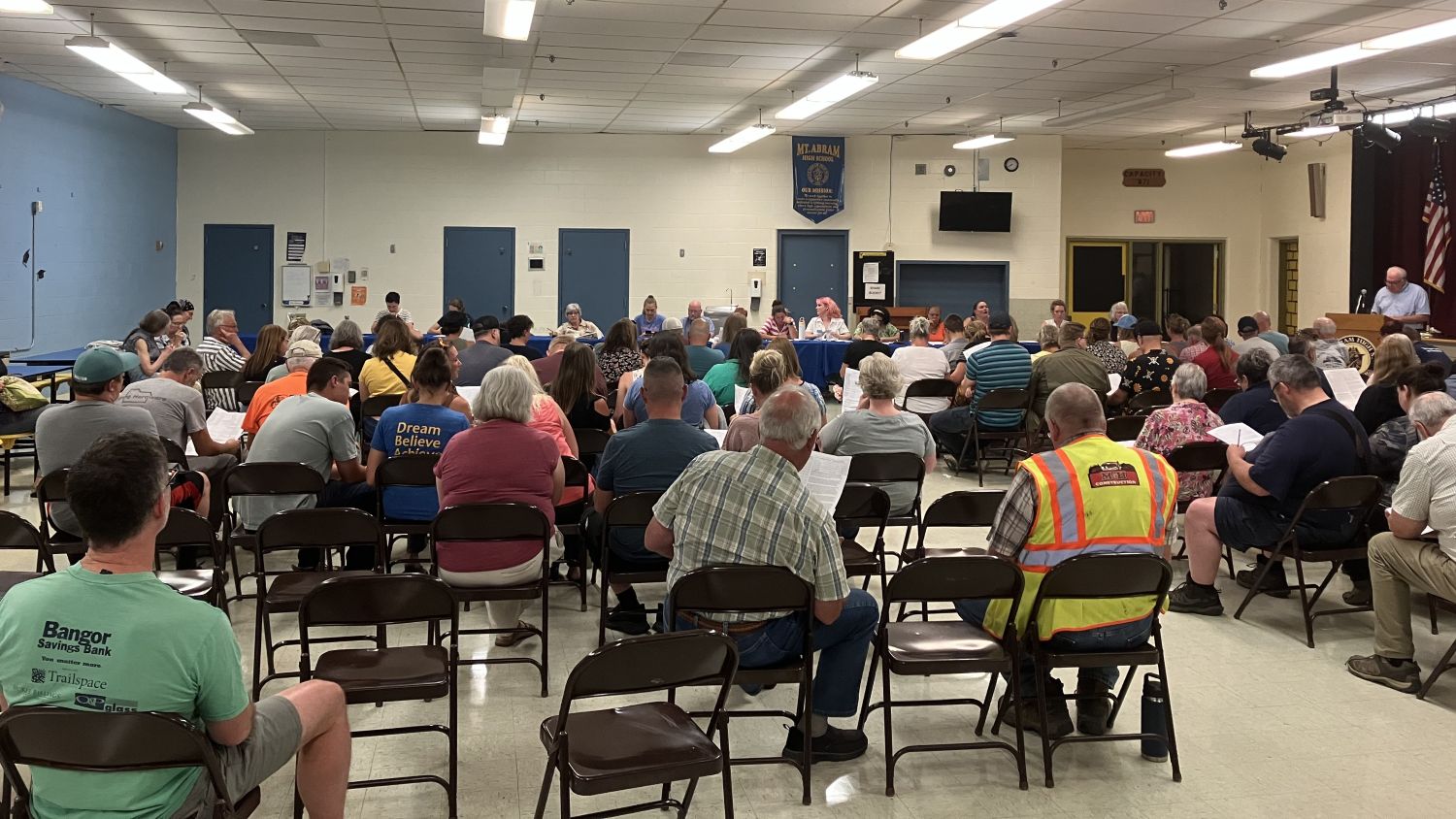
SALEM — More than 150 people attended Maine School Administrative District 58’s second budget meeting Monday evening, approving the $13.2 million budget recommended by the School Board in a two-hour, at times contentious meeting.
This budget is higher than the one rejected by voters by referendum on June 9.
The $13,208,847 in expenditures set on Monday includes a $667,491 increase over the budget passed last year, or 5.32 percent. If approved at a validation referendum on Aug. 10, the budget would raise the district’s overall assessment by 6.13 percent.
The meeting featured discussion about both the budget and questions about meeting procedures. Residents in favor of cutting the budget attempted to make a series of amendments to the cost centers, similar to the actions taken at the May 18 meeting when voters trimmed $472,000 from proposed spending and rejected setting aside another $500,000 for reserve accounts, but were out-voted by wide margins. Supporters of the board’s recommended budget then began to immediately move articles to cut off debate.
Some residents questioned that tactic, including Director Adam Bilodeau of Avon.
“The problem is, you’re silencing another group,” Bilodeau said. “That’s the most undemocratic thing we could possibly do.”
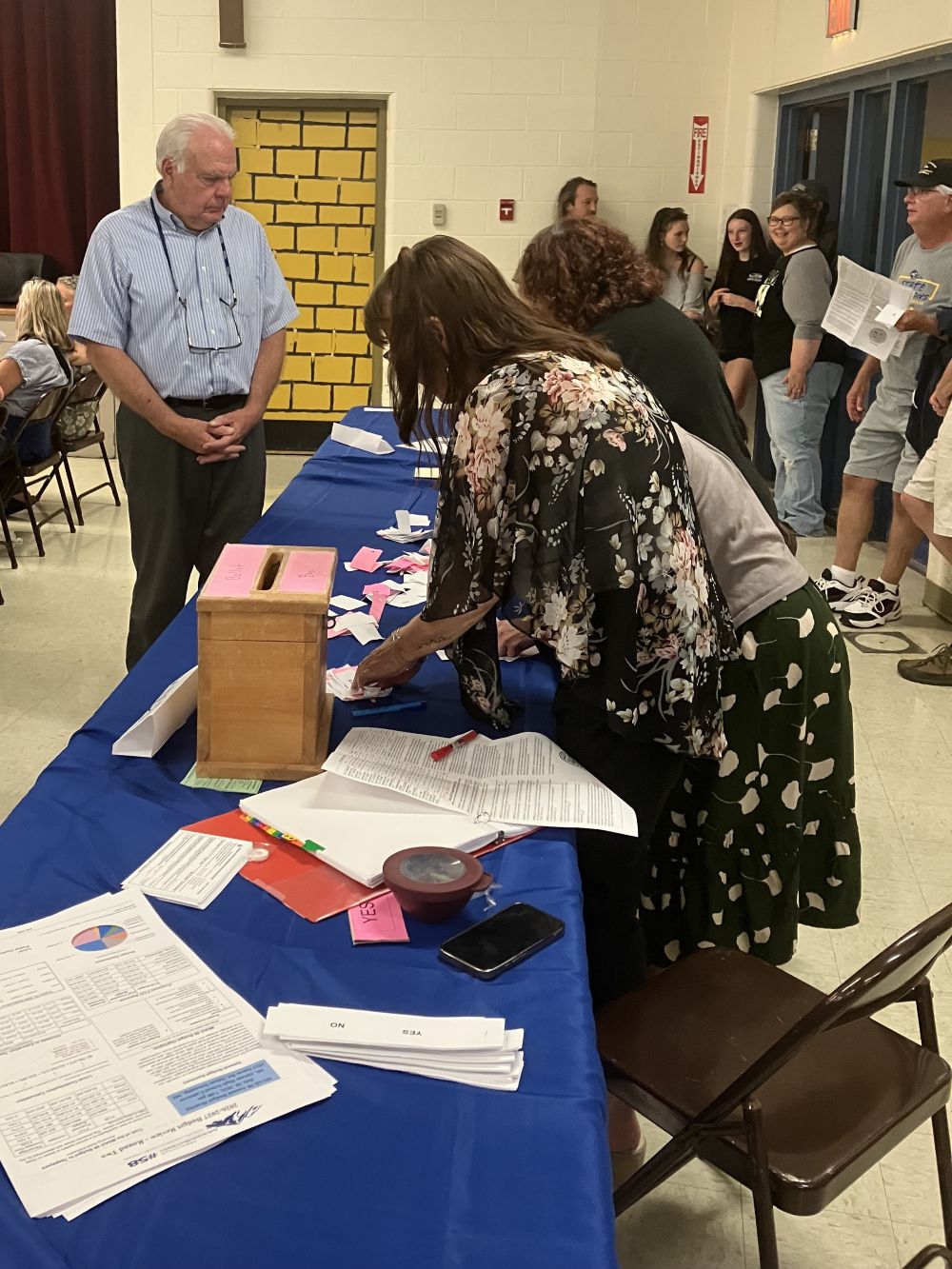
Bilodeau told those at the meeting to “have a good night” and left the building. Others began to drift out as well, and by the time the assembly reached Article 13, which sets the district’s above-Essential Programs and Services funding and required a written ballot, the vote was 118 yes and 16 no.
Residents speaking in support of the budget argued that strong public education was critical to the region’s future success, and that the impact of the increased cost was minimal on individual households.
The local share of the $13.2 million budget would be $5.84 million, an increase of $338,000 over the previous fiscal year.
Stacey McCluskey, a resident of Kingfield, pointed out that the increase translated to the owner of a $200,000 piece of property in her town paying an additional $7.34 per month.
“I think most of us can handle that increase for education,” McCluskey said. “It seems like a bargain to me.”
Those in favor of cutting the board’s recommended budget disagreed.
“We need to reduce this budget so people can afford to stay living in our towns,” Rupert Pratt, chair of the Strong Select Board said.
Pratt offered the first amendment, a $50,000 cut to the regular instruction cost center that had been recommended by the board at $3.36 million, an increase of 3.49 percent. A written ballot was requested and overwhelmingly rejected, which set the tone for the rest of the votes that evening.
Another resident attempted to move a $25,000 cut to the same cost center as a compromise. That’s when grumbling began among those supporting the board’s recommended budget.
This continued with the next article for special education, with spending recommended at $3.35 million, an increase of 5.55 percent. That article was initially proposed at $80,000 less the recommendation and then successfully amended back to the full $3.35 million.
Resident Bob Webster of Kingfield pointed out that MSAD 58 was budgeting similar amounts for regular instruction and special education, something that he said only a handful of districts in the state were doing.
“I believe this article is over-budgeted,” Webster said. He pointed to $300,000 in special education that the district hadn’t spent last year. “It seems to me that with that kind of money that (MSAD 58) either couldn’t spend or didn’t need to spend, that this is a place where a reduction could be made.”
Others said that public education meant educating all students and that the district was required to provide services to meet the needs of all children. Even a single out-of-district placement could quickly cost the district $100,000 or more, administrators and educators said.
Special Education Director Sabrina Reed-Carrier estimated that 30 percent of MSAD 58 students were receiving special education services.
“One family, one need can be a lot,” Reed-Carrier said. “And it could be anyone’s children. They’re all our children. They’re regular ed first, and then some of them are also special ed.”
After the article was amended back to the board’s recommendation, a resident attempted to reduce it again by $40,000 through another amendment, which was voted down. That is when other attendees began to move questions immediately after motions were made, forestalling further amendments and discussion.
Moderator Ken Lexier stayed busy, reminding residents which amendments they were voting on, calling on speakers through applause and asking for calm. At one point he asked an attendee to leave after she repeatedly spoke without being recognized.
Much of the budget discussion that did occur related to the district’s undesignated funds. MSAD 58 was informed in April by the district’s auditors that it had approximately $1.6 million in its undesignated fund, accumulated over the past few years. The district is using $400,000 to reduce the impact of the budget on the towns while transferring another $1.2 million into reserve accounts.
Voters approved transferring $500,000 into the district’s capital reserve and $100,000 into two reserves — insurance and fuel — at the May 18 meeting. Voters at that meeting rejected transferring an additional $500,000, but those attending the July 20 meeting reversed that and approved the transfer of an additional $300,000 to capital reserve and $100,000 to reserves for special education and technology — two accounts that were created on May 18 but not funded.
Administrators and board members have supported the reserve accounts as a better way to manage the budget. Having a reserve for special education, for example, would allow MSAD 58 to be more prepared for unexpected expenses, such as a student with needs moving into the district. Having money available for items that fluctuate — such as fuel costs or insurance plans — would allow the district to budget more frugally.
Some of those in attendance instead advocated to spend more to offset the budget’s impact on taxes.
“The elephant in the room is there is $1.2 million in undesignated funds that sits there and does nothing and only $400,000 of that is coming back into the budget to support taxpayers,” Rebecca Lane of Strong said. “And I don’t understand why that is.”
Superintendent Laura Columbia pushed back on the idea of using the majority of the undesignated to reduce taxes.
“It’s a great one-time funding source but, long term, it’s really not fiscally conservative to do that,” Columbia said. “We’re looking at long-term planning, sustainability in our district. So, it’s a fun one-time — your taxes go down — but next year your taxes are going to go up probably $2 million, because that one-time funding source is gone.”
Funding the capital reserve, which supports the district’s facility projects, was important given the age of the buildings, Columbia said, calling it a statewide issue. MSAD 58’s buildings were constructed in the 1950s and 60s and, when budgets had become strained, the first thing that had been cut was upkeep costs.
The Mount Abram High School’s roof and parking lot have been recent beneficiaries of the district’s capital reserve, which is now slightly under $700,000, prior to any transfers this year. Other funds have or will go toward a chimney at Phillips Elementary, two ventilator units and flooring at the Day Mountain Regional Middle School in Strong.
“The amounts of money that we’re talking about are small in comparison (to the district’s facility needs),” Director Ashley Hopwood Farrar of Kingfield said. “In my opinion, adding to these funds is a good idea. If we add incrementally each year, then we can prepare ourselves better for the future.”
In addition to MSAD 58, the amount of undesignated funds impacts towns considering withdrawal from the district. Under the plans approved by the board for Strong and Kingfield, those towns would take a percentage of the district’s undesignated funds if they leave.
Adult education was approved at the May 18 meeting at the recommended $22,580, a decrease of 9.7 percent from the previous budget, and was therefore not addressed at Monday’s meeting.
If the school budget is validated at the referendum in August, assessments for the four member towns would increase as follows:
- Avon: $693,000, up $27,426 (4.12 percent)
- Kingfield: $2.3 million, up $81,467 (3.67 percent)
- Phillips: $1.4 million, up $125,792 (9.77 percent)
- Strong: $1.4 million, up $103,291 (7.74 percent)
Voting is set for all four towns from 8 a.m. to 8 p.m. on Aug. 10.
A “yes” vote approves the actions taken at Monday’s meeting and sets the budget. A “no” vote rejects it, sending it back to the board.
Voters should also expect an optional straw poll to share their opinions on the budget. The poll will provide MSAD 58 directors with more information on whether voters favor a higher or lower spending limit.
MSAD 58 is already into its new fiscal year, which started July 1. The district is operating on the $12.6 million budget set for 2025-26, until a new budget is passed.
The meeting was recorded by Mt. Blue TV, and can be viewed here.