


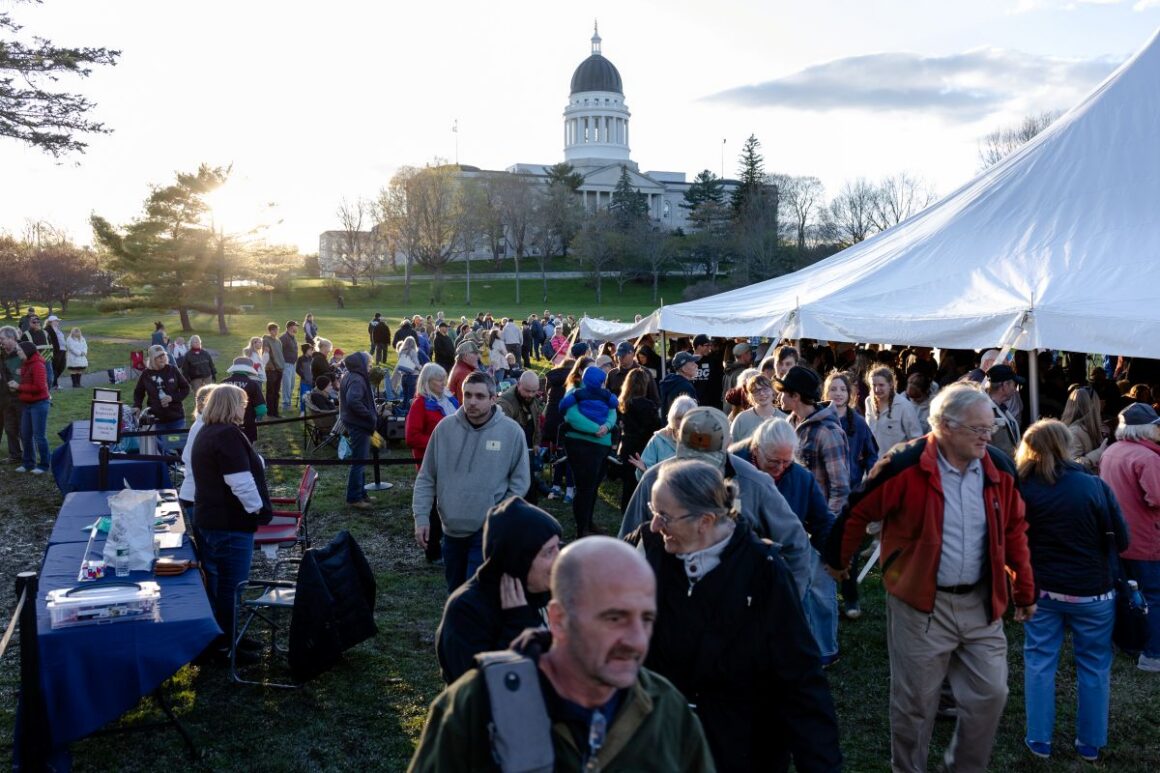
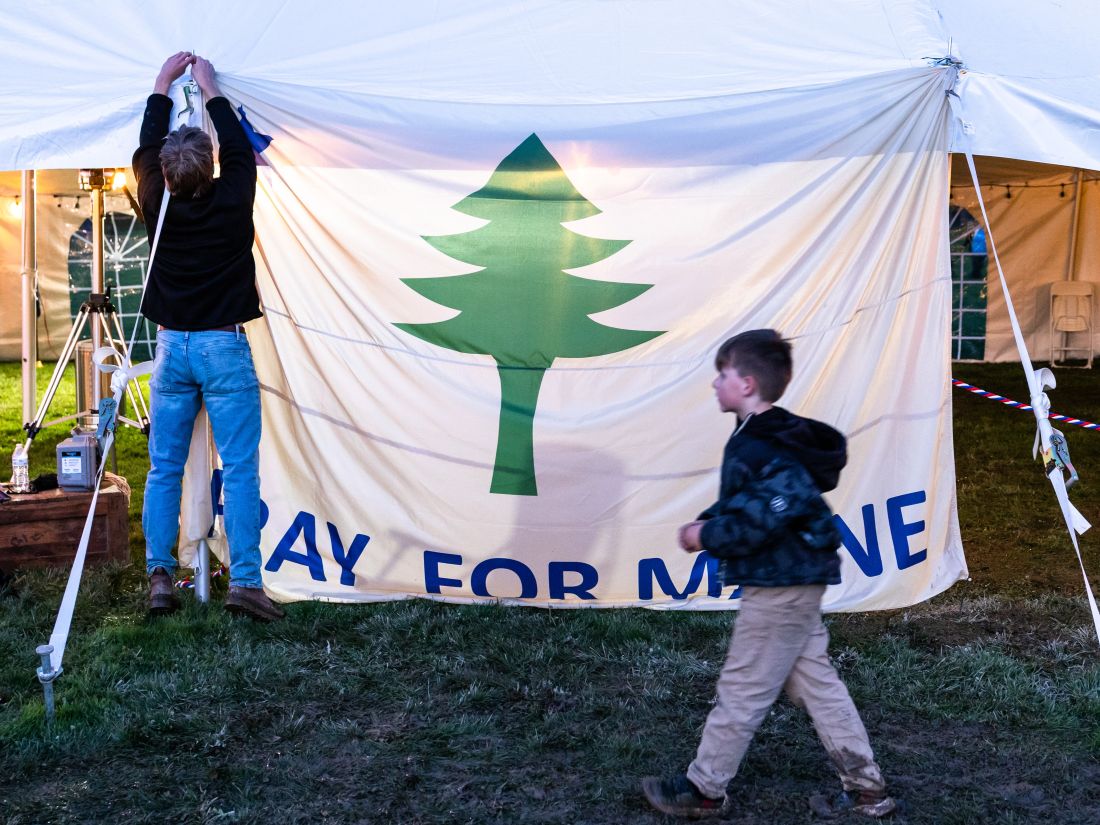
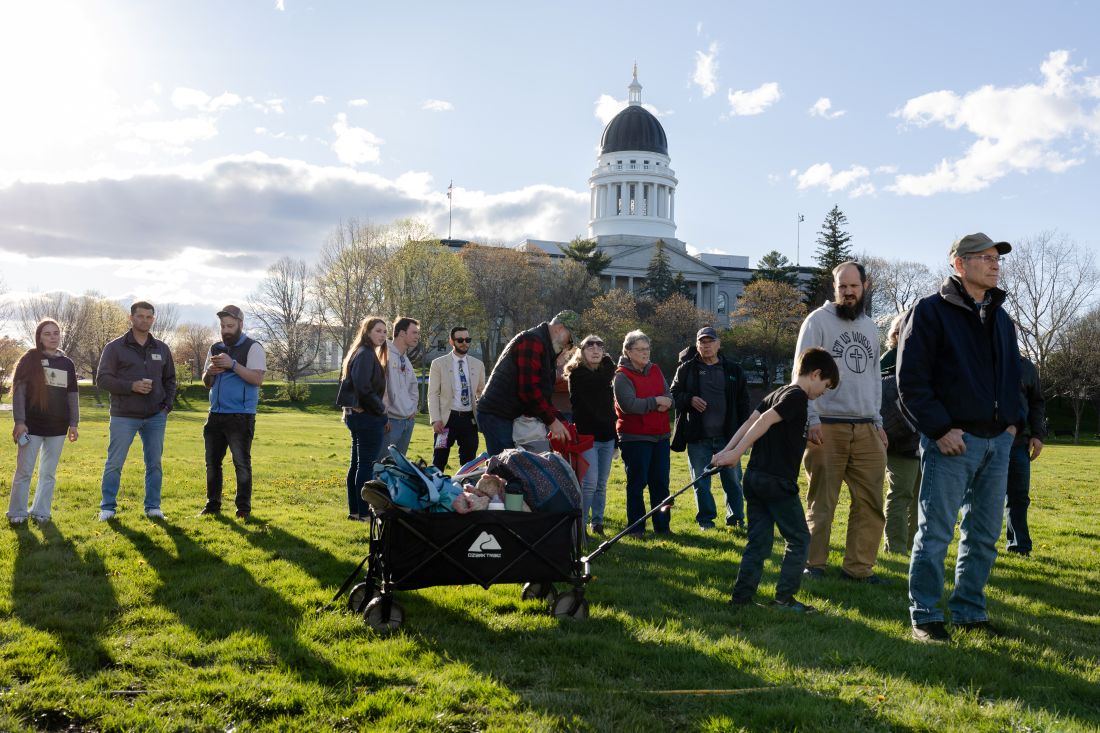
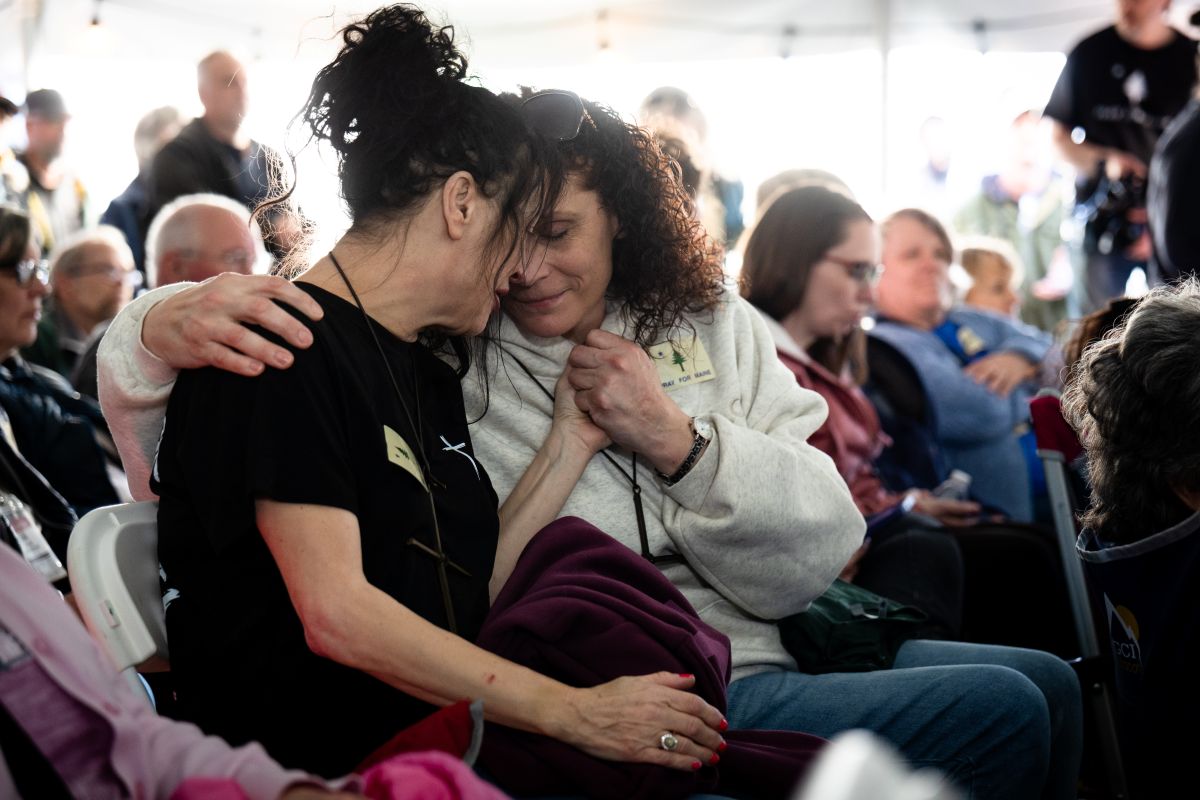
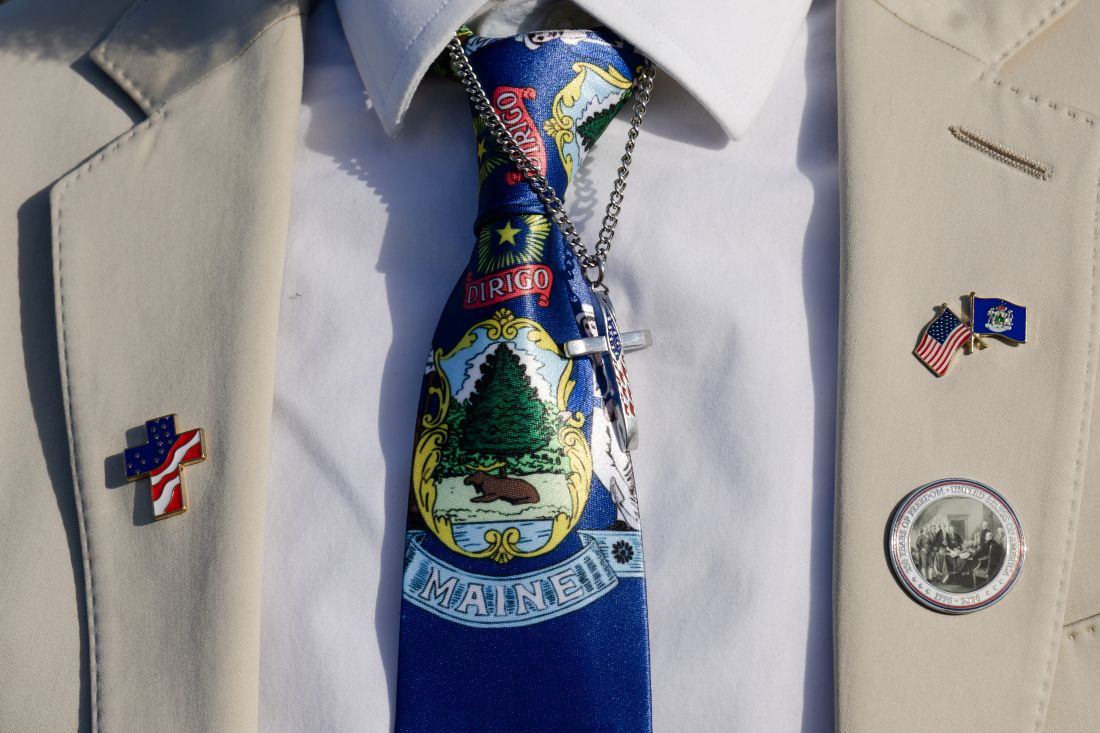
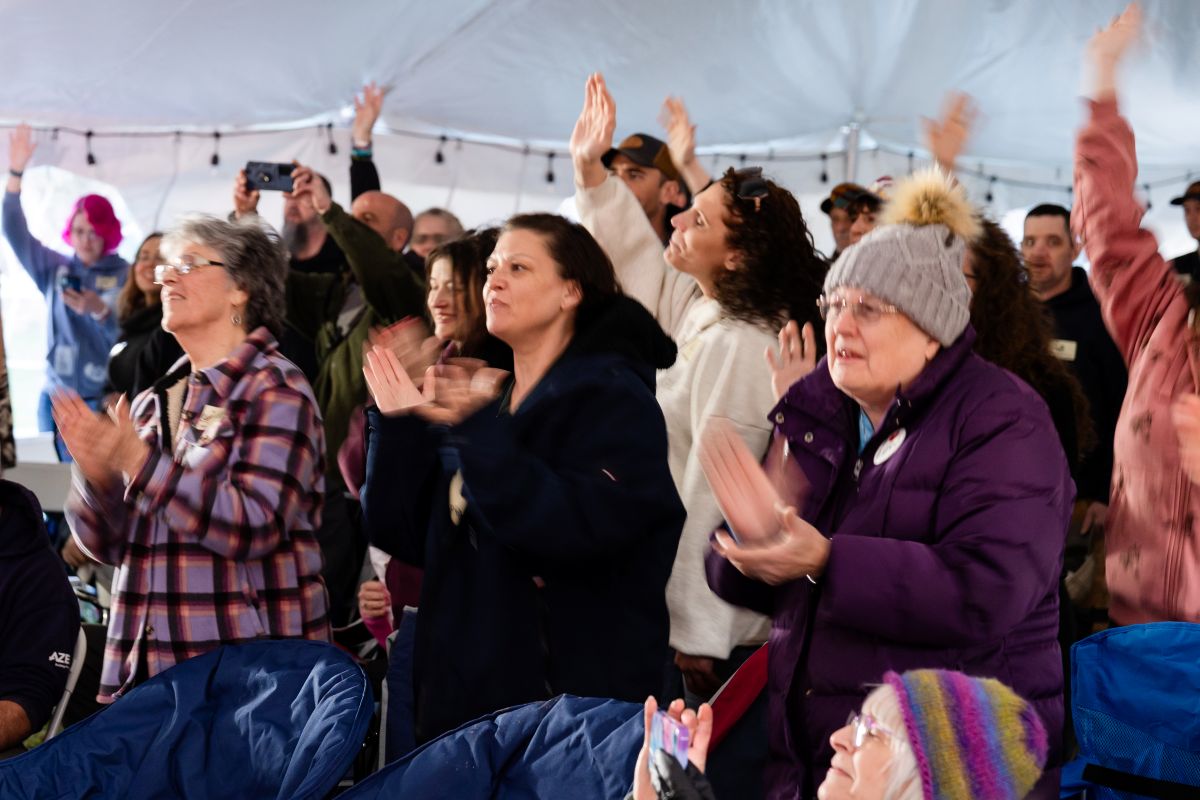
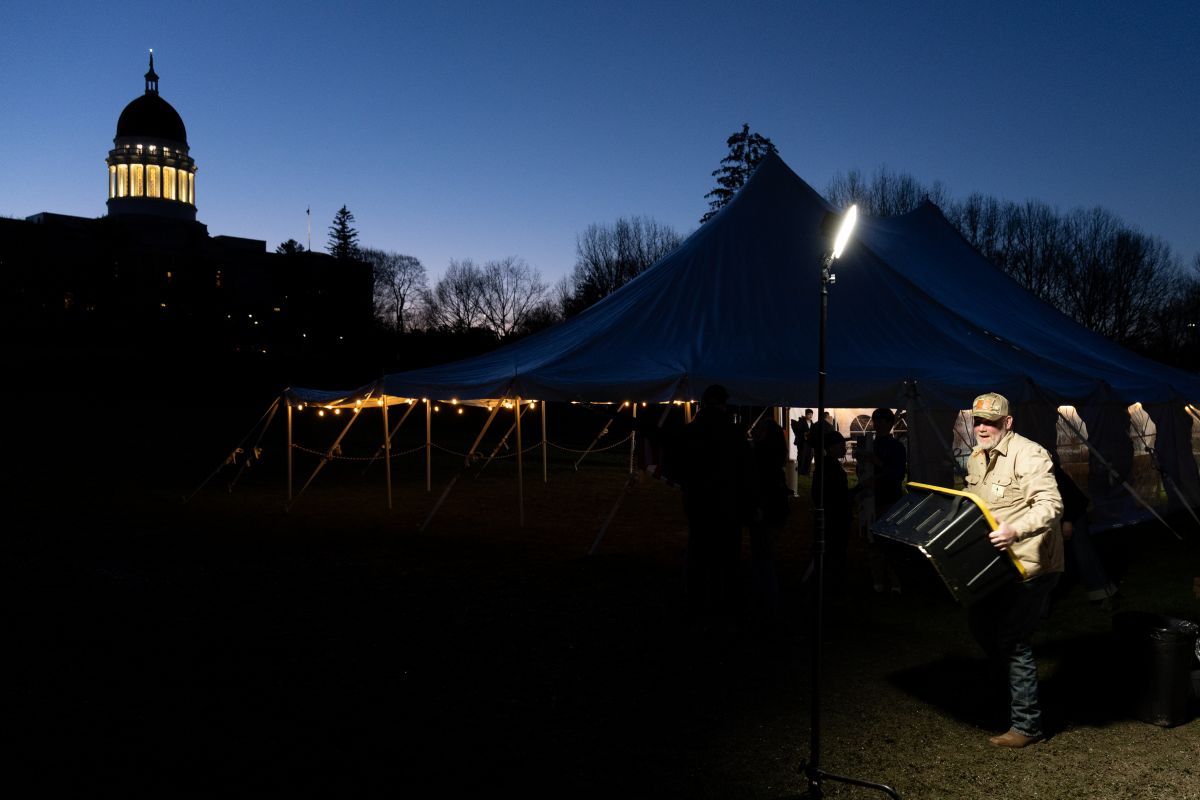
More than 400 Christian Mainers gathered in and around a large tent erected in the shadow of the Maine State Capitol in Augusta last week, braving the mud with camp chairs and hiking boots to listen as pastors from across the state called for a spiritual revival on the National Day of Prayer.
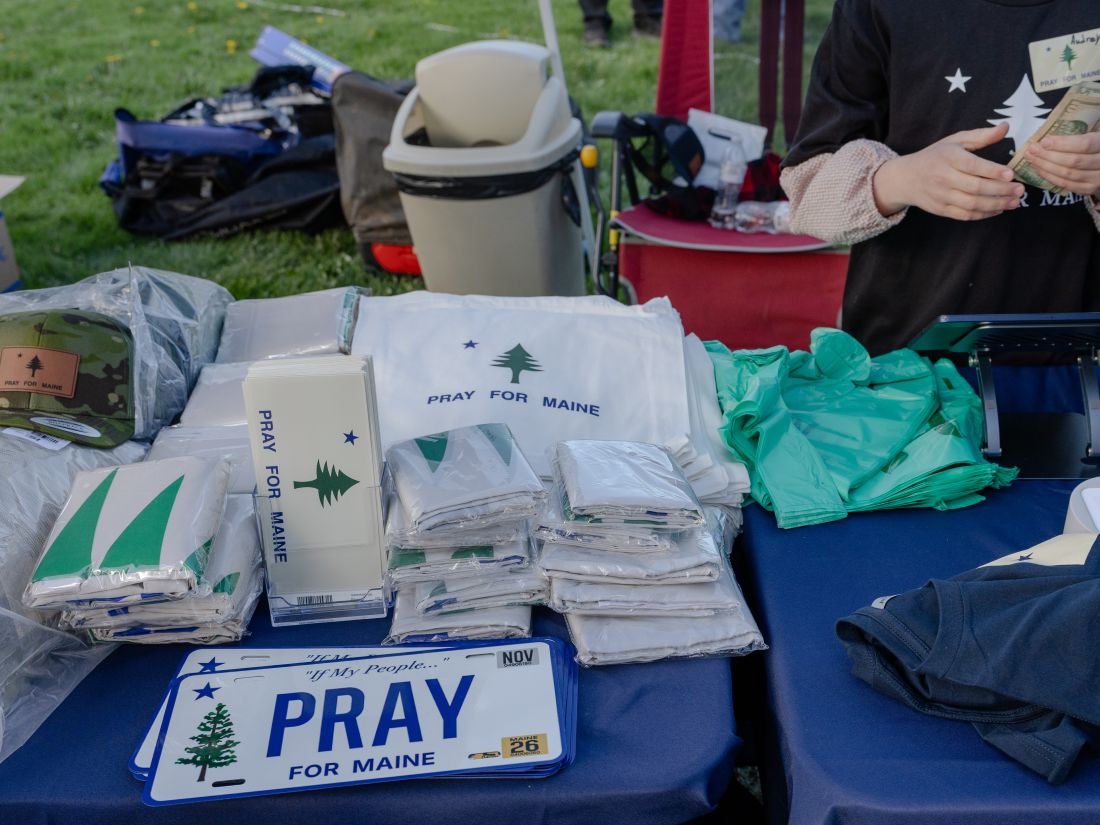
A flag featuring a pine tree and a blue star emblazoned with the phrase “Pray For Maine” hung from one edge of the tent, and appeared on T-shirts and stickers worn by attendees. The design referenced both the Maine state flag and the Appeal to Heaven flag, a Revolutionary War-era naval banner that has in recent years become a symbol of the Christian right.
As the night went on, a praise band led the group in songs of worship, pastors spoke about the importance of upholding “biblical policy” and people broke off into groups organized by county to pray.
The event was organized by the Christian Civic League, a nonprofit lobbying organization founded in 1897 that pushes for conservative biblical values in state policy and endorses candidates who share its beliefs. In the past year and a half, the organization has put a greater focus on public outreach, including a monthslong campaign encouraging Christians to pray for the state Legislature.
Nick Adolphsen, the group’s executive director, said he has prioritized giving pastors an online platform to affect political change and making evangelical Mainers feel connected to “brothers and sisters in Christ” who work in state government.
As the Trump administration has encouraged religious expression and given conservative Christians prominent roles, and the assassination of right-wing activist Charlie Kirk has led to calls for a religious revival, some Republican lawmakers in Maine have become more explicit about tying their faith to their politics.
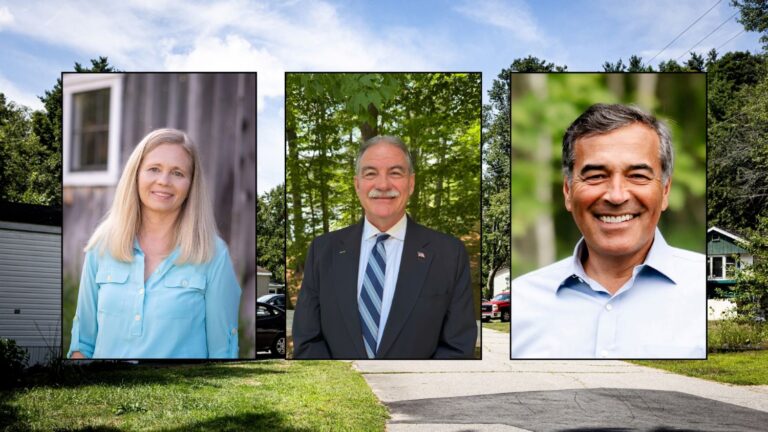
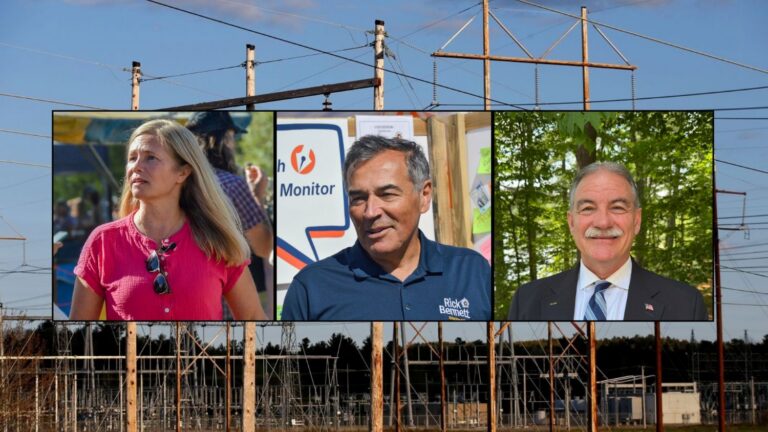
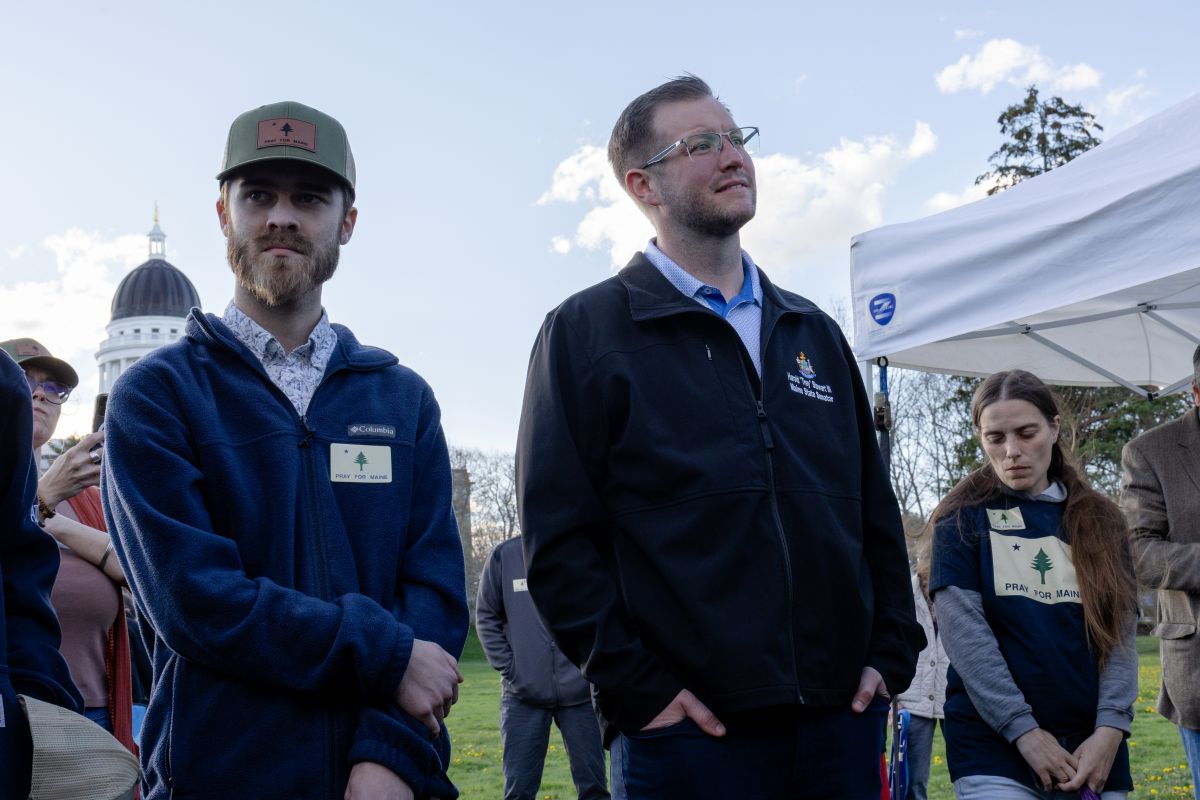
In the opening prayer of the May 7 event in Capitol Park, Senate Minority Leader Trey Stewart, R-Presque Isle, took the stage and called for more like-minded Christians in state government.
“Lord … we need you guiding our decisions, guiding our words, guiding our actions, guiding our votes,” Stewart said. “Let us take this opportunity, take this energy, take this chance that you have given us here to affect outcomes in our state and change the course of history.”
Stewart was not always a devout Christian, but he recently went through a spiritual transformation and said he now believes “God and His hand” have guided his journey in Maine politics.
Toward the end of 2024, Stewart was inspired by his boss to start reading the Bible. He has since joined a church and has committed himself to Christ, he said during an event at Calvary Chapel Greater Portland in March.
He now prays and reads scripture every day, and his faith keeps him humble at the State House, he told The Maine Monitor. Last year, he started a weekly men’s Bible study for legislators.
The Bible study is one of several signs of how conservative Christianity has become more visible in Augusta over the past two years, alongside increased public outreach by the Christian Civic League and an expanded prayer caucus at the State House.
The event in Capitol Park was “much bigger” than those held in prior years, said attendee Angie Anderson. Her friend Amanda Schrader traveled three hours from Washington County to take part, saying she was excited for a chance to unite with others who shared her beliefs and to pray for the “heartaches” she sees afflicting Maine.
Schrader has offered faith-based testimony at the State House before, including in support of religious exemptions to vaccine mandates. In the past couple of years, she said she has seen the conservative network of Mainers offering religious feedback on legislation grow.
The Maine Legislative Prayer Caucus, which initially formed under then-Gov. Paul LePage in 2012, last year began partnering with My God Votes, a Texas-based initiative, to bring in volunteer pastors and outside musicians who lead “church at the capitol” every Tuesday morning, complete with worship music. The Texas group’s mission, according to its website, is to “wake up the church and steer our nation back to God,” an effort that involves “helping Christians show up at the battle — the seat of government power.” Maine is one of six states where it is holding capitol worship services.
“It’s so much nicer” than before, when a small group of Republican legislators would gather weekly to pray, said Rep. Rick Mason, R-Lisbon, who has chaired the caucus since 2025. The services tend to attract around 30 people, including lawmakers, church leaders and members of the public.
‘Forces of good and evil’
Connecting evangelical Christians with like-minded lawmakers has been a big focus for Adolphsen, the executive director of the Christian Civic League, particularly on social media.
Since being hired in early 2025, Adolphsen has launched two video series featuring pastors and state legislators from across the state. One series features nearly a dozen Republican lawmakers asking voters to pray for things such as wisdom and discernment. The speakers are largely focused on ideals, not specific policies.
Another set of videos features pastors from various churches, some of whom are more explicit about the changes they would like to see. They advocate against abortion and gender transitioning, and use the platform to argue the United States is a Christian nation. They also push back on the idea of separation of church and state that is rooted in the First Amendment.
Justin Thacker, pastor of Assemblies of God Church in Rumford and a town selectperson for Andover, has made multiple videos for the series. “If Christians stay away from the political arena,” he said in one posted in March, “our society will lose its salt and light, and lives will decay away until there is nothing left.”
In another video posted last December, while describing the role of Christians in founding the U.S., Thacker repeated a claim by evangelical Christian author David Barton that more than half of the signers of the Declaration of Independence were clergy, former clergy or had studied to be Christian leaders — a claim that has been debunked. While most of the founders were Protestants, Brian Kaylor, a Baptist minister who writes about religion and politics, said the assertion is incorrect because it includes those who attended schools founded by religious organizations — all colleges had religious affiliations at the time — even if they didn’t study theology.
Thacker sees government as “ordained by God,” but he said he does not believe in creating a theocracy that relies on the Bible as law. He said his religion influences his character and his mediation skills more so than specific decisions, but he believes a Christian conservative view should inform social policy on issues related to gender, marriage and family.
“There are quite a few Christians and people in society, non-Christians, that think Christians should stay away from the political realm,” Thacker said in an interview with The Monitor. “I don’t believe that one second. I think separation in church and state is a misnomer.”
Rep. Paul Flynn, R-Albion, serves as pastor at Freedom Congregational Church and made a video in which he said the “forces of good and evil” clash daily in Augusta. He asked for prayers of forgiveness for “those in power who truly don’t know what they’re doing.” Separating his faith from his role in the public square, Flynn said, would be an “impossibility.” He believes the label “Christian nationalism” — which is used to describe the belief that the U.S. is and should be a Christian country — stifles dialogue and creates a fear that the church will take over the American government, an idea he does not support.
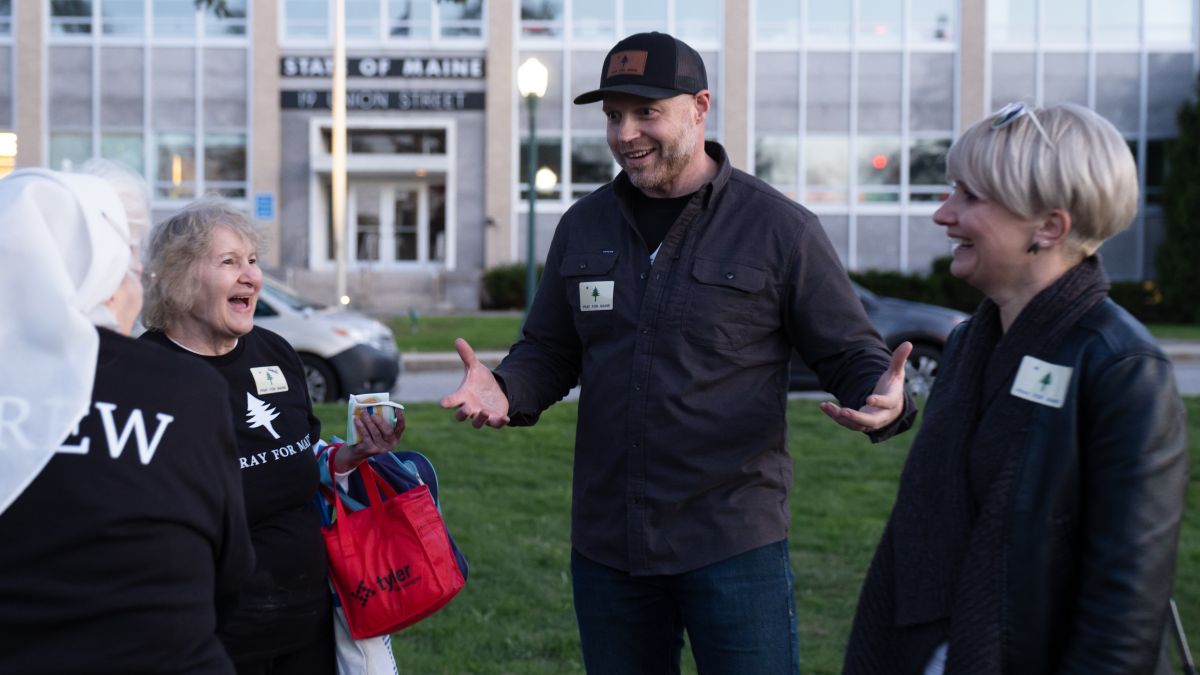
Many of the videos end with a shot of the “Pray for Maine” flag, designed by the Christian Civic League. Kaylor said the Appeal to Heaven flag it references was flown by some American ships during the Revolutionary War but has surged in popularity among Christian nationalists looking for evidence that the U.S. was founded as a Christian nation.
“Since [the founders] didn’t actually create us as a Christian nation,” Kaylor said, “those that want us to be and want to make the argument that this is what we were supposed to be, they have to dig around and find little hints and pieces that they can prop up and magnify.”
Ray Vensel, president of the Maine chapter of the Freedom From Religion Foundation, said Christian conservatives in Maine have become more vocal about their faith since President Donald Trump’s reelection in 2024. At the same time, their language has become more militaristic, he said, often framing Christian leaders as “battling forces of anti-Christian, anti-American” people and “moral decay.”
His group supports the separation of church and state and often pushes back on what it sees as efforts by conservative Christians to blur the line between the two. Vensel sees this as dangerous because he believes “where a single faith mixes with government, censorship, discrimination against minorities and restrictions on personal rights often follow,” as he wrote in an op-ed last year.
‘Slippery slope’
While the visibility of faith at the State House has always ebbed and flowed, referencing religion has become more common in Augusta in recent years, including from Democrats looking for rebuttals to conservative religious ideology, said Rep. Lydia Crafts, D-Newcastle. Her Christian faith has inspired her to serve marginalized communities both as a legislator and as chair of the Sheepscott Community Church Board of Directors.
Faith-based conversations at the State House can change based on just a few voices in government, Crafts said, and several current members speak of their faith “very openly.” She has personally resisted explicitly tying her faith to any specific policies.
“When I see faith being used to support a political initiative, I’m very suspicious of that,” she said. “While I don’t want to question the motives of people who are drawing those conclusions, I personally think that it’s a very slippery slope because when my ego is tied to the winning of or the achievement of a political goal, that can take me farther from God.”
Among progressive Christians, the organization that plays a similar role to the Christian Civic League is the Maine Council of Churches, a coalition of five mainline Protestant denominations, Quakers and Unitarian Universalists. The group highlights several progressive policy priorities on its website and has encouraged members to testify in support of issues such as transgender rights and reproductive care at the State House. Unlike the Christian Civic League, though, the council does not make endorsements or retain a lobbyist, said Executive Director Jane Field.
Field said the council has been “resisting the rise of Christian nationalism, seeking to be faithful to the call of the gospel,” noting that this includes “calls to do justice” and to “walk with humility, to feed the poor and welcome the stranger and to protect the vulnerable.”
Rep. Holly Stover, D-Boothbay, represents the United Church of Christ on the council’s board of directors. Her faith has led her to value inclusion, avoiding judgment and serving marginalized communities, she said.
“You can’t separate me as a human because my Christian values and my political values, they’re overlapping and interwoven across all the things that I do,” Stover said.
During the second Trump administration, Field said much of the council’s focus has been on countering what she sees as a rise in authoritarianism supported by Christian nationalism. She pointed to a section of the Christian Civic League’s website describing government as a “gracious gift from God,” historically shepherded by a “king,” as evidence that the league is sympathetic to authoritarian governance.
The language on the website references biblical passages, Adolphsen said, and isn’t intended to advocate for a monarchy today. For the authors of the Bible, he said, a king was the most common form of government, but he sees the American form of government with the freedom “to speak publicly against it” as a blessing.
Despite the Christian Civic League’s focus on state government, Adolphsen told the crowd on May 7 the event wasn’t political. Still, as the sun began to set behind the State House, Pastor Martin Heald of United Baptist Church in Mars Hill led the audience in prayer, saying that, to him, nothing in politics was possible without prayer.