



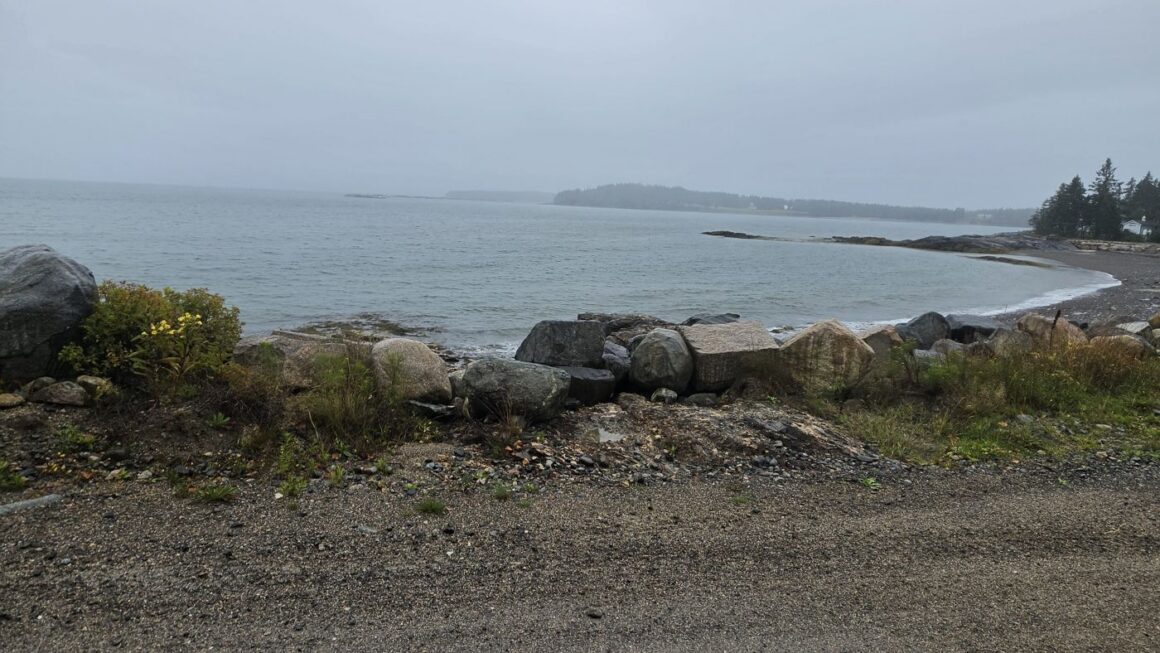
MACHIASPORT — The Maine Business and Consumer Court has denied a motion for a new trial in a civil lawsuit challenging Machiasport’s use of eminent domain to acquire property for a decades-old coastal road in the Point of Maine.
Plaintiffs Carmine DeFalco, Christine DeFalco and Paula Aschettino, who own property in the Starboard District affected by the right of way, have filed an appeal with the Maine Supreme Judicial Court.
Carmine DeFalco told Monitor Local the appeal centers on protocol, judicial impartiality and the right to a fair trial.
The legal challenge comes as Aschettino raises sharp questions about the town’s legitimacy in securing a grant to relocate the right of way out of an existing coastal floodplain.
Aschettino raised the claims in a short documentary film released last month on YouTube.
The film was produced with Risan Media, an environmental advocacy group led by her nephew, Todd A. Johnson.
In the video, Aschettino claims the town relied on inaccurate information to secure a $475,000 resiliency grant from Maine’s Infrastructure Adaptation Fund in August 2024.
She also reflects on buying her property in 1984, describing her 315 feet of oceanfront on Machias Bay as “a piece of heaven.”
While the town asserted in a recent statement that the road has served the community for more than a century, Aschettino said her deed tells a different story.
“In our deed, we had direct oceanfront,” Aschettino said in the video. “There was no road or town road.”
She calls the town’s award from the infrastructure resiliency fund “an issue of great concern.” She argues that moving the road inland violates the fund’s mission statement to establish long-term climate change resiliency for Maine’s coastal roads.
Aschettino is not alone in questioning the road’s location. Sue Baker, state coordinator for the National Flood Insurance Program at the Maine Emergency Management Agency, emailed the town in 2023, writing, “Maintaining this road is going to be a never ending battle when considering future sea level rise.”
Baker’s advice aligns with guidance offered in 1989 by Jonathan A. Cullen, then an official in the Maine Department of Environmental Protection’s Bureau of Land Quality Control.
“It would seem to me that a better solution would be to abandon future efforts to maintain the Shore Road and look for another right of way,” Cullen wrote at the time.
The grant application proposes moving the road 35 feet inland. The town said engineering consultants Haley Ward Inc. recommended the plan, which includes underground drainage and shoreline stabilization funded by the grant.
Attorneys at Rudman Winchell, the Bangor-based law firm serving as the town’s legal counsel, said in a statement: “Haley Ward advised the Town that moving and improving the road would help it withstand increasingly severe beach erosion and weather events. The Town is awaiting final construction plans and cannot yet provide specific storm-surge or sea-level-rise design thresholds. During the permitting process, the project engineers will be available to explain how the design addresses those conditions and meets applicable standards and the Select Board’s design objectives.”
Homeowners point out that the town already holds a free, deeded upland easement. They said the inland route offers better long-term storm access than a coastal road, but alleged the town rejected the alternative and failed to disclose it on the grant application.
A Change.org petition titled “Take the Upland Road” — named after the Risan Media film states: “They applied for the funds to be utilized for this purpose despite the Town Select Board being aware of a more resilient, deeded upland easement far from the coast for a right of way that has been offered to the town for free, with no restrictions from the property owners, for 38 years.”
The petition asserts that the application erroneously claims more than 250 cars per day travel on the road. In an email statement to Monitor Local, Board of Selectmen member Sarah Craighead Dedmon clarified the traffic figures.
“It is true that the application stated roughly that level of traffic on the Port Road,” Craighead Dedmon said. “However, importantly, the figure in that application is required to come directly from MaineDOT and was not a product of the Town’s own estimates.”
State officials awarded the grant in 2024, but have not yet distributed the funds, according to an email from Joyce Taylor of the Maine Department of Transportation to the plaintiffs.
In a statement, the town confirmed it received the $475,000 grant and expects total construction and project costs to reach roughly $500,000.
Of that total, $300,000 will fund moving the road inland — a move the town said costs about 40 percent less than improving the road in its current location. The remaining $200,000 will cover additional construction-related expenses.
Earlier this month, the presiding judge in the civil lawsuit, Michael A. Duddy, denied the plaintiffs’ motion for a new trial, citing a lack of evidence of partiality. The motion targeted Duddy and Town Clerk Marcia Hayward over undisclosed historical high school and family ties alleged by the plaintiffs.
The town of Machiasport posted on its Facebook page last week: “In its October 5, 2026 order, the Court concluded that there was no basis for recusal or a new trial and stated that the Plaintiffs received a fair and impartial trial.”
The town released a copy of the order, in which Duddy wrote: “A half century ago, this judge attended high school for three years in Calais, Maine, graduating in 1977. … Prior to attending high school in Calais, this judge did not live in Calais or any other town in Washington County. This judge has lived his adult life outside of Washington County. Plaintiff’s contention that this brief sojourn in Calais as a minor in the 1970s in any way deprived them of a fair trial in 2026 is without merit.”
While acknowledging that Hayward also graduated from the same Calais high school in 1977, the order noted that the judge was unaware of the connection and recalled no contact with her in 50 years.
Despite the ruling, the plaintiffs argue the potential for acquaintance violates Rule 2.11 of the Maine Code of Judicial Conduct, which mandates, “A judge shall disqualify or recuse himself or herself in any proceeding in which the judge’s impartiality might reasonably be questioned.”
On Oct. 13, DeFalco and the other plaintiffs filed an appeal with the Maine Supreme Judicial Court, listing the town of Machiasport as the respondent.
Town attorneys welcomed the ruling in a statement, saying: “Our responsibility is to maintain this public road and preserve access for the community, and the rulings support the decisions made toward that goal. We recognize that the property owners have concerns about the project and that the question of compensation remains before the Court.”
The town also said in its statement that it is “awaiting final construction plans. Once those plans are received, the next steps are to obtain an updated cost estimate and submit permit applications for review by the Planning Board.”
Town officials said that during permitting, project engineers are expected to explain how relocating and improving the road helps withstand “increasingly severe beach erosion and weather events” for decades.