



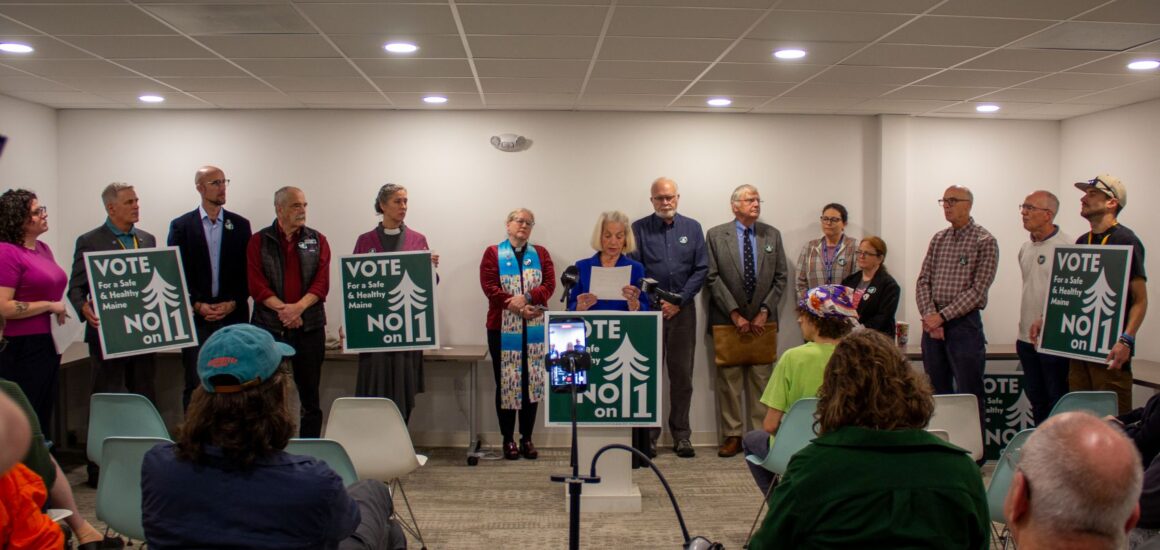
A coalition of doctors, social service providers and other advocates launched a campaign this week urging Lewiston voters to reject an upcoming ballot question that could significantly restrict needle exchange programs in the city, which are seen as an important public health tool.
On Nov. 3, Lewiston residents will vote on a citizen-initiated referendum that would limit how many sterile needles syringe service providers are allowed to distribute, require that they operate in one fixed location and ban mobile units. The proposal stems from safety concerns about used needles on the street.
Syringe service programs offer sterile needles and other supplies to people who inject drugs and connect them to services such as substance use treatment and housing assistance. Public health officials say their work is essential to reducing overdose deaths and preventing disease outbreaks.
The move to limit Lewiston’s program to a one-to-one exchange comes as Maine continues to grapple with a historic HIV outbreak in Penobscot County. Since the outbreak began nearly three years ago, 48 people have been diagnosed with HIV, 44 of whom reported injection drug use within a year of diagnosis. The majority of the people were also diagnosed with Hepatitis C, a bloodborne virus that causes liver inflammation.
The Maine Center for Disease Control and Prevention certifies syringe service programs and the sites where they can operate. State rules dictate that a program may not give out more than 100 new syringes for every used syringe that is turned in.
Local officials frustrated with used needles littering the streets in some Maine cities have pushed for more restrictions on the programs. Over the past several years, city officials in Sanford have attempted to curb the local syringe service program, saying Maine Access Points carries the blame for increased needle litter.
In December, the city closed down the needle exchange for one year while allowing the program to continue education and testing services, among other operations. Two years ago, Portland city councilors rejected mayor Mark Dion’s proposal to restrict programs to a one-to-one exchange. Augusta city councilors in August approved a 180-day moratorium on new programs amid concerns about needle litter.
The upcoming ballot question in Lewiston proposes limiting syringe service programs to exchanging one new needle for each used one that is turned in, with a daily maximum of 20 needles per person per day.
A group led by former city councilor and state senate candidate Eryn “Ryn” Soule gathered enough signatures to put the question before the city council earlier this year, after Soule had previously advocated for the one-to-one restriction when she was a councilor. Councilors opted to send the question to voters rather than vote on it themselves.
“I want Lewiston to be a city where you can enjoy a walk in the park without fear of your children picking up used needles,” Soule said in a campaign video. “I want Lewiston residents who are struggling with addiction to have real help instead of just more enablement.”
The goal of reducing needle litter and making Lewiston’s streets safer is one the members of the coalition fighting against the referendum, Safe & Healthy Maine, also share, they said at a press conference Wednesday.
“They want the same thing as we do,” campaign chair Paul Vinsel, a retired emergency and addiction medicine physician, said of the referendum proponents. “They want to be able to take their kids to the park and not have needles on the ground. I understand that totally. I totally agree with it. I just don’t think that the ordinance is going to get us there.”
Various studies have found that the number of improperly disposed needles in public spaces went down after a syringe service program was established in an area, in part because people injecting drugs had a place to safely dispose of used needles.
And restricting how and where these programs can operate could have other negative consequences, said Dr. Edward Walworth, representing the Maine Medical Association.
“My concern is simple: when we restrict access to a proven public health tool without evidence that these restrictions will solve the problem you’re trying to address, those problems don’t disappear. Instead, we risk creating new and preventable costs and burdens for our health care system and our community,” he said.
Soule, who is leading the charge for the new restrictions, said in an interview Wednesday evening that she understands the need for harm reduction services but thinks “there is a better way.” Public health and public safety do not have to be mutually exclusive, she said, adding that she believes the restrictions the question would impose represent a compromise between opposing sides of the debate surrounding needle exchange programs.
Twenty new needles per day should be enough, Soule said. “Why do the taxpayers have to be responsible for someone else’s addiction?”
She believes the needle exchange programs began with good intentions but said she hasn’t seen any data to back up claims that such programs reduce litter and encourage people to find treatment and recovery.
“There’s a better option than to just keep giving them the tools they need to continue their addiction,” Soule said. When asked what this would entail, she said she “doesn’t have all the details,” but that the money spent on syringe service programs could instead be spent on other initiatives, such as increasing recovery bed capacity statewide.
The potential changes being considered this November follow other restrictions on syringe service programs that the city instituted late last year.
In December, the Lewiston city council amended an ordinance regulating businesses to include syringe service programs, requiring that state-certified programs obtain a license to operate in the city and restricting their location to certain zones. The change limited the city to one syringe service provider at a time. Under the new rules the provider can operate at up to two approved locations but cannot use mobile outreach vans.
Lewiston’s current syringe service provider, Spurwink, operates out of a location on Lisbon Street. The previous provider, Church of Safe Injection, had its certification revoked by the Maine CDC last summer after its building was condemned.
Across the state, more than 11,600 people were enrolled in a certified syringe service program between November 2024 and October 2025, according to the Maine CDC’s annual report. Nearly 2,800 of those were new enrollees. The programs distributed more than 2.5 million syringes and collected just under that amount.
Editor’s note: This story was updated to include comments from Eryn Soule, who responded to an interview request after the article was initially published.