




After Maine’s red flag law was passed via ballot referendum last fall, advocates expressed hope that the law would expand pathways for family members to get dangerous weapons out of their loved ones’ hands quickly.
But in the two months since the law went into effect, only four petitions for a red flag order have been filed in Maine courts. Meanwhile, law enforcement agencies have completed 86 yellow flag orders, an average of one per day since Feb. 21.
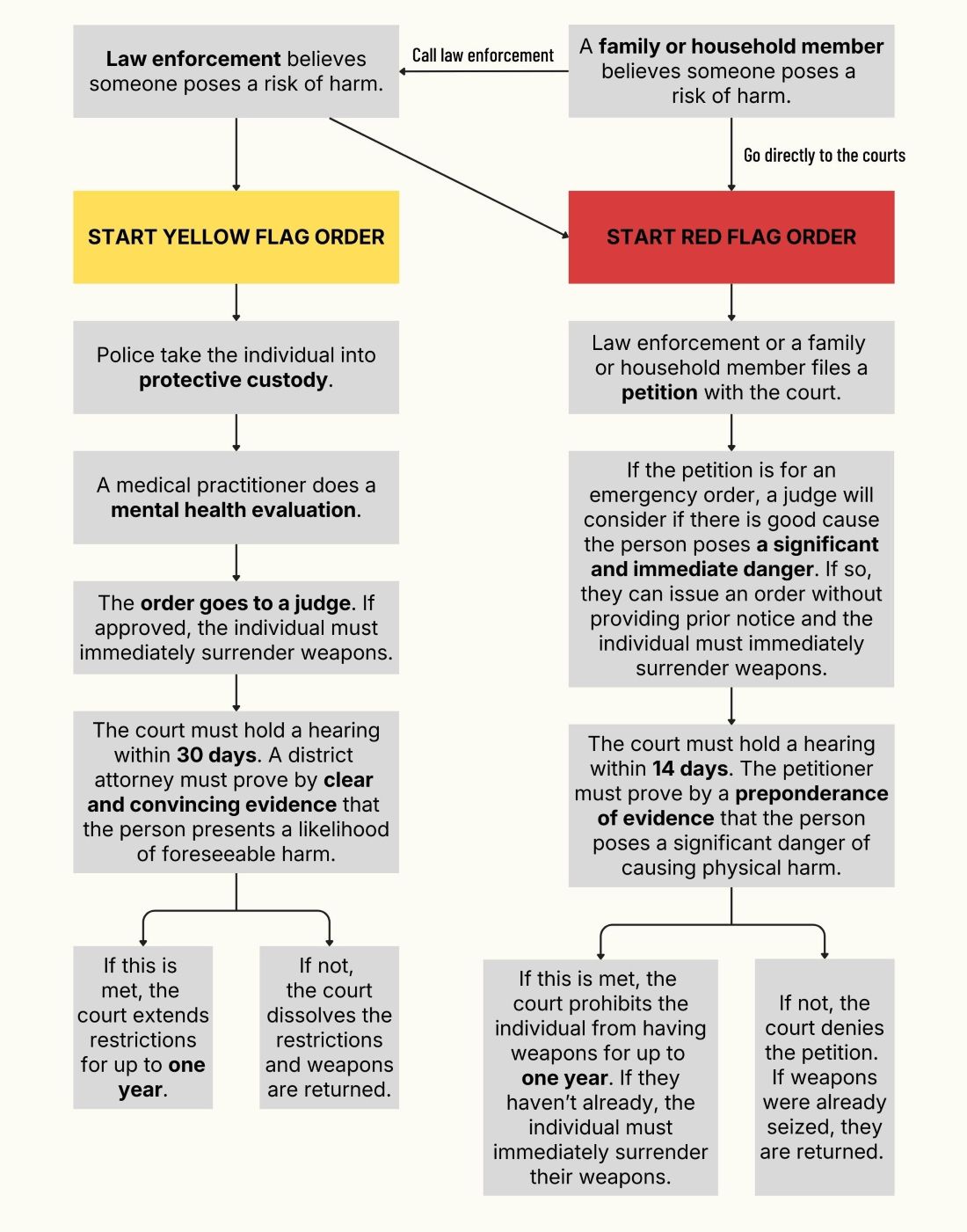
Both processes are typically used to remove guns from people who are suicidal or pose a risk of harm to others. A yellow flag order must be initiated by law enforcement and requires that the individual be taken into protective custody and given a mental health evaluation, while a red flag order can also be initiated by a concerned family member going directly to the courts, without a behavioral assessment. Red flag forms are available online or in-person at the courthouses.
Both laws require a judge’s approval before weapons can be temporarily removed.
Although law enforcement agencies appear to be favoring the yellow flag law, Nacole Palmer, the Maine Gun Safety Coalition executive director, isn’t overly concerned.
“From our perspective, it’s good that the law is already being used,” she said.
The red flag law is still new and law enforcement agencies need time to train their officers and figure out how to use it effectively, she said.
Next month, the Johns Hopkins-based National Extreme Risk Protection Order Resource Center is hosting a training that will include the center’s experts and law enforcement officials from other states with red flag laws. Palmer said invitations went out to every agency in Maine.
Data provided by the Maine Judicial Branch shows that two red flag orders were filed within a week of the law’s effective date, in the South Paris and Skowhegan district courts, respectively. The third petition was filed on March 17 in Portland and the fourth on April 13 in Skowhegan. Palmer said all four red flag orders were initiated by police.
The first petition was filed by Paris Police on Feb. 26. Chief Michael Ward said his department decided to use a red flag over yellow flag because they did not have and could not get the individual into protective custody — the necessary first step to initiate a yellow flag order.
“We are concerned about public safety,” Ward said. “I thought there was enough totality of the circumstances that we went forward with the red (flag) and the judge agreed with us.”
The judge approved Paris Police’s petition on the same day it was filed. The man’s lawyer, Mark Gillis, filed a motion to dismiss it on March 23, according to The Bangor Daily News. At a hearing Tuesday, a judge postponed the proceedings to a later date.
Ward said the process moved fairly quickly and his agency will continue to use the red flag law when the circumstances call for it. “If it’s the only tool that I can use, I’m going to do it to protect the public,” he said.
While the intention behind the red flag law may be to allow family members to petition the courts, Ward said he’s “glad (law enforcement) are included.”
Law enforcement agencies submit information on every completed yellow flag order to the attorney general’s office, and that data is available through public records requests. The data includes the date of the order, the agency filing it, the age and gender of the subject, and a brief description of the events leading up to the order.
Getting information on red flag orders is less straightforward.
When asked if and how many red flag orders had been filed so far, clerks at several district courts declined to provide that information and directed a reporter to a spokesperson for the judicial branch. The spokesperson, Barbara Cardone, provided The Monitor with the dates and district courts in which the four red flag orders were filed, but no further details.
The Maine Judicial Branch will be required to report annual statistics on the law’s use to the Legislature starting next year, although it’s unclear how often the judiciary is collecting that data. Cardone previously said that while red flag cases are public, documents are available only at the district court where petitions were filed.
The Judicial Branch announced in January that the Kennebec and Somerset courts had transitioned to the state’s new online system. However a search for the two Skowhegan red flag orders showed only the docket numbers and no documents. The filing date also differed from the information provided by Cardone. The statewide transition to an online system, which began in 2018, is expected to be completed by February 2027.
Data on yellow flag orders from the attorney general’s office show that as of April 22, a total of 1,407 orders have been completed since the law went into effect in July 2020.
Uptake of the yellow flag law was slow. In the roughly three years before the mass shootings in Lewiston, law enforcement agencies completed just 80 orders. Use of the law went up significantly after the shootings in October 2023. Agencies have completed an average of 44 orders per month in the nearly two-and-a-half years since Lewiston, compared to an average of just two in months prior.
Three-quarters of all yellow flag orders to date have been filed in response to an attempt or threat of suicide.