


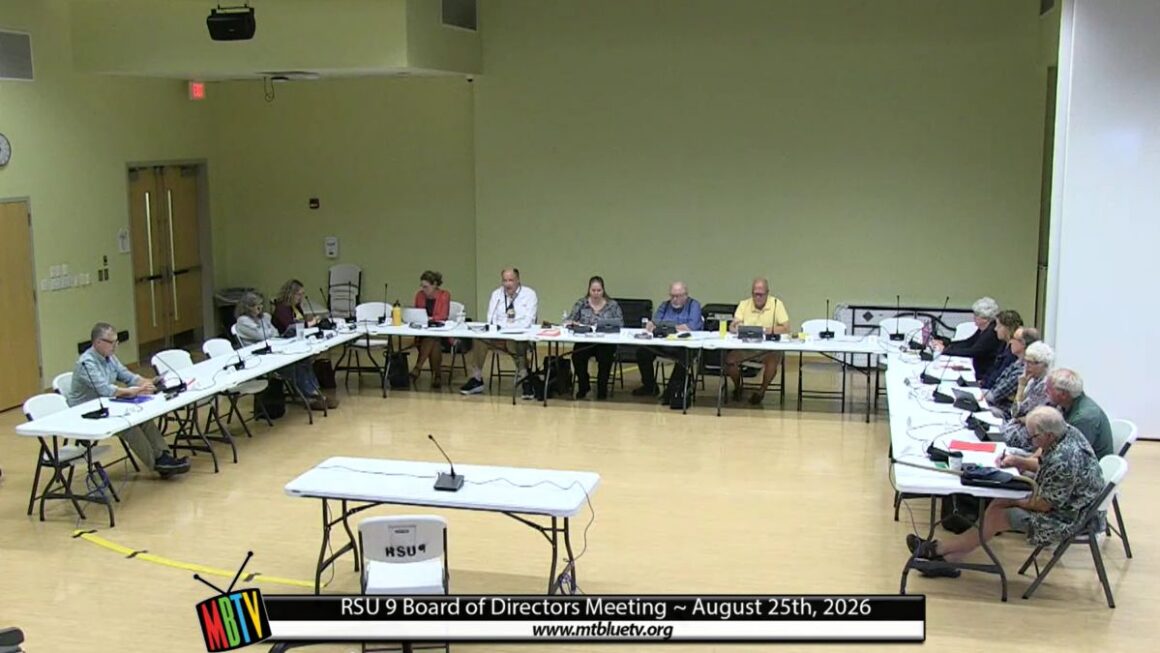
FARMINGTON — The Regional School Unit 9 board directors unanimously approved adding seven special education positions Tuesday night to address a surge in students with complex needs.
Superintendent Christian Elkington told the board in a memorandum that 17 students with individualized education plans transferred into the district over the summer, including two in the past week.
Two RSU 9 students left the district, but two others lost access to out‑of‑district placements and will now need new programs or in‑district services.
“(The transfers) were not anticipated. We had many folks move in, transfers right up until the 11th hour,” Assistant Director of Special Services Michael Hanson told the board. “We had a student with some pretty specific needs just this week that we did not have a heads up about.”
A student’s previous district will sometimes contact RSU 9’s special education department to let staff members know a student with an individualized education plan, or IEP, is coming, Hanson said.
Other times, there is no warning, as was the case this week.
“As we build a budget in December,” Hanson said, “it’s tough to plan ahead for that, capture those needs and know where positions will be required.”
Directors suggested reviewing average numbers of incoming students with IEPs from past summers, along with other metrics, to better plan for summer enrollments. Hanson said the department is preparing to give the board data while maintaining confidentiality standards.
The board approved hiring seven educational technicians: three in the adaptive skills program and four in day treatment. Elkington declined to say where those positions will be added, citing student confidentiality.
Students in the adaptive skills program learn academic and daily living skills and may qualify for other services, such as speech and occupational therapy. About 60 percent of students in the program require a high level of assistance throughout the school day.
Day treatment serves students with mental health or behavioral challenges. In addition to specially designed instruction, those students may receive counseling or therapy.
The seven positions are estimated to cost $350,000, an expense for which the district did not budget. The exact cost will depend on who is hired. Elkington said RSU 9 will first look to MaineCare to cover the cost.
“The one advantage we have is that we know that MaineCare funding is a solid source,” Elkington said. “We are fortunate enough that we don’t have to ask our taxpayers to fund this. The issue will be if MaineCare funding changes.”
Another complication is that the district can bill MaineCare only for the days students attend a program. If a student is absent, RSU 9 does not recoup its costs for that day. Elkington said those losses have contributed to recent closures of some special purpose schools in the state.
If costs outstrip MaineCare reimbursement, Elkington said the district would fall back on its Special Education Reserve Account of $850,000. The account was built over the past four years, replacing the district’s previous practice of raising contingency funds.
Hanson said he knew of people interested in applying for the new positions. The district has in‑house trainers, which should speed the integration of new staff members, he said.
The district’s special education department is likely to see further changes soon. RSU 9 has had issues placing students in special purpose private schools — specialized facilities that provide a wide range of treatments for students who cannot receive services in a less restrictive setting.
Special purpose private schools are understaffed, and there are not enough of them to meet the state’s needs. Hanson said one school told him it would be 2½ months before the district’s referral would be considered. He said that school was more than an hour from RSU 9.
“That’s our challenge that we have to navigate every year,” Hanson said. “Sometimes we know ahead of time. Oftentimes we don’t, especially if students (with needs) come to us from another district.”
Elkington said the district is discussing creating the equivalent of a special purpose school at RSU 9.
“I’m not sure where we put students if we don’t have programs for them to go to,” Elkington said.
Creating a new program could be done at limited cost to the district and would benefit students, he said. The idea will be discussed further in the coming months.
Earlier in the meeting, Elkington addressed the district’s recent failure to obtain grant funding for students experiencing homelessness, saying the district was looking into whether its application had been complete.
Last month, district leaders expressed disgust that RSU 9 did not receive state funding for its proposal. A June report from Amanda Clark, the district’s McKinney‑Vento Homeless Assistance Act coordinator, showed that 61 students qualified for services for the 2025‑26 school year.
Instead, a little more than $2 million from the Emergency Housing Relief Fund was awarded to seven other districts, each receiving between $18,000 and $800,000 to address homelessness among their student populations.
Elkington said he had been in communication with MaineHousing, which oversaw the grant process, and had been told that RSU 9’s application was missing four or five items. He said he took responsibility for what appeared to be a “system issue.”
“If that’s found out to be true, we will take responsibility for that at the district office and do our best to not let that happen again,” Elkington said.
The superintendent said district personnel would meet and discuss the process internally before meeting with MaineHousing. District and housing authority staff members would review RSU 9’s submission and those of districts that received funding.
Elkington also thanked Clark, who he said had come in over the summer to work on the grant.
Regardless of the district’s application, Elkington said in response to a board member’s question that the state money had been dispersed and RSU 9 would need to seek other sources for its needs this year.