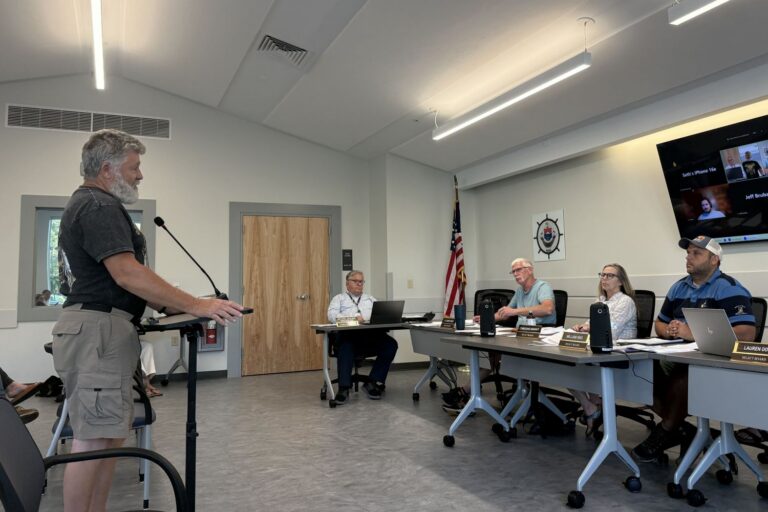




FARMINGTON — The superintendent of Regional School Unit 9 presented a $46.2 million draft budget to the public Tuesday evening.
The proposal aims to offset rising fixed costs and a reduction in state funding through position cuts and other reductions, holding the average tax increase across the district’s towns to 1.44 percent.
The proposed budget totals $46,229,243, an increase of $681,547, or 1.5 percent, over the current fiscal year.
Superintendent Christian Elkington said major cost drivers include inflation, negotiated salary increases, an 11.5 percent rise in health insurance premiums and higher repair expenses tied to years of deferred maintenance.
The district is also facing a roughly 2.5 percent decline in student enrollment and an associated loss of about $500,000 in state funding.
RSU 9 is additionally preparing for the possibility of higher heating and transportation costs due to continued volatility in global fuel prices.
The administration and the district’s Budget Committee cut about $1.6 million from initial spending requests. The district also plans to use $1.2 million from its unassigned fund balance to reduce the budget’s impact on the tax rate.
The cuts include eliminating six positions: a math teacher and half of a science position at Mt. Blue High School; three classroom teaching positions at Academy Hill School, G.D. Cushing School and W.G. Mallett School; and a districtwide custodial job.
The teaching positions were held by staff members who are retiring or otherwise leaving at the end of the year.
The budget adds one position by making permanent a Cascade Brook School teaching job created last year on a one‑year basis. A gifted and talented position would also increase from three‑fifths to full time.
Projected class sizes with the staff reductions increase at the lower grades, from 12.25 to 13.86 at G.D. Cushing; 18.4 to 19.22 at Academy Hill; and 14.68 to 15.28 at W.G. Mallett.
Class sizes at Cape Cod Hill School in New Sharon are projected to decrease, from 14.6 to 13.6, as are those at Cascade Brook School, from 18.87 to 18.47.
Mt. Blue Middle School class sizes are expected to hold steady at 20 students.
Mt. Blue High School’s enrollment is expected to increase by about 25 students.
Elkington said there were about 50 classes this year with fewer than 10 students. Next year, the superintendent’s approval will be required to offer smaller classes.
Regular instruction expenses are proposed at $12.7 million, a 2.88 percent decrease from the current fiscal year. The reduction is driven largely by fewer teaching positions and by staff retirements, which typically replace employees at the top of the pay scale with those earning less.
A proposed increase in special education spending was also trimmed by $100,000 before the Budget Committee’s review.
Shifting the support for two coordinators out of grant funding and into the budget creates the appearance of a significant increase in special education spending — a 3.46 percent rise for the entire cost center, to $8.3 million.
Elkington said the move was intended to avoid losing $40,000 in retirement money taken by the federal government. He noted that the 3.46 percent increase is the lowest for special education in western Maine.
Other major reductions include $750,000 taken from maintenance lines, partly offset by the district using $250,000 from its capital reserve and moving other repair projects into the current fiscal year.
The facilities maintenance cost center is recommended at $5.1 million, a decrease of 0.57 percent from the current fiscal year.
System administration expenses are recommended at a 5.75 percent increase, to $1.6 million.
The increase is driven by technology needs: $33,000 to update Wi‑Fi access points, $30,000 for a consultant to support the new employee assigned to the district’s PowerSchool database and $27,000 for increased subscription costs.
The Foster Career and Technical Education Center is funded through the Career and Technical Education, or CTE, line, which is overseen by a committee representing the four districts that send students to the school. That budget is up nearly $300,000, to $4.6 million, and is funded entirely by the state.

Elkington noted that among the 19 CTE schools in Maine, only United Technologies Center in Bangor offers more programs than Foster Tech.
Franklin County Adult Education is proposing a $724,000 budget, up 22.6 percent from the current fiscal year, which saw a modest reduction.
The program plans to use money from its own fund balance, and the increase would not affect the local share.
Roughly 58.9 percent of the budget would be funded by the state, 24.7 percent would be raised locally and 5.5 percent would come from the federal government.
The remaining 10 percent would come from other sources, including tuition from out‑of‑district students, MaineCare reimbursements and money from the district’s unassigned balance.
The district plans to use $1.2 million from the fund balance to support the budget and to transfer $100,000 into the technology reserve.
After those expenditures, the district projects it will end the next fiscal year with a $3 million fund balance.
Elkington included a survey of 14 western Maine districts and their proposed budgets as of mid‑March. RSU 9’s proposed 1.5 percent increase falls near the bottom.
Maine School Administrative District 17 and Regional School Unit 4 were the only districts proposing smaller increases, while the Andover School Department was tied.
J. Jeffrey Barnum of New Vineyard, a director on the RSU 9 board who serves on the Budget Committee, said the district has a student population of about 2,300, a staff of about 500 and an extensive transportation system.
“But still, the budget is only going up 1.5 percent,” Barnum said. “That’s half of what the inflation rate has been the last two or three months. I think that’s really praiseworthy.”
The average change in the 10 towns would be 1.44 percent, which Elkington said was the lowest out of the 14 surveyed districts.
Town assessments are based on valuation figures calculated by the state off of property sales.
If approved as recommended, the total budget would result in four towns seeing a decrease in their assessments to support RSU 9: Weld at $603,000, a reduction of $57,198, or 8.67 percent; Temple at $469,000, a reduction of $23,568, or 4.79 percent; New Sharon at $1.1 million, a reduction of $24,253, or 2.15 percent; and Industry at $1.12 million, a reduction of $3,369, or 0.3 percent.
Six towns would see increases: Starks at $639,000, an increase of $29,954, or 4.92 percent; Vienna at $848,000, an increase of $32,982, or 4.05 percent; Farmington at $5.72 million, an increase of $217,600, or 3.96 percent; Chesterville at $1.23 million, an increase of $21,428, or 1.77 percent; New Vineyard at $924,000, an increase of $15,710, or 1.73 percent; and Wilton at $3 million, an increase of $12,632, or 0.42 percent.
The RSU 9 board of directors must approve meeting dates, but the annual budget meeting is currently set for May 26 at 7 p.m. at the Mt. Blue Campus. Voters are expected to set the budget at the meeting.
The referendum vote to confirm the budget will likely take place June 9 in the towns, coinciding with the state primary election.
More information can be found on the district’s website, and the presentation can be viewed on Mt. Blue Community Access TV.