


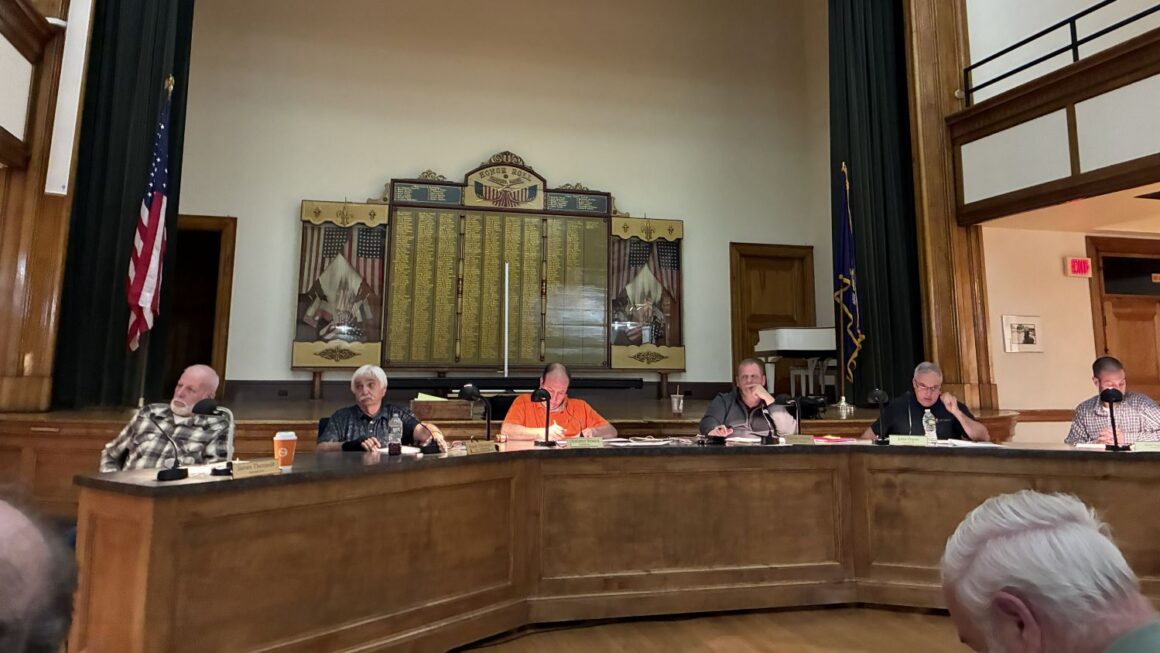
RUMFORD — Rumford’s Select Board meeting began with a bang on Thursday, when two residents used the public comment period to complain about a significant increase in their property taxes following the town’s recent market rate adjustment.
Resident Cliff Harding said his tax bill will increase 30 percent. “It’s exploitation,” he complained.
Harding told the board that he grew up in Rumford and lives in the house his father-in-law built. He said Thursday he fears his children won’t have the same opportunity and questioned the board about its unanimous vote to approve the tax increase at the last meeting.
Resident Tom Puiia stepped up to the microphone to make the same case and wondered where the money was going.
Although property taxes were not on the agenda, the board responded to the comments.
The town is not collecting 30 percent more in taxes, said Town Manager George O’Keefe Jr., adding that the municipal budget is up about 6 percent this year.
The problem, O’Keefe explained, is that the tax base is shifting. In 1987, 78 percent of the town’s total tax base came from the paper mill, now owned by ND Paper. Last year the mill represented 12 percent of the town’s total tax revenue, said O’Keefe.
While there are state tax deferral and abatement programs, he continued, there are two primary ways to bring down property taxes: expand the tax base or cut services. The town continues to explore opportunities to expand the tax base, such as with wind and battery projects, said O’Keefe. Without additional tax revenue, he explained, “that becomes a burden to residents who can ill afford it.”
The other mechanism for reducing residents’ tax burden is to cut services, said O’Keefe.
“If you want your tax bills to go down, you have to be prepared for really significant cuts to services.” The police and fire department budgets have seen some of the biggest increases, O’Keefe said, adding that cuts that do not affect public health and safety are hard to find.
Select Board Chair Christopher Brennick added that an $800,000 loss in revenue sharing from the state is making matters worse. “This is going to suck no matter what we do,” he said, noting that the board is scrutinizing levels of service, staffing, and capital projects in every department, looking for ways to cut costs. “We want people to know we hear you.”
Later in the meeting, Med-Care Ambulance Chief Paul Landry outlined his department’s 2027 budget, which Landry said includes an increase of about 10 percent. Landry explained the increase is due to contracted labor costs, fuel increases and expenses tied to federal mandates for tracking medications.
The increase is “bare bones,” said board member Frank DiConzo.
Other business on the select board’s agenda last night was less controversial and proceeded with little or no discussion.
The board voted unanimously to approve recognition of individual designated fund balances as of June 30. There were some negative balances, which O’Keefe said were due in part to the town’s attempt to hold taxes down in 2024. “I don’t think anyone regrets that,” he said.
The board tabled a proposal to remove trees at Hosmer Field, but unanimously approved all remaining agenda items: an additional accessible parking space at Hosmer Field; delaying the winter parking ban to Dec. 1 or the first storm; blanket approval of games of chance or bingo; and the installation of a privately funded monument in memory of Leonard Waite.
The next meeting of the board is Thursday, Nov. 19, at 6 p.m.
Correction: This story was updated on Nov. 6 to clarify that the mandate to track medication is a federal requirement, not a state mandate. It was also updated on Nov. 9. The town did not recently conduct a revaluation. It did a market rate adjustment.
Marna Miller is a Community Reporting Fellow receiving training through the Journalism New England Career Lab to do civic reporting that provides people in towns across New England with the information they need to be engaged in their community.