


About half of Maine students failed to meet mathematics standards during the 2024-25 school year, marking the third consecutive year of flat academic performance, according to the most recent assessment data from the Maine Department of Education.
The latest results show minimal progress statewide since officials introduced the Maine Through Year Assessment in 2022-23. Mathematics remains the primary academic hurdle for public school students.
State education officials note that results from the older MAP Growth assessment — used in 2021 and 2022 — do not directly compare to the current test because each measures achievement differently. Consequently, the department treats the 2022-23 school year as its baseline for tracking trends.
Statewide, 50.6 percent of students scored below expectations, compared with 52.8 percent in 2023-24 and 51.3 percent in 2022-23.
While the percentage has shifted slightly over the past three years, about half of Maine students have failed to meet expectations in mathematics each year since the state introduced the assessment.
English language arts results remained stronger but similarly stagnant. In 2024-25, 36.2 percent of students scored below expectations, compared with 34.6 percent in 2023-24 and 35.4 percent in 2022-23.
School results in Franklin, Oxford, Somerset and Washington counties mirrored the statewide pattern, with math consistently lagging behind reading.
Among the counties reviewed, Franklin County recorded the strongest average performance, with 35.8 percent of students missing benchmarks in English language arts and 50.4 percent in mathematics.
Washington County recorded the weakest average performance, with 43.1 percent of students scoring below expectations in English language arts and 60.9 percent in mathematics.
Oxford County followed at 42.6 percent in English language arts and 57.7 percent in math, while Somerset County averaged 42.1 percent and 56.3 percent, respectively.
Although countywide trends showed persistent math challenges, several districts demonstrated improvement over the three-year period.
Regional School Unit 9 showed gains in English language arts, reducing the percentage of students falling short of benchmarks from 45.3 percent in 2022-23 to 36.6 percent in 2024-25.
By comparison, Regional School Unit 73 continued to report some of the state’s highest failure rates. In 2024-25, 68.3 percent of its students scored below expectations in mathematics, while 44.9 percent missed expectations in English language arts.
National assessment data provides additional context for Maine’s performance. Results from the 2024 National Assessment of Educational Progress, or NAEP — commonly known as the Nation’s Report Card — showed Maine fourth graders scoring significantly below the national public school average in mathematics. Maine eighth grade math scores did not differ significantly from the national average.
Although both tests evaluate student achievement, they serve different purposes. The Maine Through Year Assessment determines whether students meet state academic standards, while NAEP provides a uniform benchmark to compare performance across states.
Chloe Teboe, communications director for the Maine Department of Education, said assessment results should be viewed alongside other indicators of student success, such as attendance, behavior and graduation rates.
Teboe also cautioned against directly comparing state assessment results with NAEP because the national test relies on a representative sample rather than every student statewide.
The NAEP assessment includes about 1,700 randomly selected fourth and eighth grade students in Maine. By comparison, roughly 85,000 students in third through eighth grades and 10th grade participate in the Maine Through Year Assessment twice each year.
State-level “data indicates that Maine students are performing at or above the national norms,” Teboe said.
She said factors including academic standards, curriculum and instructional practices can influence differences between NAEP and state assessment results.
However, student achievement concerns continue to draw attention from state and national leaders.
During a September 2025 hearing of the U.S. Senate Health, Education, Labor and Pensions Committee, Sen. Susan Collins, R-Maine, said the state’s academic challenges existed before the COVID-19 pandemic and have continued in recent years.
“It is very troubling when you look at the Nation’s Report Card,” Collins said during that hearing. “There was a time when Maine was justifiably proud to be at the top of the ratings. We were consistently in the top five.”
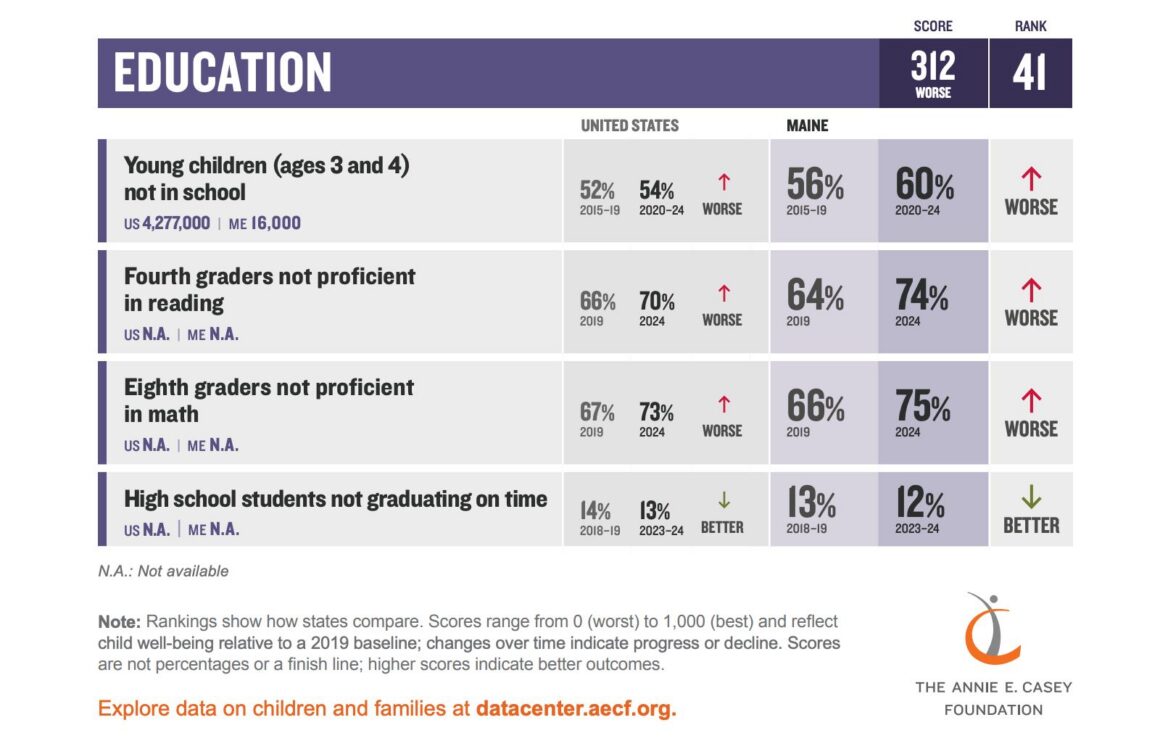
The Annie E. Casey Foundation’s 2026 KIDS COUNT Data Book, which was released this month, also highlighted Maine’s educational challenges, ranking the state 41st nationally in education outcomes.
The report found that 74 percent of Maine fourth graders were not proficient in reading in 2024, compared with 70 percent nationally, while 75 percent of Maine eighth graders were not proficient in mathematics.
The data book also identified Maine as one of the states with the steepest declines in education outcomes since 2019, noting that nearly every state performed worse in 2024 than before the pandemic.
Maine ranked sixth nationally in family and community well-being measures, but lagged behind every other Northeastern state in education outcomes.
While some districts have made measurable gains over the past three years, statewide assessment results indicate that broad academic recovery has yet to occur.
After three years of comparable data, mathematics remains Maine’s most persistent challenge, with roughly 1 in 2 students continuing to perform below state expectations.
Note: The headline and excerpt for this story were both updated after publication on July 23.