


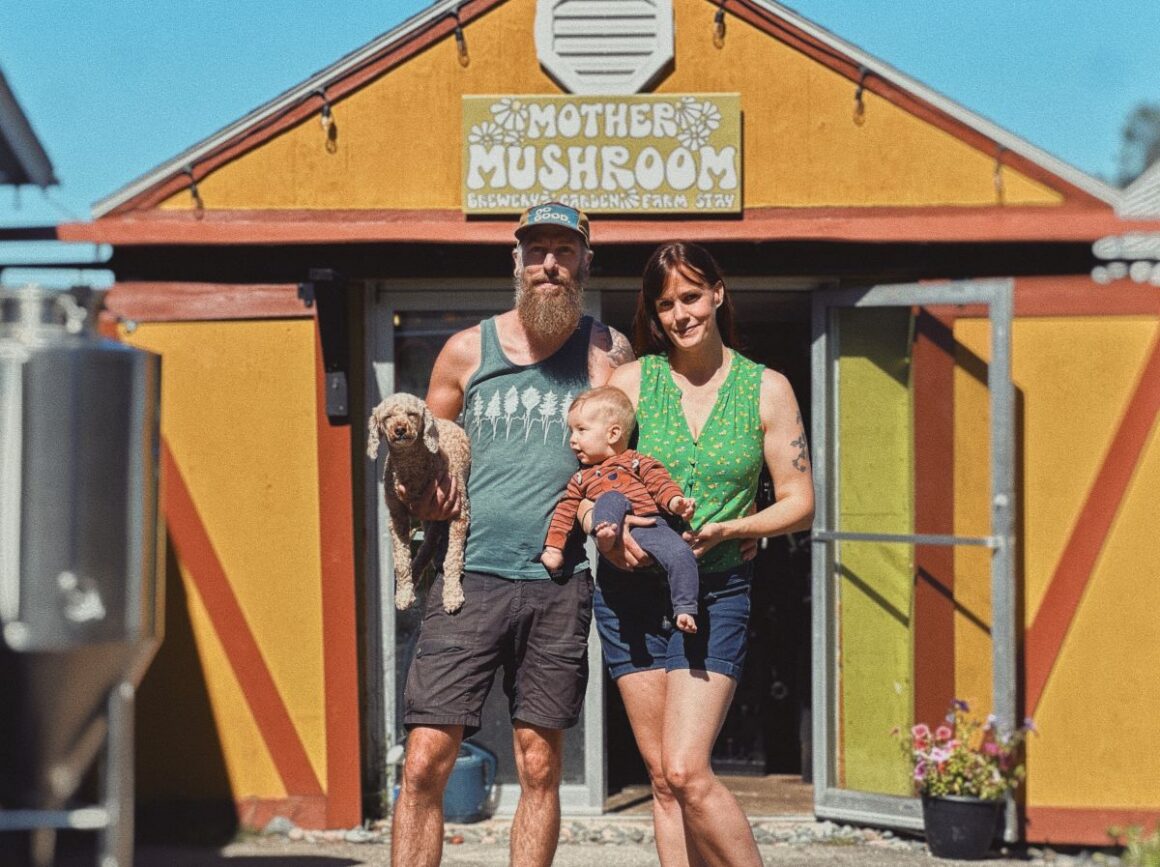
LUBEC — A cross‑border tariff fight between the United States and Canada is pushing a Campobello Island couple to consider moving their Mother Mushroom Brewery to Lubec.
In the latest escalation of the tariff dispute between the two nations, the Trump administration imposed a 50 percent tariff on alcohol products entering the country, prompting the New Brunswick brewery to seek relocation to Downeast Maine.
Owners Zoltan and Laura Fox said the latest tariff makes their current business location unsustainable.
At the start of President Donald Trump’s second term, he established the America First Trade Policy, calling it “robust and reinvigorated” and “a trade policy that promotes investment and productivity, enhances our Nation’s industrial and technological advantages, defends our economic and national security, and — above all — benefits American workers, manufacturers, farmers, ranchers, entrepreneurs, and businesses.”
One section of the policy, “Addressing Unfair and Unbalanced Trade,” required top U.S. trade officials in 2025 to produce preliminary reports identifying the nation’s trade deficits and associated national security risks. The directive marked the beginning of a tense period in U.S.-Canada trade relations, resulting in multiple tariffs between the two countries.
The couple opened Mother Mushroom Brewery in June 2025 on property owned by Laura Fox in a prime tourism location on Campobello Island.
Campobello Island is part of New Brunswick, but its businesses cater almost entirely to American tourists who cross the Franklin Delano Roosevelt Memorial Bridge — the island’s only physical link to any mainland.
With no bridge connecting Campobello Island to the Canadian mainland, Laura Fox said the island feels like “a sister community” to Lubec, even though it sits in another country.
The couple, who share their 5-month-old son, Hazen, told Monitor Local they were aware tariffs could affect their business and factored that risk into their decision to open last June. It is the new “dual‑direction tariff,” they said, that makes their Campobello Island location unsustainable.
“This is the challenge with conveying this story,” Zoltan Fox said. “A lot of people don’t seem to understand that we’ve been subject to tariffs, and up until the 22nd of August, the impacts to us were a single‑direction impact.”
The single‑direction impact was something for which the couple planned. They estimate they spent close to $10,000 over the past year at the border into their home country, transporting goods needed for their business that were subject to existing Canadian retaliatory tariffs. That included a fine for fraudulent declaration after they accidentally miscalculated the value of a box of free books and other small used items — a mistake that cost them about $2,000.
In February 2025, Trump announced a 25 percent tariff on Canadian goods entering the country and a 10 percent tariff on energy. In Maine, nearly 60,000 northern and eastern residents rely on energy exported from New Brunswick for at least part of their power supply, according to reporting by Portland television station WGME in 2025.
The current trade uncertainty between the two countries comes despite their continued participation in the United States-Mexico-Canada Agreement, the 2020 free trade pact that sets rules for commerce among the three nations.
The instability has some Mainers questioning the long‑term reliability of energy costs and access after Ontario Premier Doug Ford said he would cut off critical supplies to the United States if necessary.
The Portland Press Herald reported last month that Maine Public Utilities Commission Chair Philip Bartlett said Maine has maintained “very good relationships with New Brunswick over the years.” The paper also reported that New Brunswick Premier Susan Holt was taking a “less bullish” approach than some of her colleagues.
However, the February 2025 trade proclamation by the United States prompted Canada to announce retaliatory tariffs that increased the cost of importing many goods — including some grocery items and machinery — into the country. That is a necessary operational expense for Mother Mushroom Brewery, whose supply chain requires goods to cross the bridge from the U.S. mainland in Lubec.
Still, the company reported to Monitor Local a 110 percent increase in year‑over‑year sales when comparing peak season totals from 2025 to 2026. It was the most recent round of tariff increases that crushed their business model, Zoltan Fox said.
In July, Trump signed three proclamations that resulted in steep tariffs on many Canadian goods entering the United States.
One of the proclamations — “Imposing Additional Duties to Offset Canadian Discrimination Against the Commerce of the United States with Respect to Alcoholic Beverages” — instituted a 50 percent additional tariff on Canadian domestic alcohol producers, including beverages and alcohol products subject to tariffs that went into effect Aug. 22.
Typically, these fees are assessed at the border by customs agents based on the declared value of items being transported. The cost is passed through to the business importing or exporting the tariffed goods, which then pays it to its government. When tariffs are applied broadly to industries, the cost of products in those industries also increases.
“No one is wanting to pay $7.50 or $8 American for a can of beer. That’s ridiculous,” Zoltan Fox said, referring to alcohol the brewery ships from Campobello Island into the United States.
He said the price point under current trade conditions makes the business model unsustainable.
He added that it is also a moral issue for him, saying he is fundamentally opposed to charging the Lubec community that much – a factor that influenced the couple’s decision to move off the island.
Zoltan and Laura Fox turned to Facebook to reach out to Washington County in a public group, writing: “We are unable to continue operations on Campobello Island with the new dual‑direction tariffs. We need to find a way to move the brewery to Lubec.”
They asked the public for assistance finding a new base for their operations.
Many people responding to the post suggested the couple look into taking over the Lubec Brewing Co., which closed in mid‑August when the owners retired for health reasons.
Zoltan and Laura Fox said they have been weighing whether to take over the former brewery’s location or otherwise fill the gap left in Lubec’s brewpub community with Mother Mushroom beer.
The couple also started a GoFundMe at the request of Lubec residents on Facebook who were looking for a way to help.
In their GoFundMe post, they wrote: “Because of our lack of Canadian supply chain and our reliance on the United States for both customers and supplies, … our ability to provide for our family, including our new 5‑month‑old son, is in jeopardy. We need help to relocate our business across the bridge to Lubec, Maine, unifying it with our supply chain on the U.S. mainland so we can continue serving this cross‑border community without being impacted by these dual‑direction tariffs.”