



WATERVILLE — City officials are considering the creation of a municipal board of health to coordinate community health priorities and strengthen public health education.
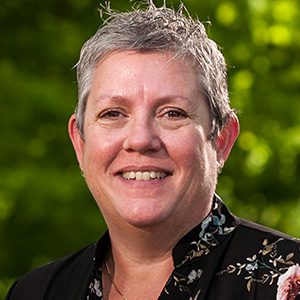
Councilor Flavia DeBrito, D-Ward 2, who also serves as a state representative for parts of Waterville and Winslow, presented the concept to the City Council during its regular meeting Wednesday to increase collaboration with local health care professionals, including social workers and mental health experts, “to really be proactive when we’re thinking about public health.”
Waterville’s Health and Welfare Department administers the General Assistance Program, and Welfare Director Denise Murray oversees the city’s wellness program.
DeBrito is proposing an advisory board separate from existing city services, stemming from a law signed by the governor in May to support municipal public health efforts. The law authorizes towns to establish local boards of health and appoint three to seven members, in addition to the required local health officer, to oversee public health education, propose ordinances promoting general health, and advise select boards and city councils on issues that may fall outside the health officer’s expertise.
Such boards are optional under the law, but if formed, they must include certain members — at least one health professional and others with experience in medical or public health, mental health, nursing, social work or communications.
The boards may also seek grant funding outside the municipal budget to support activities, potentially easing the financial burden of health projects, including collaborations with local nonprofits.
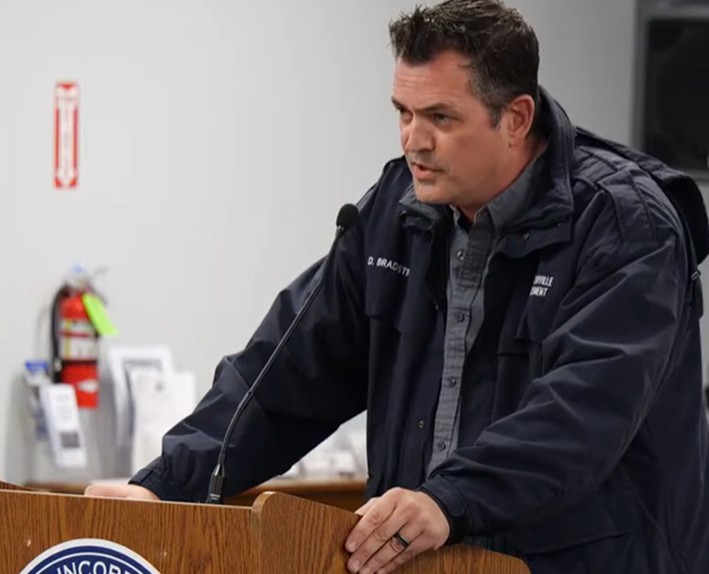
In Waterville, Daniel Bradstreet, the city’s director of code enforcement, also serves as the local health officer. At Wednesday’s meeting, he said his health-related duties have changed significantly since the COVID-19 pandemic, shifting from straightforward public education and training to more specific responsibilities like “connecting residents with public health services, enforcing public health safety laws,” and other tasks that take time away from his code enforcement work.
Bradstreet did not take a position on whether he supports forming a local health board, but noted that the city now has 212 open building permits and $154 million in ongoing construction projects that demand most of his attention — along with routine duties such as inspecting apartment buildings and responding to property complaints.
“My fear,” he said, is that while enforcing more than 9,000 pages of evolving building codes, he might not have the time or expertise to take on the heightened duties heading up a public health board.
“I don’t think I’m the guy to do it. I don’t think I have the time to do it,” he said, noting he does not want to sacrifice his code enforcement work, which serves as a revenue stream for the city.
Bradstreet said he likes the idea of a dedicated local health committee and pointed to municipalities that have adopted similar committees while sharing local health officers on a stipend basis — an approach he said might be an option for Waterville.
“We’re a growing city, and that doesn’t seem to be slowing down,” Bradstreet said, and being able to share personnel with other communities makes sense.
He pointed to how Maine’s new law provides a rough framework for committee membership and duties, and said that if the city decided to create such a committee, it would likely free him up for critical code enforcement tasks.
“We’re a busy office,” he said. “There’s a lot going on, and we’re yanked in a lot of different directions,” especially with new construction projects.
Councilor Thomas Klepach, D-Ward 3, said he believes the formation of a local health board is long overdue.
“It seems like we need this,” he said, noting it would help separate community health duties from the code enforcement director’s role.
“It’s pretty clear that it’s kind of absurd that we have one person who has to be an expert on syphilis and GFCI outlets all in the same human being. I’m all for a renaissance man, but that’s kind of ridiculous,” Klepach said, expressing support for a new position dedicated to coordinating local health structures.
Bradstreet acknowledged that if he did not have local health officer duties to manage, it “may allow us to get to inspections a little faster,” helping move construction projects along more quickly.
DeBrito said she brought the idea before the City Council “to put public safety up front, which is the responsibility of a municipality,” pointing to a successful model in Bucksport.
Councilor Scott Beale, D-Ward 6, also appeared to support having a dedicated local health officer separate from the code enforcement director’s role, saying “it should be part of a board of health approach.”
Following about 30 minutes of discussion, Council Chair Rebecca Green, D-Ward 4, formally proposed that the city explore a local health board model involving other partners, possibly from neighboring towns — similar to the shared local health officer arrangements seen in Oakland and Fairfield.
Bradstreet offered to research what other towns have adopted, including cost structures, but said that based on what he’s seen, “I don’t believe it’s a very large financial burden to most municipalities.”
Mayor Michael Morris acknowledged the city could be doing more to promote community health issues among residents.
“It’s one of those things that you don’t think about until you have to. The pandemic kind of taught us that,” he said.
Morris agreed with DeBrito that “now is the time to be proactive with this,” and said Maine’s new public health board law could help guide the structure.
When the law came before the Legislature’s Committee on Health and Human Services last April, it drew support from a broad coalition of public health agencies and organizations, including the Maine Public Health Association, Physicians for Social Responsibility Maine, Maine Children’s Alliance, Maine Medical Association and the Children’s Oral Health Network of Maine.
In its testimony, the Maine Public Health Association noted that the statute outlining the scope and composition of local boards of health was written in 1885 — and that the public health challenges now facing Maine have far outpaced those vintage requirements.
All towns in Maine are required to have local health officers — and have been for years. The new law gives municipalities the option to establish local health boards, expanding the number of members who can be appointed and updating the scope of public health issues they can address.
It also provides a mechanism for these boards to seek funding, though any funds raised would be subject to standard municipal financial processes and procedures.
During the legislative process, the Maine Municipal Association expressed caution about expecting all-volunteer local health boards to deliver on specific goals, noting that volunteers are becoming harder to find. Still, the association appreciated that municipalities interested in establishing such boards would now have the option to do so.
The Waterville City Council did not set a date for further discussion, but intends to revisit the proposal after more information is available.