



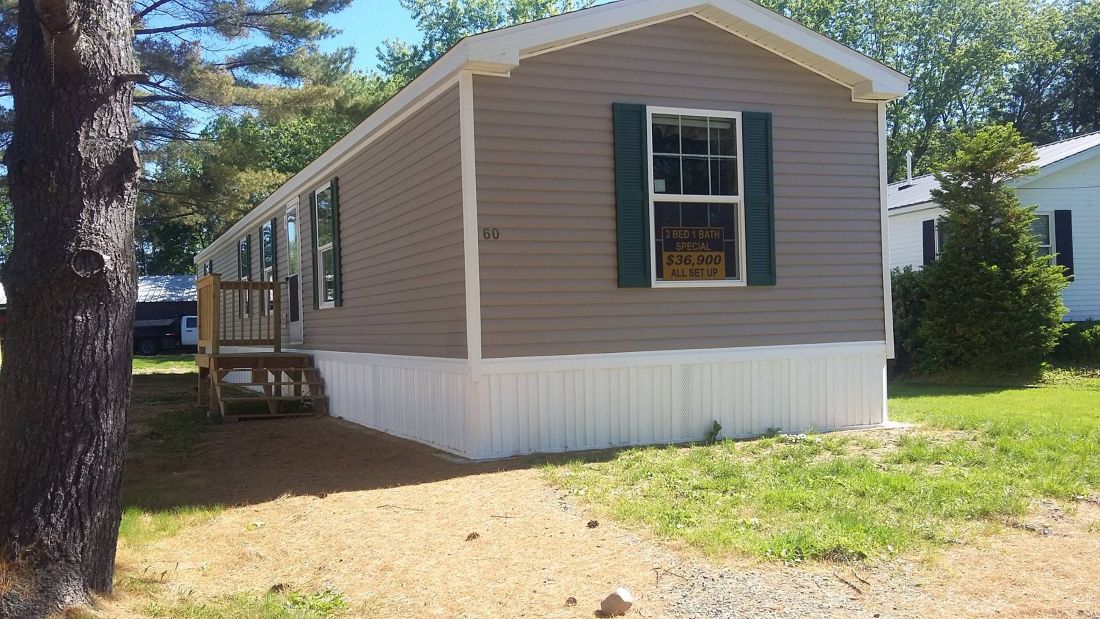
WATERVILLE — The City Council is making progress on a proposed Mobile Home Park Rent Stabilization Ordinance.
The move follows a unanimous moratorium imposed in August to address rising mobile home park rents.
City Solicitor Bill Lee presented options to the council in early December after the issue was first raised by Maine state Rep. Cassie Julia, who also serves on the Waterville Planning Board.
Julia sponsored L.D. 1765, “An Act to Ensure Affordability and Stability in Residential Housing and in Manufactured Housing Communities.”
The bill originally set out to limit rent increases to once every 12 months and to cap fee increases, but those did not make it into the final version. The law, which was enacted in June, made changes to the data that needs to be collected for manufactured housing community licensing and tasked the Governor’s Office of Policy Innovation and the Future with developing a model municipal rent stabilization ordinance and compiling other recommendations.
This accompanied L.D. 1723, “An Act to Amend the Laws Governing Manufactured Housing Communities to Prevent Excessive Rent and Fees Increases,” which sets out the process by which mobile home park owners must notify tenants of a rent increase and establishes steps tenants can take to request mediation if a park owner increases the rent above a certain threshold.
Julia first became involved in mobile home rent issues about three years ago, when community members appealed to the Planning Board to fight 20 percent rent increases.
The issue is not unique to Waterville.
In November 2024, Old Orchard Beach adopted a Mobile Home Park Rent Stabilization Ordinance that capped annual lot rent increases at 5 percent. Julia recognized the issue as a statewide problem.
“A lot of towns were having the same problem and wanted to help their communities, but didn’t know how to do it,” she said. “The moratorium arose out of frustration with seeing constant rent increases coming to the park without added services to the people who live there.”
Mobile home parks have high maintenance costs, and owners who cannot meet all requests often sell the land. Rent does not include mortgage, property taxes, insurance or amenities, such as water, sewage and trash pickup.
The town of Jay is also considering a moratorium on park rent increases, as are many municipalities across Maine.
Mobile home park residents “don’t have the luxury of just packing up and moving like someone would in an apartment,” Lee said.
Lee brought two main questions to the council. First, he asked what would trigger a hearing on rent increases — whether it would be automatically prompted by a rise beyond a certain percentage or only if residents requested one.
Councilor Spencer Krigbaum, D-Ward 5, warned that the proposal could disadvantage residents, many of whom work two or more jobs and lack the time or transportation to gather enough signatures and present them to the City Council.
Changes or complaints would be heard by a newly established board, with members nominated by the mayor and approved by the council.
One mobile home park resident, attending the meeting via Zoom, asked if residents could serve on the board. Councilor Scott Beale, D-Ward 6, said that would be a conflict of interest, but residents could still appear before the board to state their case.
There will be “the right to equal participation,” Beale said.
The council agreed that hearings on rent increases would be triggered by a specific percentage rise, not by resident requests.
Lee’s second question was what specific percentage increase would trigger a hearing.
Beale suggested using the Consumer Price Index as a potential cap. He also questioned whether setting a fixed percentage would effectively lock renters into annual increases at that rate.
Councilor Thomas Klepach, D-Ward 3, agreed, asking, “By stipulating a specific percentage, I’m wondering if we are baking in a constant rise?”
Dave Johnson, a member of the Waterville Planning Board, proposed limiting rent increases to one per calendar year, tied to the Social Security cost-of-living adjustment. The council did not settle on exact percentages, but Lee is expected to provide revised draft language in January.
Julia emphasized that the ordinance would be adopted by the municipality based on residents’ needs. She noted that only about one-third of mobile home parks face rent issues. The goal of the ordinance, along with laws such as L.D. 1723 and L.D. 1765, is to protect tenants while avoiding interference with fair business practices.
“(Mobile home park owners) are for sure doing things that are predatory or not within the reasonable scope,” Julia said. “We don’t need to be monetizing people’s living situations.”
Correction (12/29/2025): This article was updated to correct information about L.D. 1765 and L.D. 1723. A prior version of the article incorrectly cited language from earlier versions of the bills, not the final text as enacted.