


While there is little doubt that Paul LePage is going to be the next U.S. Representative for Maine’s 2nd Congressional District, there is going to be a delay in the final results.
Simple math shows that the former Republican governor is all but guaranteed to defeat Democratic State Auditor Matt Dunlap. But a complicated interplay between the vote totals and Maine’s unique ranked-choice voting system means an additional round of tabulation will be necessary to make LePage’s victory official.
LePage had already declared victory on Wednesday afternoon. Dunlap conceded and congratulated LePage on Thursday after the secretary of state’s office released vote totals and said the race would go to a ranked-choice runoff.
Maine uses ranked-choice voting, which allows voters to rank candidates by preference and employs multiple rounds if no candidate gets majority support at first, in some but not all of its elections. It is used in Maine’s races for federal office when there are more than two candidates, including this year’s 2nd District contest featuring LePage, Dunlap and write-in Gregory Ward.
“Maine law requires that the secretary proceed with ranked-choice voting tabulation if no candidate receives 50 percent plus one,” Maine Secretary of State Shenna Bellows told The Maine Monitor on Thursday afternoon.
LePage fell infinitesimally short of that threshold, based on the vote totals distributed by Bellows’ office on Thursday. Of the 341,248 total ballots cast, LePage secured 49.89 percent with 170,263 votes to Dunlap’s 48.3 percent with 164,845 votes.
Ward only picked up 123 votes, and those are not what kept LePage from crossing the 50 percent threshold.
Instead, it’s a collection of 6,017 blank ballots, in which people made no first-choice selection, that have pushed this race into ranked-choice tabulation. Maine’s ranked-choice process allows voters to abstain from the first round of voting but still make selections in subsequent rounds.
Even before the secretary of state’s office released those numbers, LePage’s campaign was confident based on its own assessment that he had secured the victory.
“I have spoken with Secretary of State Bellows and we are aware initial indications show a small number of blank votes and write-ins for this race may trigger Ranked Choice Voting based on their interpretation of law,” LePage campaign advisor Brent Littlefield said in a statement on Thursday. “It is very clear from our campaign team’s work yesterday talking one-on-one with local town clerks, and the publicly available numbers, that Paul LePage is the Congressman-Elect.”
Maine voters first chose to use the ranked-choice approach in 2016 when they approved a statewide ballot question, and then doubled-down on that support during a second referendum battle in 2018. At the time, Dunlap was the secretary of state tasked with implementing the new system while LePage was the governor and repeatedly opposed it.
And while both men have now acknowledged LePage’s victory in this election, Bellows said the law and numbers are clear that ranked-choice tabulation has to proceed.
Bellows called it an “unprecedented result” due to the incredibly narrow margin by which LePage failed to get a majority of the vote. There have been several other tight 2nd District races that have gone to a ranked-choice runoff since Maine started using the system in 2018, but none where the percentages were this close.
A necessary formality
Blank ballots also played a significant role in the 2024 2nd District race between current Democratic Rep. Jared Golden, Republican challenger Austin Theriault and write-in Diana Merenda. Initial results had Golden up by just over 2,000 votes with more than 12,000 blank ballots in the initial count.
“Both Golden and Theriault urged our office not to proceed with ranked-choice voting, but we consulted with the Office of the Attorney General and the statute, and it was just clear that the law requires it,” Bellows said.
Golden argued at the time that the blank ballots should not be included in the initial count. Republican state Rep. David Boyer later proposed legislation to change the way blank ballots are counted, but the bill died in committee last year.
Bellows emphasized that the law does not allow her office to skip a ranked-choice tabulation even if all the candidates involved don’t want it.
“A good example is the Republican gubernatorial primary of 2018. All of the losing candidates in that race urged the secretary’s office not to proceed with ranked-choice voting, but an analysis of the law compelled the secretary, who was Matt Dunlap at the time, to do it anyway,” Bellows said. “There is no exception for candidate preference.”
Some longtime ranked-choice voting supporters agreed with that interpretation.
“Congressional District 2 is a very closely divided district, and it’s important to count every vote and to ensure the intent of Maine voters,” said Jen Lancaster, deputy director for the League of Women Voters of Maine. “And once every vote is counted through that RCV process, it then guarantees that the winner does receive more than 50 percent of the vote and that they have support from the majority of voters.”
Kyle Bailey, who was campaign manager for the group leading the push for ranked-choice voting in Maine, said that this particular tabulation will be a “formality” based on the numbers. And while he was open to the idea of administrative changes that might be able to make the process quicker and cheaper for taxpayers, Bailey didn’t think a decision about whether to forgo a tabulation should rest with the candidates.
“We don’t hold elections for candidates to decide which candidate should be the winner,” Bailey said. “We hold elections for voters to decide.”
Blank ballots
Just because a ballot is counted as blank in the first round of voting does not mean the voter made no candidate selections at all. Maine’s ranked-choice process allows voters to skip a round and still weigh in during future rounds, as long as they don’t leave multiple rounds blank in a row.
“A majority of voters may have left their first choice blank, but they may have made a viable second choice, and that should be tallied,” Lancaster said. “In this particular race, it may not mean those ballots are decisive, but again, we have to ensure the intent of Maine voters.”
In order to catch up to LePage, Dunlap would need more than 5,000 of the roughly 6,000 blank votes to somehow list him as the second choice. It is almost impossible for that to happen.
In 2018, when Golden claimed the 2nd District seat by knocking off sitting Republican Rep. Bruce Poliquin in a race that went to a ranked-choice tally, the unofficial results reported by towns showed that more than 6,700 ballots were initially counted as blank. A large majority — more than 5,500 — remained blank throughout all the rounds, according to court documents after the results were challenged.
Bailey said that the committee supporting ranked-choice adoption in Maine didn’t have a strong feeling either way about how to include blank ballots from the get-go, and wasn’t opposed to election administrators making changes if there are ways to improve the process based on experience, as long as any changes comply with the existing law.
“I’m an election reformer, so I always believe that processes can be improved,” Bailey said.
What this count will look like
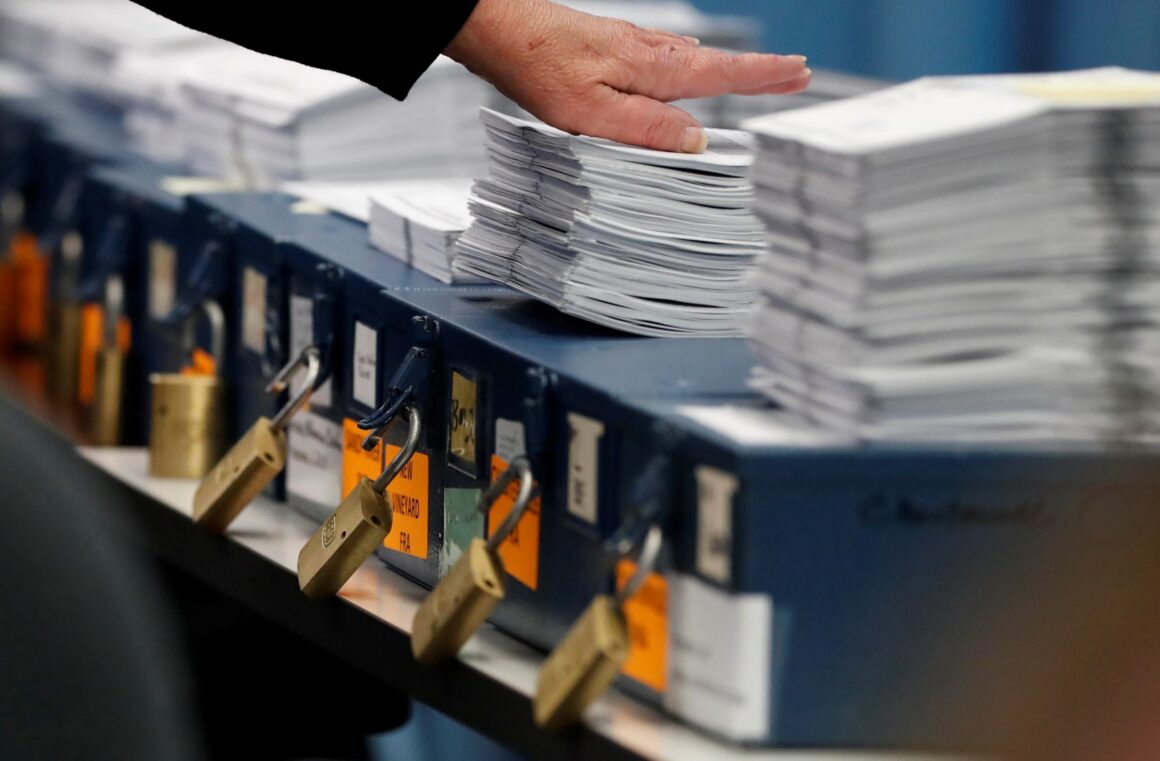
The secretary of state’s office plans to start the tabulation process on Monday, once law enforcement officers have traveled around the 2nd District to collect ballots from towns that still count by hand, and memory devices from those that use electronic scanners.
Those materials are brought to a central location in Augusta where secretary of state staff verify the votes and then run the ranked-choice tabulation. It’s the verification that takes the most time, with the ranked-choice tabulation in this year’s June 9 primary stretching 10 days after the election.
That primary tabulation cost slightly more than $219,000 when totaling costs for law enforcement and secretary of state staff time, space rental, vendor support, meal reimbursement and overtime, according to the secretary of state’s office. And it was punctuated by some technical issues in Augusta and mix-ups at the municipal level that saw the process drag out longer than officials originally predicted.
But the primary had three different statewide or congressional races go to ranked-choice runoff at the same time, rather than just one congressional race as in this case. And 73 towns have added electronic tabulators since June, according to the secretary of state’s office.
Bellows is hopeful that the process will go faster than it did in June because there are fewer ballots from hand-count towns to scan thanks to those additional tabulators. She said the process is “likely to take about a week,” and did not expect staff to be working on Veterans Day or outside regular business hours.
“We are not going to predict an end date,” Bellows said. “We’re going to ensure that it is accurate.”
While law enforcement started collecting ballots and memory sticks on Wednesday after the primary election, that process didn’t start until mid-morning on Thursday this week because it wasn’t immediately clear that a ranked-choice tabulation would be needed.
“Given just how tight this race was, we did not deploy law enforcement until we had clear certified results from the towns,” Bellows said.