



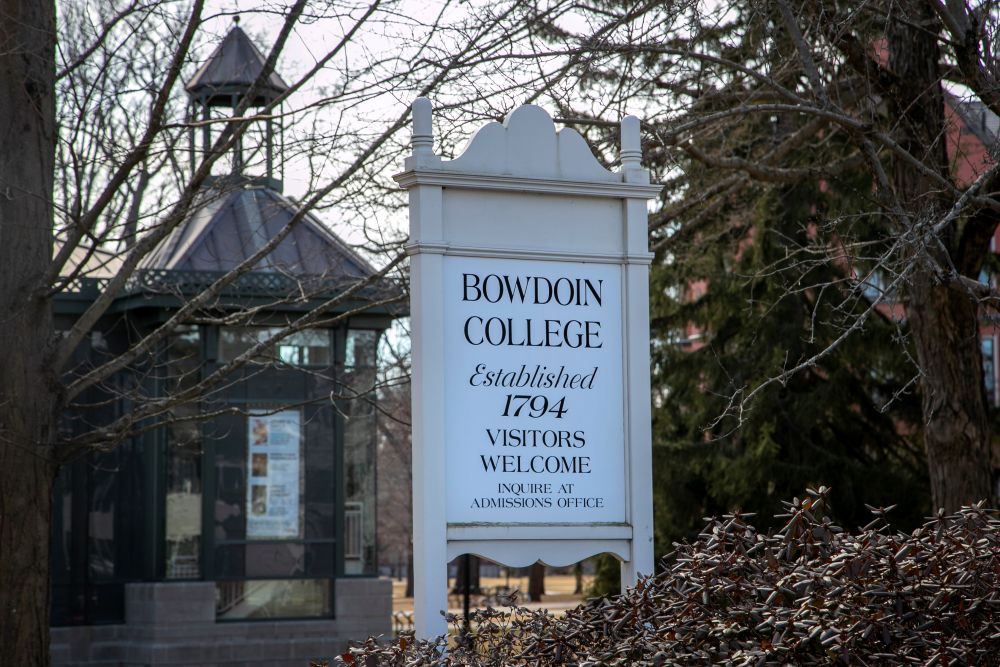
KINGFIELD — Bowdoin College has withdrawn its application to establish a campsite at the Finnegan McCoul Woodruff Mountain Center in Kingfield.
Minutes before the Kingfield Board of Selectmen meeting Tuesday, Town Manager Leanna Targett received an email from John Simoneau, Bowdoin’s director of capital projects, formally withdrawing the application and pledging not to refile it for at least six months.
Simoneau wrote that Bowdoin still views the Bowdoin Outing Club proposal as a “modest” and “well‑considered” project that deserves approval. But he said the college chose to “voluntarily withdraw (its) pending application” in response to public concerns about whether the town’s ordinances adequately cover such a development.
The pause, he said, will give the town time to review its ordinances and allow for more “substantive dialogue with stakeholders,” helping Bowdoin better understand and address issues raised during the review process.
While Bowdoin, a liberal arts college in Brunswick, is disappointed the project will not be available for students this fall, Simoneau said the college’s priority is to “work collaboratively with the community and ensure the facility” is a good fit.
Bowdoin’s proposal calls for seven gravel campsites that would allow up to 28 tents, or 112 students, at full capacity. The campsites would occupy 1.8 acres of the 20.7‑acre property and include a 950‑square‑foot picnic area and a 600‑square‑foot sanitary building with a vault toilet and septic system. The plan also calls for staggering vehicle departures to ease traffic on the road.
In his letter to the Board of Selectmen and the Planning Board, Simoneau emphasized that the project “is not a commercial development. It is a simple, low-impact campsite designed to serve a student outdoor program.”
He said Bowdoin students already travel throughout the state for outdoor activities and are expected to respect their surroundings.
“We have not had significant complaints in decades,” he wrote, adding that the college is “confident we would prove to be good neighbors.”
In anticipation of refiling the application after six months, Simoneau wrote that, with the town’s support, “we would have an opportunity to move forward with a project that is small in scale, serious in purpose, generous in its community commitments, and likely to create lasting appreciation for this remarkable corner of Maine for generations to come.”
Several residents oppose the project, saying they fear increased vehicle hazards at the Route 27 and Iron Bridge Road intersection, on the bridge itself, and along the steep, icy approach to the proposed site in winter.
Earlier this month, residents presented a petition to the Planning Board seeking a temporary moratorium on the project.
In response to residents’ concerns, Bowdoin has pledged $5,000 annually toward road maintenance and said it is committed to partnering on longstanding bridge issues unrelated to the project.
The college said traffic and noise concerns would be mitigated by the facility’s seasonal, primarily weekend use from August through October, along with staggered vehicle departures to reduce congestion. Bowdoin added that students “are expected to respect their surroundings” and said it has not received “significant complaints in decades.”
The college also emphasized the project’s broader purpose, noting the center would honor a late Bowdoin student and Outing Club member, Finn Woodruff, and help introduce students to Maine’s outdoors while fostering appreciation for the region.
In an email to Monitor Local, Douglas R. Cook, Bowdoin’s director of communications, said that despite the withdrawal, the college remains “fully committed to this project and to creating the opportunities it will provide for our students.”
Selectman Wade Browne responded positively to the withdrawal but noted that significant work remains.
“I think they want to be good neighbors,” he said.
Browne said that allowing the moratorium to proceed would give the town 180 days “to come up with a game plan of what everybody’s concerns are,” adding that if 180 days is not enough, “then we should end it because I don’t think we are going to be able to dot every ‘i’ in this whole conversation.”
Browne said the temporary pause should be used for “thoughtful discussion to fix the ordinance.” The project has highlighted a central issue: how the town wants to define and interpret a “transient overnight recreational development” and how to incorporate that language into an ordinance where it is currently absent.
Town officials also recognize that Airbnb rentals could be significantly affected if they are deemed to fall under this category of short‑term lodging — another issue they will need to resolve.
Questions surrounding the bridge connecting Route 27 to Iron Bridge Road remained unresolved as safety concerns continued to surface. Selectman Chris Rushton again pointed to the bridge as a safety issue, while Browne said any effort to widen the privately owned structure “has nothing to do with the town.”
Targett added: “Hypothetically, (the bridge) wouldn’t be in the state it is now if it were ours. Would the town accept it? Doubtfully. Unfortunately, unless the bridge and roads are brought up to standards, the townspeople aren’t going to accept them. It would probably cost $1 million to replace the bridge. Do they want that bill?”
Lawyer Kristin M. Collins of Preti Flaherty, standing in for the town’s attorney, Amanda Meader, said Bowdoin’s withdrawal letter changes nothing.
Collins said: “In the sense that the (Board of Selectmen’s) job is to look at if the moratorium is legally justified based on need, based on the criteria and the statute about whether there is a need that is not addressed in the current ordinances, and it is not tied to Bowdoin’s application specifically, does the board think that there is justification that these ‘transient campgrounds’ are something that are not adequately addressed in the ordinances currently and that we think, if someone were to come in and challenge this moratorium, would there be enough for the town to say it is legally justified because the ordinances are insufficient?”
That question went unanswered, and selectmen decided to put the moratorium before voters, with Targett saying she was “pretty sure it’s going to get voted through.”
Targett said she will write a formal letter to the Maine Department of Transportation requesting a new traffic study of the road and bridge intersection.
Currently, “nobody can give a real answer on how many (households) this project equates to” in a traffic study, Board Chairman Hunter Lander said.
Lander added: “The underlying point of this ordinance is to call out the elephant in the room and stop Bowdoin from doing what they’re attempting to do. So, if we put this through, we change, we redistrict, we change whatever it may be, and we could potentially make it so that Bowdoin could not do what they are attempting to do.”
“We’ve been gifted with this opportunity,” Selectwoman Kim Jordan said. “If I were on the Planning Board, I’d be meeting seven days a week to make sure this gets done properly. Lots of meetings to get it done correctly.”
The changes have the potential to alter the comprehensive plan, which is a time‑consuming undertaking. Targett said the Dollar General coming to town because the ordinance allowed it is a perfect example of the ordinance not being up to date.
“We can’t just keep throwing stuff into an ordinance because we want to do it,” she said. “There will be a lot of meetings to get it done and get it done correctly.”
The board has 60 days to send the moratorium to voters and has scheduled a special public hearing for July 6. Members of the public will be limited to five minutes to speak, and the Board of Selectmen is expected to take up the moratorium at its regular meeting scheduled for July 13.
The July 6 and July 13 meetings are set to begin at 6 p.m. at the Town Office.
This story was updated May 28 to remove a quote wrongly attributed to Town Manager Leanna Targett.