



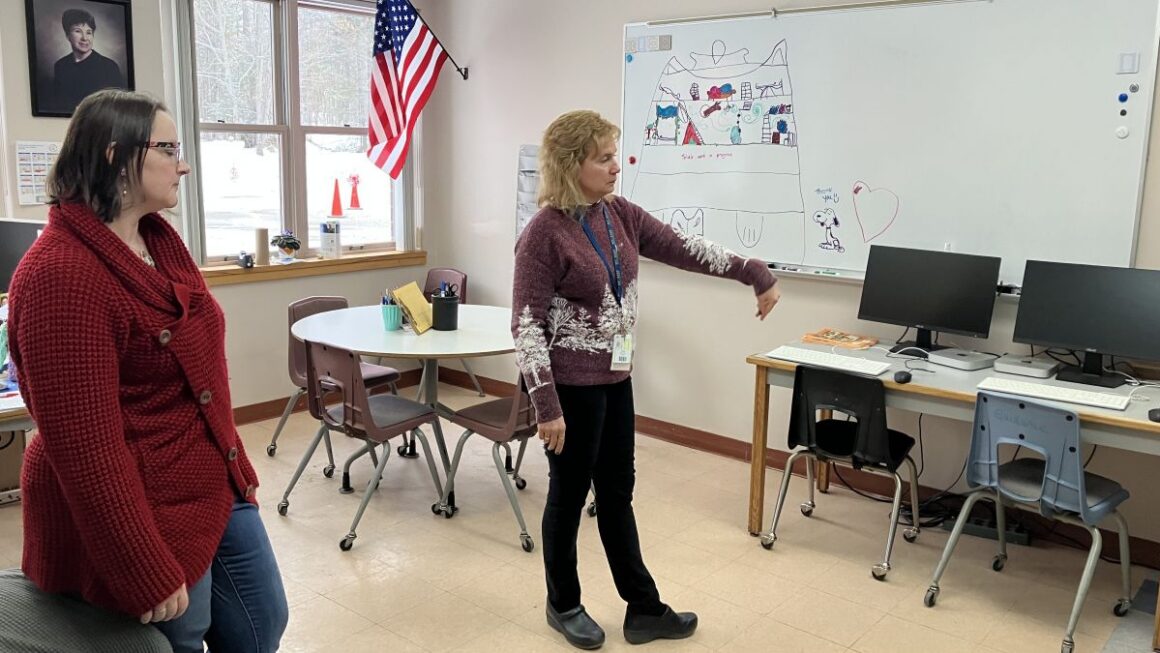
NEW SHARON — On‑site child care before and after school. Pantries stocked with snacks, toiletries, clothing, backpacks and footwear. Dentists checking students’ teeth in the band room.
These are among the growing services local schools now provide to meet students’ basic needs.
“If you want children to thrive, you have to meet their basic needs,” First 10 Community School Outreach Coordinator Anita Stevens said. “We’re solution oriented.”
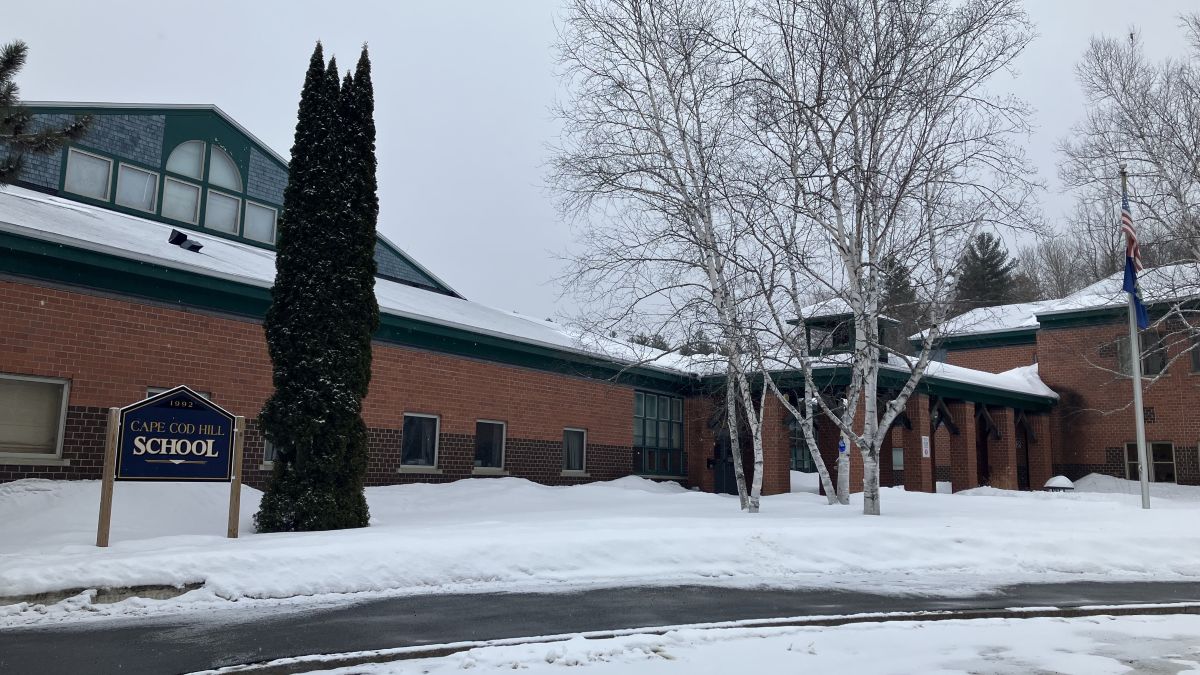
Cape Cod Hill School, or CCHS, serves prekindergartners through fifth graders from five rural western Maine communities: Chesterville, Industry, New Sharon, Starks and Vienna.
More than half of its students qualify for free or reduced‑price lunch.
Within Regional School Unit 9, Cape Cod Hill is the district’s most remote school, serving a sparsely populated area where distance makes delivering services especially challenging.
In 2022, CCHS secured a $25,000 grant from the Maine Department of Education to begin meeting needs that no other local provider could. What started with a food pantry and a few free after‑school child care slots expanded in 2023 with the help of a $125,000 state Department of Education Community School grant.
“I think they saw how popular it was,” CCHS Principal Carol Kiesman said.
Cape Cod Hill School is one of a half‑dozen Community Schools in Maine and the only one in western Maine.
Kiesman described the model as more of a strategy than a single program. It was originally built around four major tenets — or “pillars” — that reinforce one another: integrating student supports; expanding time and opportunities for learning; actively engaging families and the community; and sharing responsibility for student outcomes among staff, parents and community members. National advocates have since added two more pillars: community‑oriented classroom instruction and maintaining a culture of safety and belonging.
The school has steadily expanded what it can offer families. CCHS now hosts up to 40 students from 7 a.m. until 8:45 a.m., when the school day begins.
The after‑school program is capped at 25 slots, giving those students a place to stay until 4:30 p.m. while their parents finish work.
The extra time before and after the school bell rings is critical, Stevens and Kiesman said. The nearest child care options are 20 miles away.
In addition to helping keep students in classrooms — attendance is a “huge goal” across the district, Kiesman said — the child care program helps keep families from leaving the area.
CCHS offers a range of after‑school enrichment programs, from a craft club to a seed squad to an outdoor play group.
Despite the expansion, demand has outpaced resources, leaving a constant waiting list for before‑ and after‑school care. Kiesman said she follows up with families when students stop attending to confirm whether they still need the slot.
Transportation is another challenge. Although the Community School funding from the state Department of Education included money for busing, RSU 9 has not been able to provide drivers — a common issue across Maine. Stevens said she organizes rideshares and other workarounds when possible.
Child care is just one cog in what Stevens describes as a big clock: Remove any piece and the whole thing stops ticking. The school’s food pantry has expanded to include weekend food supplies distributed through the RSU 9 pantry in Farmington, along with everything from daily snacks to Thanksgiving food baskets for families. In winter, a Giving Tree offers clothing and other essentials and has become one of the school’s most popular supports.
There is also a clothing pantry, supplied by donations and a partnership with Apparel Impact, stocked with everything from galoshes to T‑shirts to backpacks. During last November’s parent‑teacher conferences, paper bags of clothing were set out — each labeled “size 8,” and so on — for families to take home.
If a family has a specific need, Stevens said she taps local organizations and businesses. When three students needed sneakers, the local Masonic Lodge stepped in to provide them – and did the same when others needed sweatpants. She has also had success securing gift cards from Walmart, Hannaford and other businesses.
The district contracts with behavioral health providers who come directly into the school to meet with students with a wide range of needs. Without in‑school visits, Kiesman said, most families seeking services would not receive them.
“Most families get put on a waiting list and then wait forever,” she said.
“They wouldn’t receive services,” Stevens agreed.
Another service the school offers is a pop‑up dental clinic that comes a couple of times a year. Hygienists arrive in the parking lot and roll their equipment into the band room, where students with permission slips meet them for cleanings and checkups. At the most recent visit, the clinic saw 20 students — enough that it expanded from the band room into the music room.
That access is particularly important, said Maria Watson, the school nurse, because it can take months to secure primary dental appointments — even for families who have the means to get their child there.
“I’d love to get some eye support in here,” Watson said.
Eyeglasses are one thing, but getting students in front of an optometrist is far more difficult.
For Watson, tending to student health can now mean arranging the delivery of heating oil, getting a family’s car repaired, running a monthlong challenge that encourages healthy habits (eat your vegetables and win a basketball hoop) or sending water bottles home to promote better hydration.
“‘We don’t do that’ really isn’t an option,” Watson said.
In many cases, Watson’s support does not draw directly on Community School resources, but the model still gives her a framework for delivering services effectively across a wide geographic area.
While much of the Community School model is geared toward students attending classes at CCHS, organizers have also worked to support families that homeschool. When parents drop off their child for an in‑school offering such as gym class, they can now wait in a former staff room that’s been converted into a lounge equipped with computers, a printer and books — rather than sitting in their car.
Stevens’ office is in the family den, which gives her a good opportunity to check in.
Kiesman said she is convinced the model is producing positive results at CCHS, but sustaining it is the biggest challenge.
The First 10 funding that brought Stevens into the district in 2024 is set to phase out in March. The larger state Department of Education Community School funding stream is also designed to taper, from $125,000 in 2023 to $75,000 in 2024 and $50,000 last year.
“Funding is fading out, but the need is not,” Stevens said. “The need is growing.”
Kiesman and Stevens appeared before the RSU 9 board of directors in early February, winning approval to apply for a $23,750 grant from the Fisher Charitable Foundation to support staff hours later in the school year.
The board also approved having CCHS apply for $50,000 in state Department of Education Community School funding for the 2026-27 school year.
Stevens’ thinking now extends beyond meeting student needs to shoring up future funding for the program. In addition to pursuing grants, she is exploring possible collaborations with the Children’s Task Force’s 21st Century program, which supports other district schools but not CCHS.
She is also considering a sliding‑scale model in which participating families would contribute financial support.
“We’re leveraging any and all possibilities to make the whole system work,” Kiesman said, adding that she wants the program to continue. “We need to be sustainable to keep this thing going.”