



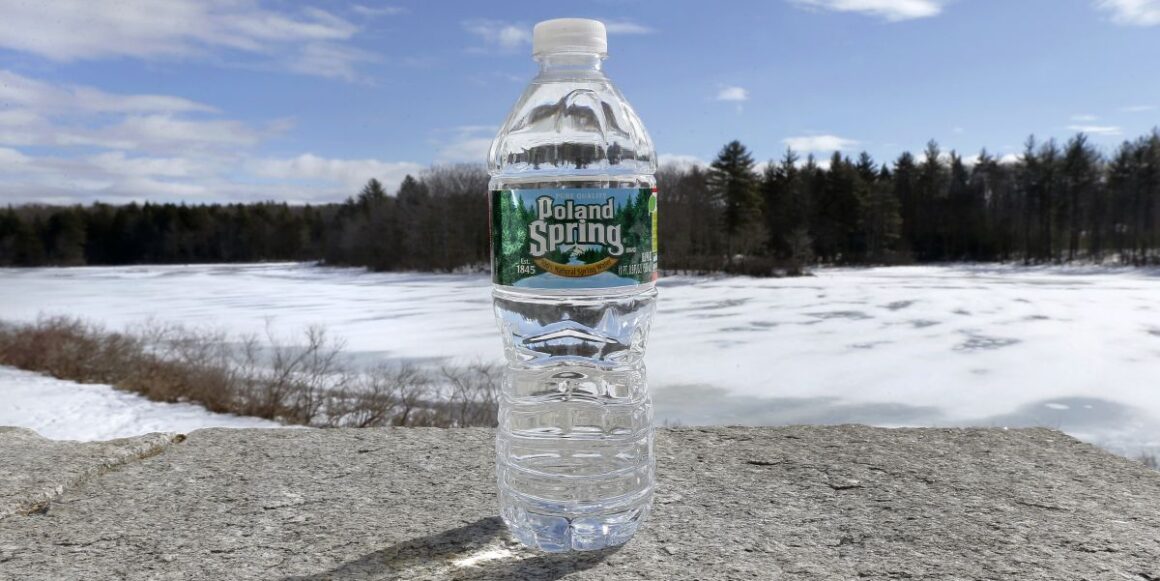
DENMARK — Residents urged the Select Board last week to reject Poland Spring’s request to renew its water extraction permit, raising concerns about Long Pond, groundwater supplies and private wells.
Poland Spring is seeking a five‑year renewal to continue withdrawing water from the Cold Spring site in Denmark.
The bottled water company is allowed to take up to 432,000 gallons per day — or 105.1 million gallons per year – under the town’s water extraction ordinance and annual monitoring report.
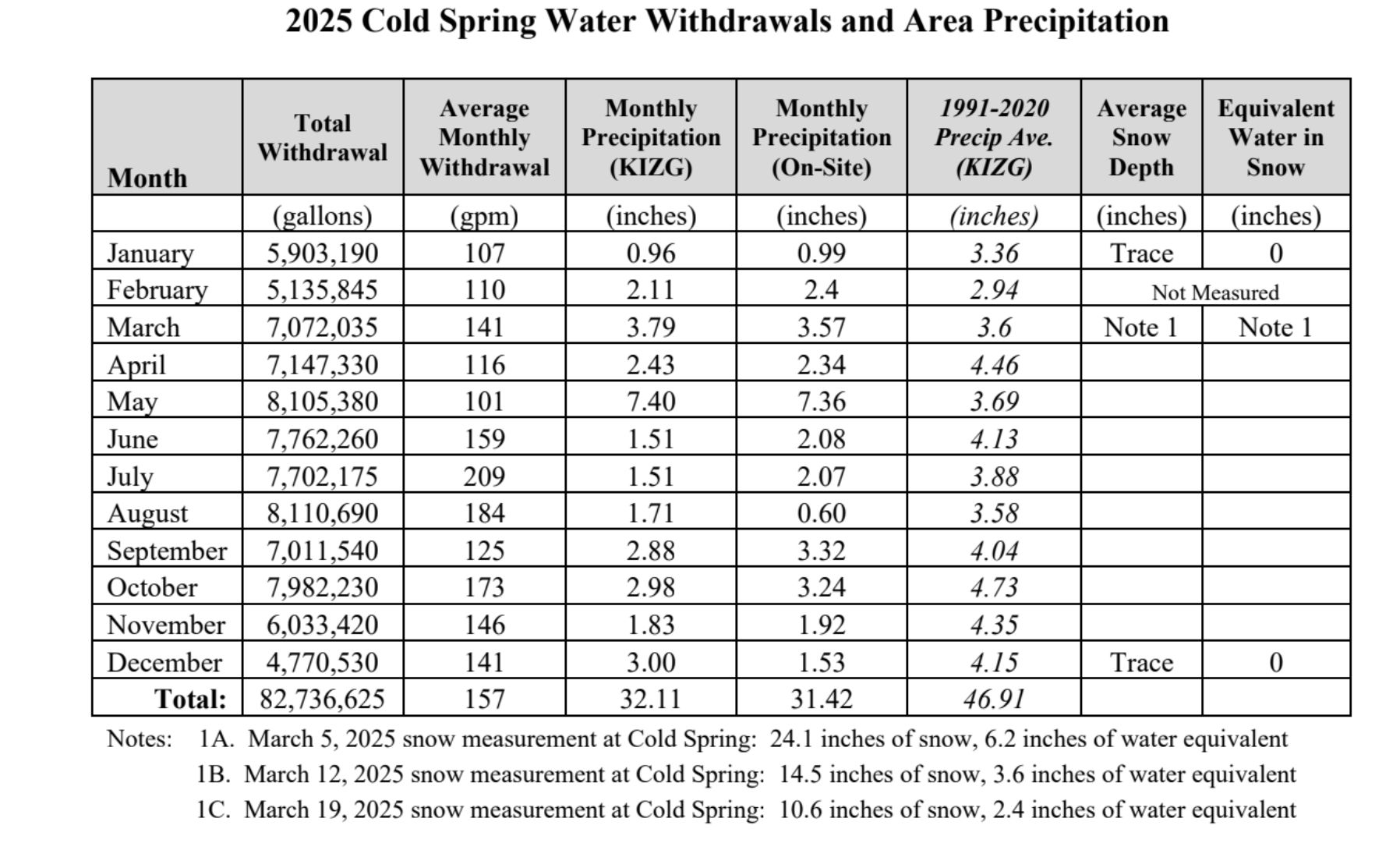
In 2025, Poland Spring withdrew 82,736,625 gallons, with the highest monthly total — 7,982,230 gallons — in October.
The town also tracks monthly precipitation, with a total of 32.11 inches of rainfall measured at the Eastern Slopes Regional Airport last year, compared with an average rainfall of 46.91 inches recorded between 1991 and 2020 at the same location.
The precipitation recorded at Cold Spring was slightly less, at 31.42 inches last year.
Several residents spoke against renewing the extraction permit, saying they remain concerned that the town lacks enough information to determine how continued pumping could affect Long Pond, nearby groundwater and private wells.
Others called for financial compensation for the town or questioned whether current monitoring and assessments provide an adequate picture of the aquifer, especially after recent droughts.
Nancy Vasiloff, a full‑time resident of Denmark, called for a more comprehensive assessment of the aquifer and said groundwater and well levels should be verified by an independent third party.
“Poland Spring should not be allowed to pump at all during drought conditions … at least until we have clear, factual and unbiased proof that the pumping is not adversely affecting the aquifer that supplies our wells,” Vasiloff said.
Resident Jocelyn Giammarino urged the Select Board to reject the renewal, saying her concerns are shaped in part by her identity as a member of the Penobscot Nation.
“Long Pond and the aquifer are not just a line on a permit,” Giammarino said. “They are a part of a relationship between the people and this land that goes back thousands of years.”
Giammarino also raised concerns about Long Pond’s health and questioned whether the available data is sufficient to rule out a connection between water extraction and the pond’s declining water levels.
“Long Pond clearly isn’t its own separate little bubble. It’s tied to the aquifer that Poland Spring extracts from, and to the wells and the wildlife that inhabit it,” Giammarino said. “Residents have been seeing receding water levels for years, and with how dry things have gotten in Maine, we cannot keep signing off on withdrawals of up to 103 million gallons of water a year.”
In March, the town of Denmark sent Poland Spring a letter after weekly well monitoring in February, when much of Maine was in severe drought, asking for an action plan if groundwater levels dropped below the standby alert threshold and what steps, if any, the company would take to reduce extraction to preserve water flow.
A month later, after a period of heavy rain eased drought conditions, Poland Spring was no longer required to submit an action plan.
Wendy Boucher, who also lives in Denmark, questioned whether the town receives enough financial benefit from Poland Spring’s water extraction. She said the town collects about $34,000 in property taxes from Poland Spring, while its parent company, Primo Brands, reported $6.6 billion in sales last year.
Boucher asked the board whether it could require Poland Spring to negotiate a community fee tied to the amount of water withdrawn as a condition of the renewed permit, rather than through taxation.
“Why doesn’t the town share in the profits of the water being taken out from under it?” Boucher asked.
Bill Sandborn, who lives on Mountain Road, pushed back on the idea that Poland Spring’s only contribution to the town comes through property taxes. Sandborn, a Lions Club member, said the company has provided financial support to local nonprofits, including the Fryeburg Fair Association, which he said needed more than $20,000 for state‑required fire suppression systems and new hoods.
“We wouldn’t be opening the booth this year if it were not for Poland Spring,” Sandborn said.
He also credited the company’s donations with supporting the local art center, library and other nonprofit organizations.
Laurie Lamountain of Denmark asked where the town’s monthly monitoring reports from before 2015 were kept.
A Select Board member said the records might be stored downstairs in the Town Office archives, but acknowledged he could not immediately say what had happened to them.
The board said it could ask Poland Spring for the reports.
The town maintains digital monthly extraction reports on its website, dating from 2015 onward.
At an Aug. 11 public hearing, Colin Ryan read a letter on behalf of 17 Denmark residents who called for greater oversight of Poland Spring’s water extraction. The letter said the Select Board has a responsibility to ensure that extraction does not compromise the town’s water resources, residents or natural environment.
The group also called for extraction, precipitation, temperature and other monitoring data to be made available to the town and public in a timely, usable digital format.
The public hearing then turned to what additional analysis could help address residents’ concerns.
Rick Vandenberg, the town’s hydrogeologist, said a properly constructed three‑dimensional groundwater flow model could help determine the relationship between Long Pond and the aquifer and assess whether pumping is affecting the pond or nearby wells.
He said the model should be independently vetted and developed with a technical expert involved to ensure it is based on sound data.
Select Board Chair Andrew Kruczek questioned why the current alert and action levels are based on data from 2006 to 2009 and called for the town to examine a broader period of monitoring.
He also asked that future reports include graphs showing water levels for all monitoring wells, groundwater flow maps and more detailed monthly data so residents can better track changes over time.
The board also sought more frequent monitoring of Long Pond and nearby wells.
Kruczek called for regular monitoring of the pond’s water levels, while Vandenberg recommended checking the pond monthly.
Kruczek also asked that Poland Spring survey 25 percent of wells in the area affected by extraction, add wells to weekly monitoring during severe droughts and after extraction rates exceed 200 gallons per minute, and retest wells removed from the monitoring program in 2012.
“Whether it’s the drought, or whether it’s the drought and the extraction activity, something is pulling the water from them,” Kruczek said.
Kruczek also called for annual testing rather than testing every three years, and asked that radon be tested in boreholes and residential Category 3 wells.
As the board discussed allowing time to address residents’ concerns before making a decision, Vandenberg said, “I think the public deserves thoughtful answers to everything.”
Mark DuBois, Poland Spring’s senior natural resource manager, said the company’s monitoring shows it has responded to changing water levels and can do more to make that information accessible to the public.
“When I boil everything down from the ordinance process and the public process it really comes down to a process of trust but verify,” DuBois said. “We’re trustworthy. I’ve tried to explain that to you, you have to verify our data.”
The town’s water extraction ordinance was amended in 2006 and 2012, and last updated in 2024.
DuBois said Poland Spring has benchmarks around Long Pond that allow the company to measure water levels, although he acknowledged the company could do more to make its monitoring visible to the public.
“I think the public deserves better,” DuBois said.
DuBois said Poland Spring had already reduced its withdrawals during the recent drought, at times operating at less than one‑third of the permitted withdrawal amount.
“We were down below 33 percent of the allowable withdrawal amount, some weeks down to 75 gallons a minute when we could take 300,” DuBois said.
DuBois also said water levels had recovered from their lows earlier in the year.
“They were the lowest this year in February and March,” he said. “They’re about a foot higher than they were in March.”
DuBois said the company views the water supply as a renewable resource and argued that its monitoring shows the aquifer can support continued extraction.
“Water is 100 percent renewable in Maine,” he said.
The Select Board continued the hearing to Sept. 8 to allow time for Poland Spring and the town’s technical experts to address questions raised by residents.
The board is expected to review those responses before deciding whether to renew the company’s water extraction permit.
For more information on extraction reports and other documents, go to: Water Extraction | Town of Denmark.
Correction: This story was updated August 31 to correct our prior reporting on the precipitation recorded at 31.42 did not include March snowfall.