



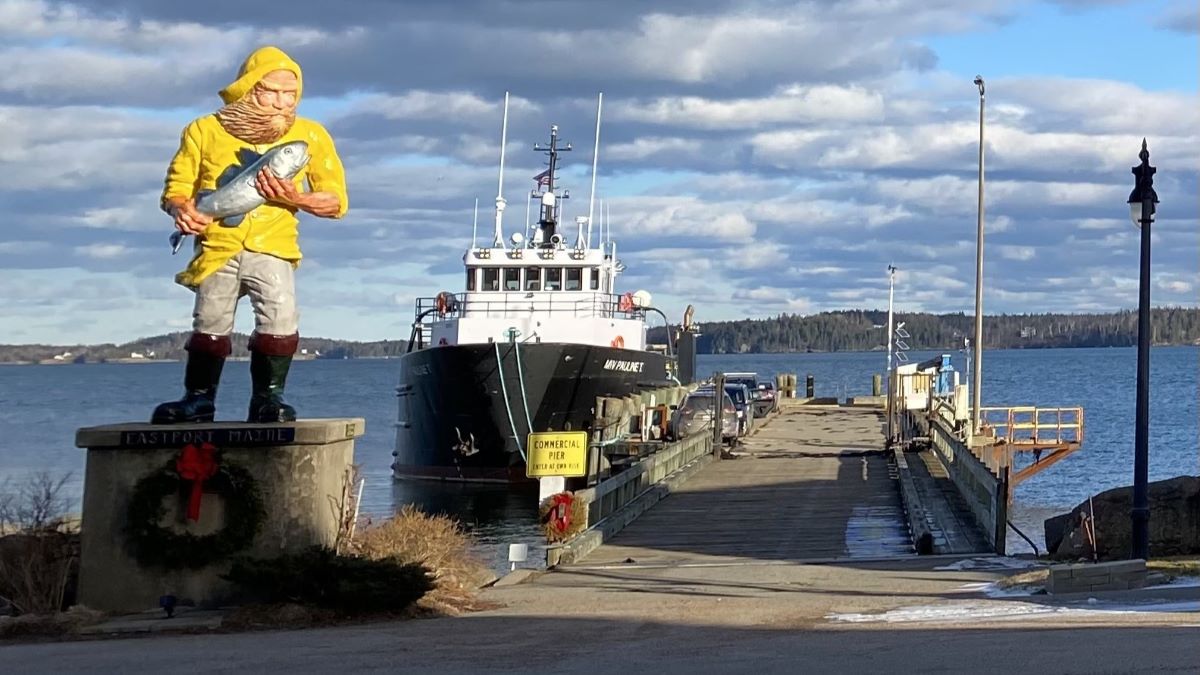
EASTPORT — A group of residents is petitioning the city of Eastport to enact a permanent ban on artificial intelligence data facilities after DeepGreen Western Passage applied for a preliminary permit to test an underwater data center off the city’s northern coast.
The petition, circulated by the Eastport Coalition for Healthy Oceans, or ECHO, calls for an ordinance prohibiting data centers larger than 25,000 square feet in Eastport and its coastal waters.
A second proposed ordinance, filed alongside the petition, would require voter approval for any new industrial or commercial development larger than 25,000 square feet on land or 10,000 square feet in the ocean if the permanent ban passes.
Both proposed ordinances include a retroactive effective date of June 1, 2026.
The petition, filed with City Clerk Ella Kowal, gathered nearly twice the required number of signatures. But when residents pressed councilors for a response at the June 17 City Council meeting, councilors said they had not seen the petition and appeared uncertain about next steps, leaving some residents questioning the city’s priorities and the cost of inaction.
With Kowal’s assistance, councilors explained they had not yet received the petition because it was still undergoing certification. Under the city charter, the municipal clerk has up to 10 business days to certify signatures. The petition was filed June 15.
Once signatures are verified and certification is complete, the City Council will receive copies of the proposed ordinance. The council must then hold a public hearing before deciding on a motion or next step, which will determine whether the permanent ban ordinance appears on the November ballot.
There are more than 4,400 active data centers in the United States, dwarfing the United Kingdom, which ranks next with 555. Many of these facilities are located in rural communities.
Eastport resident and recent City Council candidate Deborah Gillespie said she believes data center development is inevitable, but Eastport is not the right place for it.
Gillespie drafted an emergency moratorium ordinance and gave a copy to the council at its May meeting. When the council declined to make a motion on it, she said she felt her concerns — and her work — were dismissed.
In February, DeepGreen Western Passage SPV LLC applied for a 48‑month preliminary permit with the Federal Energy Regulatory Commission to conduct engineering and environmental studies — the first step toward developing a tidal‑powered underwater AI data center off Eastport, according to the filing.
DeepGreen, which specializes in underwater‑powered data infrastructure, has identified waters north of Eastport as one of two potential sites for its first project. The other is in Alaska’s Upper Cook Inlet.
Eastport City Manager Brian Schuth told NEWS CENTER Maine that it is too early in the project’s development for the city to invest in a cost‑prohibitive legal battle.
“We are a small city with limited resources,” he said, “so there’s some question about how much expense we want to incur at this stage of the process.”
Schuth, who regularly attends City Council meetings, has clashed at times with residents and left meetings during public comment.
In May, Schuth told Monitor Local that he had walked out of two City Council meetings during similar discussions, saying he struggles with feeling prepared for public engagement.
He said he wants residents to know he is not “the man,” and that people are welcome to speak with him in his City Hall office, where he has access to the information he needs to respond clearly and accurately.
“That’s not democracy,” Birdy Velveteen, a community grassroots organizer, told Monitor Local of Schuth’s approach to civic engagement. Velveteen is one of the voices behind ECHO.
At a council meeting earlier this month, Velveteen asked, “If the council doesn’t act on it, the data center won’t make it to the November ballot, correct?” The council responded yes.
Velveteen said she spoke with ECHO’s legal counsel, who told her that “state law doesn’t actually give them the option to do nothing with a satisfactory petition,” meaning one that carries enough qualifying signatures to bring the issue before voters.
In a separate email update to Velveteen this week, Kowal, the city clerk, confirmed that the petition will be brought to the City Council to schedule a hearing.
Velveteen said ECHO is raising a legal defense fund in preparation for potential future costs.
ECHO’s legal counsel said the group expects to need about $5,000 to challenge any inaction if it becomes necessary.
Alan Skinner, an Eastport business owner who attended a public hearing on a street vendor ordinance at the start of the council’s regular June 17 meeting, said he believes the measure effectively prevents him and his 14‑year‑old son from operating a food trailer in the city.
“They’re fighting it (street vendors) like they should be fighting AI,” Skinner said of the ordinance, which defines and sets rules for street vendors, peddlers and food trucks.
The Washington County Commission has expressed opposition to the DeepGreen project in an April 9 letter sent to Louis Wolfson, a developer and managing member of DeepGreen. In it, Commissioner David Burns wrote: “Washington County has a long, involved history, dependency and respect for maritime industry, and we feel this type of project would be too risky for this region and its waters and the people of Washington County who live and work here.”
The Eastport City Council sent its own letter in June, mirroring the county’s language, and signed by the city clerk.
In late April, Gov. Janet Mills vetoed a bill that would have placed a temporary moratorium on data center projects statewide. Days later, she established the Maine Data Center Advisory Council by executive order to study issues related to large‑scale data centers proposed or operating in the state, with the goal of “protecting ratepayers, maintaining electric grid reliability, minimizing environmental impacts, and enabling responsible and appropriately sited economic development.”
The order stipulates that the advisory council will submit a final report — including findings and any recommendations, such as proposed legislation — to the governor and the Legislature no later than Jan. 29, 2027.