


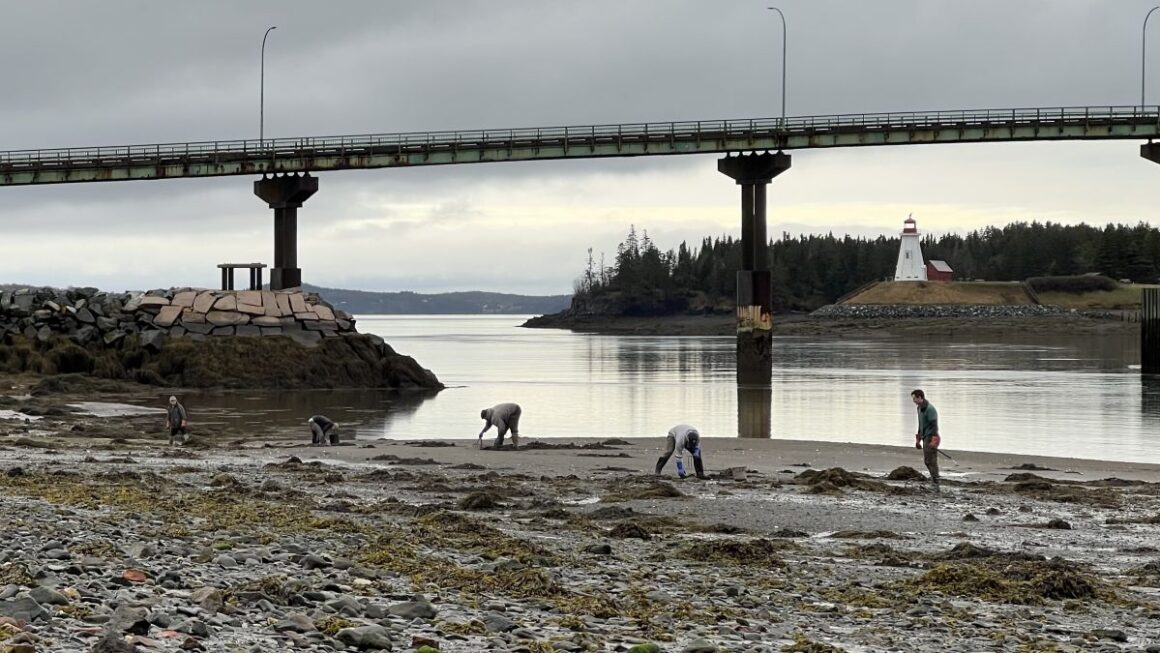
LUBEC — Lubec shellfish harvesters planted seed clams in the Lawrence’s Factory, Globe Cove and Klondike flats last week with help from Kyle Pepperman of the Downeast Institute.
The new beds will require year-round tending and close monitoring for predators and for biofouling from algae and seaweed.
The Lubec Shellfish Committee, which monitors, manages and preserves shellfish harvesting, plans to track conditions on the freshly planted flats and report changes as they occur.
A strong El Niño this year is expected to make that work even more critical for the clams’ survival.
South American fishers first named El Niño after noticing unusually warm surface waters in the eastern Pacific Ocean, where higher‑than‑normal temperatures disrupt marine wind patterns and trigger weather shifts around the world.
The effects of El Niño vary widely depending on location.
Andrew Pershing, director of climate science at Climate Central, a New Jersey-based nonprofit that monitors weather patterns, said a strong El Niño is expected to make the rest of this year warmer and wetter than usual in Maine.
He said El Niño’s effects typically show up most clearly in the fall and winter, but noted that “El Niño‑like patterns” already appear in the National Oceanic and Atmospheric Administration’s summer outlook.
A warmer, wetter 2026 will likely bring a range of impacts, affecting clams, their food sources and their predators. Some changes may emerge this year, while others will play out over the next several seasons.
One major beneficiary of milder temperatures is the softshell clam’s most destructive predator, the green crab. Green crabs (Carcinus maenas) have lived in New England waters since at least the 1800s, with confirmed reports in Casco Bay dating to 1905.
The green crab population did not begin to surge until about 50 years ago, when warming Gulf of Maine waters — one of many climate‑driven shifts reshaping Maine’s coastal ecosystems — created conditions that helped the species expand rapidly.
Once green crabs gained a foothold in Maine, their population exploded, driven in part by their enormous reproductive capacity.
Jenn Dijkstra, a research associate professor at the University of New Hampshire, said a typical female green crab releases more than 200,000 eggs at a time. Only about 1 percent survive, but that still leaves roughly 2,000 larvae drifting through the water column.
Efforts to control green crab populations have failed, and coexisting with them remains difficult — whether you are a clam, a clam consumer or a clam harvester.
Green crabs feed on clams, and their rise has driven a sharp decline in clam populations along the Maine coast.
A 2016 report from the Downeast Institute detailed the rapid collapse of the clam industry in Freeport, once home to the state’s most productive flats. After leading Maine in landings from 2009 to 2012, Freeport’s harvest fell by about 70 percent, cutting clammers’ income by roughly 50 percent.
Clams have nearly disappeared from the lower reaches of the flats in Freeport and now survive mainly at the highest parts of the flats, closest to the beach. The Downeast Institute report identifies the arrival of green crabs as the primary cause.
Like deer ticks on land, green crabs struggle to survive a hard freeze, so Maine’s traditionally cold winters have been one of the few natural checks on their spread.
Larry Harris, a retired professor of marine biology at the University of New Hampshire, said he has found green crabs — including egg‑bearing females — frozen to death in the intertidal zone. A cold winter can knock their numbers down and push surviving crabs farther offshore in search of warmer water, giving intertidal clams a temporary reprieve.
A milder, El Niño‑influenced winter this year, however, could mean more green crabs on the prowl in 2027.
Harris said even clams’ native predators, such as ribbon worms, may get a boost from warmer waters. Cerebratulus lacteus, the milky ribbon worm, can grow up to 3 feet long and swallow small clams whole. It can burrow and swim through sand, mud and water, and Harris compared it to an octopus for its ability to squeeze through very small‑gauge mesh — making it another serious threat to clam gardens.
Warmer water also gives invasive seaweeds an advantage. They can clog aquaculture netting and block clams from receiving oxygen and nutrients. One red alga, Dasysiphonia japonica, has been expanding along the New England coast since at least 2010. It grows in a low, dense turf about a foot tall, forming a monocrop that crowds out the vertical, diverse forests of kelp. Like other algal blooms, it can create anoxic — oxygen‑free — zones that smother marine life, including clam beds. When it washes ashore, it turns orange and releases toxic chemicals as it decomposes.
Other harmful algal blooms fueled by warmer waters include Alexandrium catenella, the organism responsible for red tides, according to Dijkstra at UNH.
Not all of El Niño’s effects will be negative. Increased rainfall can lead to flat closures and pollution from runoff, but in moderation, rain washes nutrients into coastal waters, feeding the phytoplankton that clams rely on. Clams also grow faster in warmer water, according to Pepperman.
Pershing, the Climate Central climate scientist, said El Niño’s impacts on Maine are difficult to predict precisely, but they are unfolding on top of an overall warming trend driven by climate change.
He said the coming year is likely to be warmer — just as Maine’s fall seasons are trending warmer overall. In that sense, an El Niño year offers a preview of the future along the Maine coast.