



Alexa McGovern first read about the potential health consequences of microplastics when she was pregnant. When her daughter was eight months old, McGovern was diagnosed with breast cancer, with no family history or genetic predisposition. She remembers her doctors saying environmental factors could have played a role.
“I just kept orbiting around this toxin problem, and thinking about how materials can either aid or abet that problem,” she said.
McGovern has long been interested in seaweed farming, and in 2023 she founded Dirigo Sea Farm, a company that uses Maine kelp to produce bioplastic.
Now, as the company identifies its first potential customers for a substitute for the plastic wrapping around dishwasher and laundry detergent pods, McGovern said she’s focused on how seaweed can be an economic driver for communities.
She joins a growing group of entrepreneurs and researchers along Maine’s coast who see big potential for bioplastics derived from seaweed.
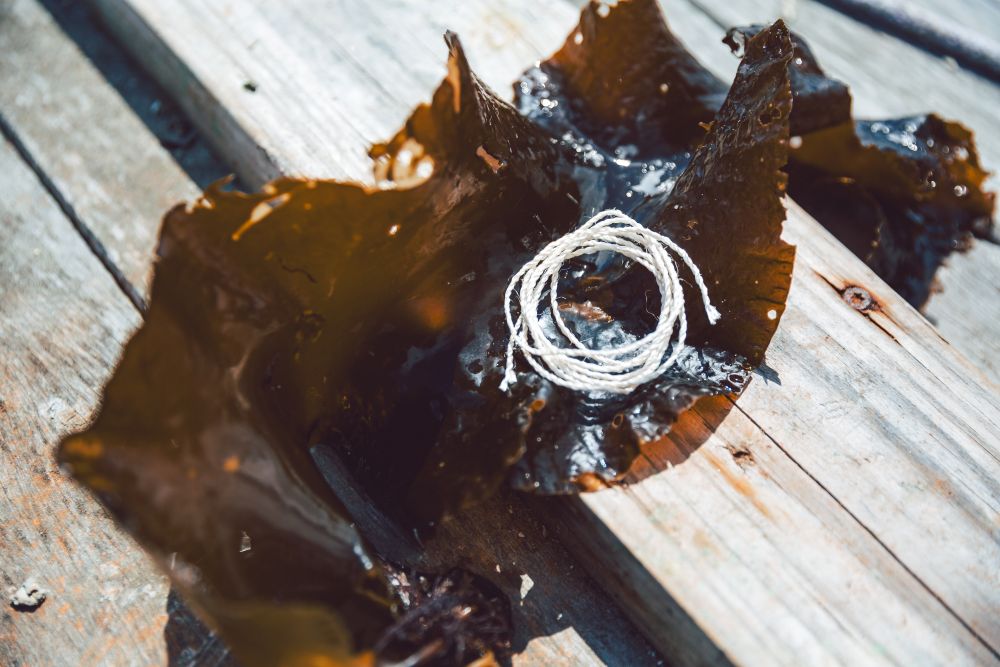
Another one is Katie Weiler, whose company Viable Gear is currently piloting a kelp-derived twine product that has applications in the agriculture and aquaculture industries. Since founding the company in 2021, Weiler has been laying the groundwork for affordable products that can help fishermen and land and sea farmers reduce their plastic usage.
As Weiler and McGovern work to scale up their businesses, they’re coming up against tough questions regarding cost and manufacturing capacity, and how to compete with the plastics industry.
“It’s really important to be price competitive, you can’t be 100 times more,” McGovern said.
She’s optimistic that over time, scaling the industry up will help drive prices down. The challenge, though, is figuring out how to build up manufacturing and processing capacity to accommodate an industry with lots of moving pieces, from growing and harvesting the seaweed to refining it for the inputs that can be used in bioplastic products.
Bill Lenart is a research scientist focused on polymer and data science at Northeastern University’s Roux Institute in Portland. His recent work explores marine polymers — the structures found in seaweed that can mimic plastic — and how different combinations can be refined and applied to real-world materials, like dish detergent pods or fishing gear.
“Right now, you have to build up the entire refining process before you can even start trying to play around with material formulations,” said Lenart. This makes it tricky to experiment with seaweed’s properties in order to get the best-performing product, and then tweak that product to make sure it doesn’t degrade in real-world conditions.
When McGovern started prototyping the seaweed-based films in 2023, she was working in the kitchen with the raw materials, a Kitchen Aid mixer, and an oven. Now that she is part of the founder-in-residence program at the Roux, she’s moved to slightly larger facilities, but is still mostly operating at what’s called the benchtop scale, the step before a pilot.
“A big part of this is it can work at the benchtop scale, but it’s really only gonna be adopted by the masses if you can prove that it can work in machinery that [the industry] already manufactures with,” McGovern said.
Dirigo Sea Farm is working on plugging into those pieces of equipment, which McGovern said is going well so far.
Viable Gear is waiting on a patent for their pilot product, the sea twine, which Weiler said should be able to hit the market at a price point between plastic products and the current alternative natural fiber products, like hemp. In the meantime, Viable Gear has been working with the Maine Organic Farmers and Gardeners Association to test their product during crop growing seasons and collect feedback from farmers.
Weiler said she wants to expand the customer base for Viable Gear’s twine product in order to bring costs down for those in the marine industry, who may want to be plastic-conscious but can’t afford the alternatives.
“We don’t want to come to market at this huge green premium,” Weiler said. “The whole goal is to do the opposite.”