


FARMINGTON — Residents are expected to decide at the May town meeting whether a long-planned project to build a multiuse bridge over the Sandy River will move forward.
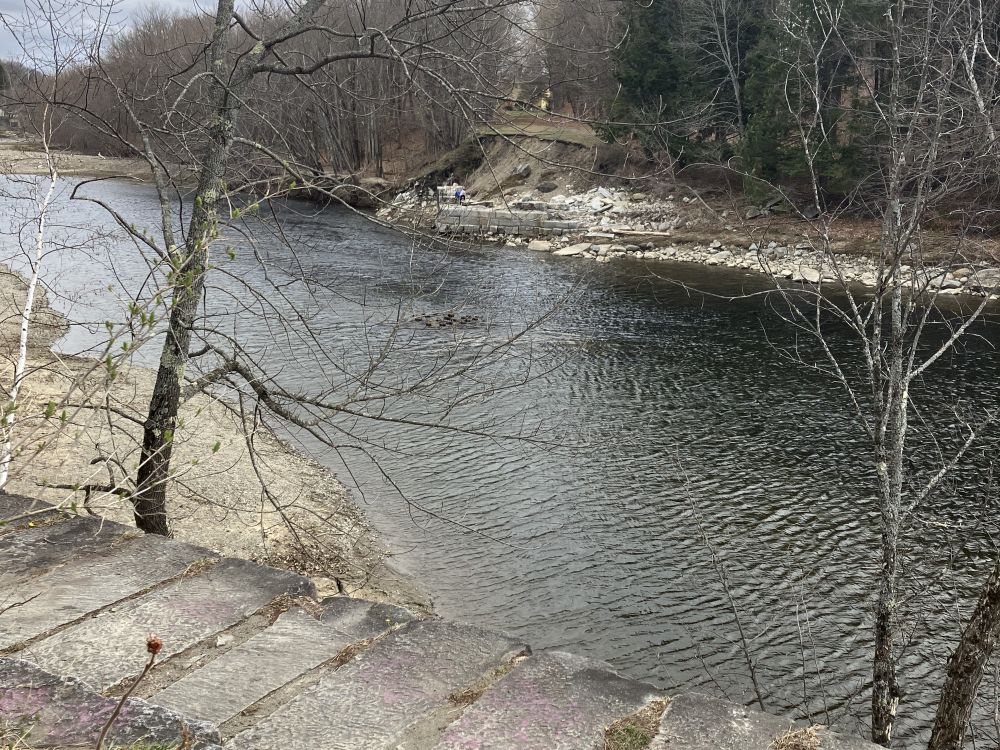
The Farmington Select Board voted unanimously Tuesday to add an article to the May 11 town meeting warrant seeking authorization to borrow up to $500,000 for the $4.2 million project. If voters approve the request, the money would help build a 336‑foot bridge connecting the Prescott Field area to West Farmington.
The bridge would give users of Whistle Stop Trail — a 14‑mile rail trail running from West Farmington to Jay — direct access to downtown. Pedestrians and cyclists can already cross the Sandy River via Center Bridge, but snowmobiles cannot.
A bridge once used by the Androscoggin Railroad provided access at the site, and the abutments on both banks and the center pier remain visible today. The bridge was deemed unsafe in 1999 after Hurricane Floyd damaged it, and it was later removed.
In 2007, the town and state designed a replacement bridge using Bureau of Parks and Lands easements on both sides of the river. The project, then estimated at $1.7 million, stalled in part because of insufficient funding.
The idea continued to draw support. It appeared in the downtown development plan that led to the creation of the Downtown Municipal Tax Increment Financing District in 2013, and again in 2015, when it was added to the comprehensive plan.
In 2021, the High Peaks Alliance, or HPA, began leading a renewed effort to get the bridge built. The largest piece of funding arrived in 2023, when the region’s congressional delegation secured more than $2 million in federal money. At that point, the project’s budget stood at $2.7 million.
HPA has also secured $400,000 in private funding and another $50,000 from local snowmobile clubs. Farmington agreed to contribute $200,000 in tax increment financing funds.
A string of delays has slowed the start of the project. An engineering plan the town obtained early in the process was incorrect, placing the bridge 8 feet lower than it should have been. It then took 14 months to finalize the agreement for the federal funding.
The Sandy River is designated habitat for endangered Atlantic salmon, limiting construction to July 15 through Sept. 30. That short window may force work to stretch over two seasons, increasing costs.
Overall, the estimated price of the bridge has risen by roughly 50 percent since the federal funding was secured.
HPA Executive Director Brent West told the Select Board on April 28 that the state has hired Thornton Tomasetti, a global engineering firm with an office in Portland.
If the town provides the remaining funding, permitting would take place over the winter and the project could go out to bid next spring. If the state accepts a bid in June 2027, construction would finish by November 2029.
The bridge would be owned and maintained by the state. It would be built above the 500‑year floodplain and designed to last 75 years.
The $4.2 million estimate includes a contingency. The actual gap between secured funding and projected cost is $200,000. If the town used the full $500,000 authorization, Farmington would cover roughly 17 percent of the total cost.
West noted that similar projects typically split funding closer to 50-50 between a town and outside sources.
“We look at Farmington as being — we think — a gateway to the high peaks,” West said, noting that the bridge would tie snowmobile, biking and other recreation activities to the downtown. “This is our shot to do this, if this is something we truly want to try.”
Josh Bell, a member of the Downtown TIF Advisory Committee, also voiced support, saying, “For me, it’s a no‑brainer for a 17 percent commitment from the town.”
John Rogers, chair of the HPA board and a snowmobiler from Strong, said riders want to be able to plan a round trip. The bridge would allow snowmobilers coming south through the county to reach downtown to buy food and other necessities.
Without the project, he said, the Sandy River remains a major barrier because snowmobile use on Center Bridge is illegal and unsafe.
“Farmington is going to become a destination place,” Rogers said. “You are the gateway to Franklin County.”
Board members who spoke were generally in favor of the project, though some questioned the economic impact statement, which projected an annual $900,000 boost to the local economy and about 8,000 additional visitors, as overly optimistic.
“I’m definitely in support of it,” board member Scott Landry Jr. said. “I’ve been waiting for it for many years, too many years.”
In response to a question from board member Randall Gauvin, West said all-terrain vehicles would not be prohibited from using the bridge itself, but access issues with nearby landowners could limit their ability to reach it.
The board was unanimous in adding an article to the town meeting warrant to authorize funding. Residents will have the final say at the May 11 meeting. The article asks voters to authorize the board to borrow up to $500,000. At a 4.5 percent interest rate on a 10‑year bond, the total cost would be $631,894.
In other matters, the board unanimously approved using up to $10,000 in TIF funds to match donated money for the annual July 3 fireworks show. Planners hope to put on a roughly 20‑minute display this year, in part to celebrate the 250th anniversary of the signing of the Declaration of Independence.