


When Flock Safety sought to expand its network of surveillance cameras in Maine last year, a York police officer stepped in.
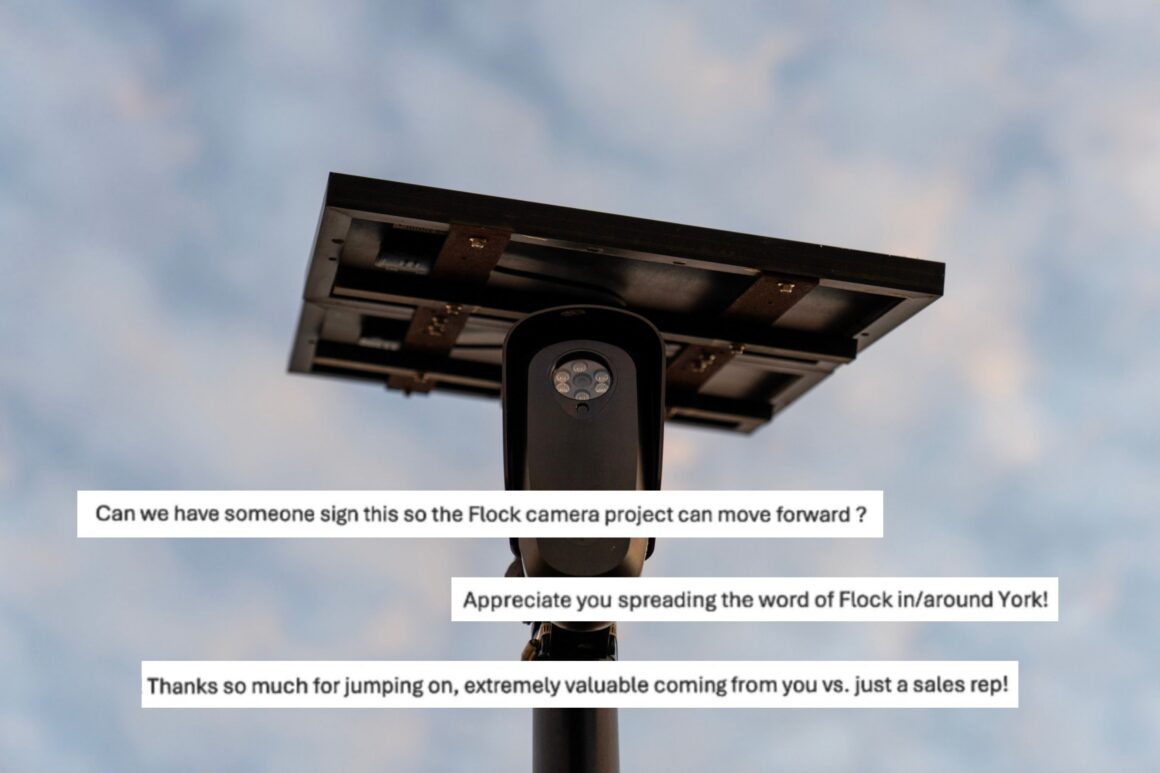
Detective Sergeant Thomas Cryan was invited to meetings between a Flock salesman and police chiefs in Eliot and Sanford. He talked up Flock on a call with the Cumberland County Sheriff’s Office. He told the salesman when Kennebunk’s chief would come back from vacation and lamented that officials were not keen to get cameras up in Kittery.
As Flock worked to install its automatic license plate readers across Maine over the past two years, the company leaned on local police officers like him for help.
Police across the country have been rapidly deploying Flock cameras, automatic license plate readers that use artificial intelligence and massive databases to help cops identify passing cars. As the technology has spread through police departments, so have legal and privacy concerns.
This year, a firehose of stories from across the country about Flock, including examples of cops tracking their exes and the technology leading police to pursue or arrest the wrong people spurred a nationwide backlash.
York police recently announced plans to take down Flock cameras in response to local pushback, joining other towns in Maine that have moved away from the tech. Residents will vote on whether to ban the cameras on Nov. 3.
Emails obtained by The Maine Monitor, along with documents obtained by the American Civil Liberties Union of Maine, offer a behind-the-scenes look at how the cameras got there: revealing how Flock has marketed directly to Maine police and worked alongside them to sell plate readers as public opinion swung rapidly against them.
Representatives for Flock did not respond to requests for comment or written questions. Cryan and other York Police Department officials did not respond to multiple requests for interviews over the past several months.
Flock markets its cameras as powerful public safety tools that give communities control over the data the cameras gather. The company says it has helped locate thousands of missing people and stolen cars, and has oversight tools built in. But civil rights groups like the ACLU have criticized Flock’s technology in Maine and nationally, arguing that automatic license plate data collection is unconstitutional mass surveillance.
“Flock doesn’t do well when people are watching,” said Michael Kebede, the director of Maine’s ACLU chapter. “Flock does well only when they operate in the shadows, and that, of course, is not how public safety is achieved.”
‘If we had those cameras in town’
Flock salespeople have been cultivating relationships with local police officers in Maine since at least early 2024. When salesman Dan DelGrosso began asking for assistance selling to southern Maine towns, Cryan, the sergeant in York, appeared eager to help.
Cryan discussed Flock cameras with at least six other law enforcement agencies in 2025. Most of the jurisdictions he contacted ultimately did not purchase cameras, though one, Wells Police Department, signed an agreement that allowed its officers to get familiar with the tech and view license plate data collected in other towns. Sanford, which Cyran also contacted, approved Flock cameras but ultimately rescinded that approval under public pressure.
Cryan’s outreach didn’t stop with pitches to area police. He connected a salesman with the owner of a local motel, which overlooks a road the police department hoped to monitor. He also helped facilitate a meeting between a Flock sales rep and a former police chief who was then involved with the town’s parks and recreation board. That introduction led the company to make an $11,000 proposal for cameras on Short Sands Beach, though the plan ultimately went nowhere.
At the Freeport Police Department, Flock’s main booster was Detective Beck Rice, who met with a sales manager as early as February 2024, according to documents obtained by the ACLU. Rice did not respond to repeated requests for an interview.
According to an email from a Flock salesman, Rice had said he anticipated Flock would face “some hurdles” from the town council. So the salesman introduced Rice to Flock’s director of municipal engagement. He asked the director to schedule “a couple prep calls” with Rice.
It’s not clear what became of Flock’s pitch in 2024, but the next April, Rice went to the town manager, Sophia Wilson, and asked for a meeting to “educate” council members.
“A majority of my cases require me spending hours collecting video footage and then hours combing through the video footage,” he wrote. “If we had those cameras in town, I would be able to quickly identify my suspect vehicle, which would cut down on further crimes occurring if they are located quickly.”
“Once criminals know we have these cameras, it will deter them from coming into town,” he added.
Wilson replied that the councilors were aware of the benefits Flock could bring to the department but were concerned about data privacy. She suggested trying again after addressing the council’s privacy concerns.
Nearly a year after Freeport rejected Rice’s plea for Flock funding, the company offered cameras for free.
In February 2026, resistance to Flock was emerging nationwide. DelGrosso, the salesperson who had cultivated a relationship with Cryan in York, invited Rice to a video call. He offered to enroll Freeport in “Project Prove It,” which would allow its police department full use of Flock cameras for one or two months as a free trial, with no commitment.
Free trials and bundling deals are common in police technology sales nationwide and can allow controversial tech to get a foothold in communities without requiring approval from elected officials. The strategy has already been used in Maine towns testing out AI-powered police reports.
Flock has used the strategy in many places, though most Maine towns appear not to have been offered such free trials. Company salespeople bought police officers lunch and invited them to Flock’s annual conference in Georgia. At least one, Deputy Chief Jeff Pardue of Falmouth, attended that conference in 2025; taxpayers footed the bill for his lodging and flights.
Freeport did not ultimately accept the offer of free cameras, though the strategy has worked outside Maine. Texas Christian University criminology professor Johnny Nhan said users say Flock is “like Costco or drug dealers.”
“They’ll give you a free sample, some free cameras, and then you get kind of hooked on it,” Nhan said. “Once they get that, then it’s contract time.”
‘I’m not here to promote’
Across the country, Flock has coached police on how to sell its cameras to an increasingly skeptical public and sometimes sells its tech alongside officers. In Wells, DelGrosso was joined by then-Police Chief Jo-Ann Putnam and another police officer to pitch Flock to the select board in August 2025.
“If you want to solve crime, you gotta go with the wave of the future,” Putnam told the board.
When a select board member raised privacy concerns, Wells Town Manager Michael Pardue, a former police chief who had been in touch with DelGrosso for weeks, jumped in to defend Flock.
“The expectation of privacy is nil if we’re not looking at people,” he said while DelGrosso nodded. “I’m not here to promote one way or the other. I’m very interested of the concerns of the public … but I am comforted by the fact we’re on camera all the time now, anyway. Everyone knows, if you’ve got a cell phone in your pocket, we know where you are.”
The team had come prepared for the select board’s scrutiny. DelGrosso had invited Michael Pardue, Putnam and other police officers to a virtual “presentation review” meeting the week prior.
The town manager told The Monitor it’s not unusual to meet with vendors ahead of a presentation to the select board. Putnam, now retired, could not be reached for comment.
“Oftentimes it’s important to me to know what it’s about and some of the intricacies so that, if I’m asked questions, I’m not blind to what the topic is,” Michael Pardue said in an interview. He said he wasn’t a stalwart supporter of Flock cameras, but he wanted town leadership to evaluate how the new technology could help.
With multiple members expressing skepticism, the board decided to discuss the tech further at a future workshop. But it would never be scheduled, despite prodding from DelGrosso.
‘Get ahead of the big brother is watching us portion’
Taige Foley loved vacationing in Ogunquit, he told the resort town’s police chief, John Lizanecz, in a June 2024 introduction email. The salesman said he was visiting soon and wanted to buy the department lunch.
By the next summer, DelGrosso had taken over the Ogunquit account. He’d discussed sensible locations for a pair of cameras as an “initial deployment” and sent over a contract for Lizanecz to sign.
Talks hit a sticking point that July. Two cameras with a traffic analytics package would cost Ogunquit $8,200. Lizanecz explained that any expenditure over $5,000 would require town manager Matthew Buttrick’s approval. DelGrosso suggested a shortcut.
“I can split the cameras into two different contracts so that both items are less than $5,000, which could bypass the [Town Manager’s] approval,” he said.
Lizanecz thanked him. “I did think of that, but overall, it’s up to him as he approves these no matter what,” he said.
In any case, DelGrosso’s window of opportunity in Ogunquit closed quickly. Within days, Lizanecz informed him that there would likely be protests against the rollout and asked for advice.
“We are ok with funding but just want to get ahead of the big brother is watching us portion,” he wrote to DelGrosso.
The salesman was under pressure to get Ogunquit’s contract signed.
DelGrosso explained that “leadership eyes” were on him after he sent out the contract, and he pushed hard for a signature by the end of the month. Lizanecz appears to have stopped replying as that deadline approached.
On July 30, the town manager sent Lizanecz a memo outlining why he would decline to authorize a contract with Flock over concerns about privacy, data retention and public trust.
“Given the State of Maine’s well-documented hesitancy to allow speed enforcement cameras, stop sign cameras, and its statutory limitations on the use of police-mounted ALPRs, I believe Maine may be among the first to enact state-level restrictions, or outright bans, on this form of surveillance,” he predicted.
Changes coming?
Across the state, Flock cameras are going offline. South Portland pulled its cameras in June. Falmouth said it removed its Flock cameras at the summer’s end.
As public angst over Flock builds, the company is pivoting. In marketing emails received by Wells officials in August 2026, Flock recommended just seven days of data retention, as opposed to the 21-day legal maximum followed in Maine towns. The company is also rolling out an “audit assistance” tool that flags unusual usage of Flock and will require case codes for all searches by police by the end of the year.
“These changes reflect years of work and deliberation,” said the email, signed by Flock’s CEO Garrett Langley. “They are not the end of that work, but simply the continuation of our commitment to both safety and privacy. We are not perfect, so we will keep listening, improving, and building a better standard for public safety technology together.”
In Falmouth, police requested that Flock take down its four cameras at the summer’s end. The department had decided instead to use readers from a competitor, Axon.
Jeff Pardue, deputy chief of the Falmouth Police Department, said that police had found the readers helpful but were not using the system to search for plates in other jurisdictions, one of Flock’s main selling points. In July, the town signed a 10-year contract for Axon to place its own cameras in the same four locations.
Jeff Pardue said that under the department’s policies and new contract, Falmouth’s camera data will not be shared as part of a database.
“We have supervisors who have their hands on the wheel,” he said. “We are making sure that we do not violate the trust that the public has put in us.”
Axon is familiar to many Maine police departments: The company manufactures Tasers and body cameras. Motorola also has automated license plate readers in Maine; Hancock County activated 13 of them in August.
In York, a “yes” vote on Nov. 3’s “Stop ALPRs” referendum would make it difficult for any of these companies to get a plate reader back up in town. The ordinance language would require any future readers to be approved by town residents.
Broader regulation may be coming soon. State Rep. David Boyer, a Republican of Poland, is aiming to introduce a broad ban on automatic license plate readers in the next legislative session. With conservative and liberal parts of the state alike pushing against the tech, the bill is likely to gain support in Augusta.
Maine’s ACLU has worked with Boyer and with activists in York to limit surveillance. Kebede, the chapter’s director, said the broad discontent over Flock is an unusual point of unity in American politics.
“People generally don’t want to live in a police state,” he said. “People generally don’t want to live in a tech dystopia, but that’s where Flock and companies like Flock want to take us. And whenever people learn about that, they want to stop it.”