


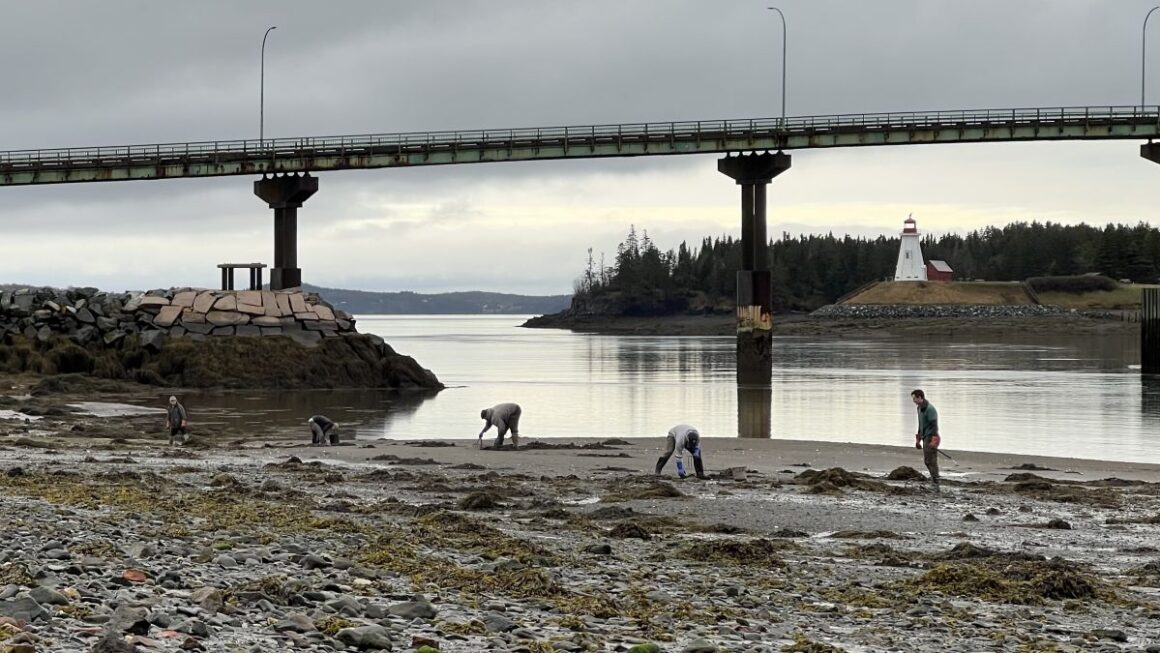
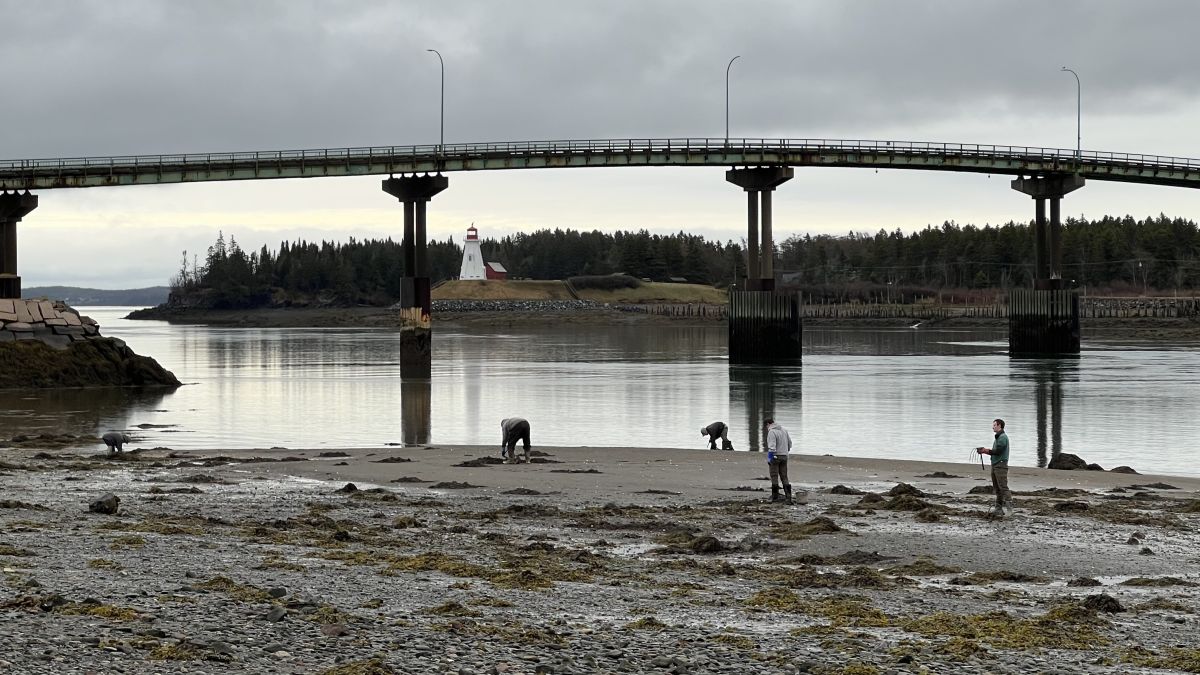
LUBEC — On a cool, overcast Thursday morning, a little before low tide, more than a dozen clam harvesters and Russell Wright, Lubec’s shellfish warden, gathered on the Narrows flats to collect juvenile clams as part of an effort to maintain the local population.
The juvenile clams collected that day were later planted on the Pirates Creek flats, which are expected to remain closed to harvesting until Dec. 1 to protect them as they mature.
The effort was part of the Lubec Shellfish Committee’s two‑pronged approach to clam conservation, which the committee discussed at its May 4 meeting: moving juvenile clams from one flat to another and planting nursery‑grown clam seed.
While harvesters sometimes refer to juveniles as “seed clams,” scientists use the term only for the tiny, nursery‑raised clams that measure one‑sixteenth of an inch or less. Juvenile clams, by contrast, are large enough to rake but still under the 2‑inch market size. Moving these juveniles is already a long‑standing local practice.
Both approaches have advantages and disadvantages. One advantage of moving juvenile clams is that it is more affordable and simpler than sowing clam seed, and it does not require special training or equipment. It does, however, require closing the destination flat for at least six months to give the juvenile clams time to mature.
The purchase and sowing of clam seed is comparatively expensive. Not only are there supplies to buy, including the seed itself and the protective netting secured over the top of the seed bed, but there are also labor costs, since the committee must hire an expert to do the planting.
In his presentation to the Shellfish Committee in February, Kyle Pepperman, executive director of the Downeast Institute, or DEI, in Beals, said harvesters who attend a DEI‑run seeding operation will come away with the skills needed to do their own seeding next time, giving them a chance to save money on this method going forward.
The seed beds that DEI recommends building require permitting from the U.S. Army Corps of Engineers. They also need to be monitored for predators and cleaned of sediment and algae, and there is a risk that netting will be uprooted if currents in the location are too strong. In some locations, depending on whether an area ices up in the winter, nets must also be taken in before the freeze.
While this method is more involved and expensive, the destination flat does not need to be closed for a clam seed program, and it comes with a potentially higher success rate, according to Pepperman, though he cautioned that it might take five years to see harvestable results.
Pepperman is expected to be in the area June 10 to plant seed clams starting at 10:30 a.m. at the Lawrence Factory flat in North Lubec, and then move on to install seed plots in the Globe Cove and Klondike flats.
At its meeting May 4, the first full session with Jennifer Brodie as chair, the Shellfish Committee finalized its proposal for a rotational closure of the Mowry Beach flats and set the timeline for this year’s out‑of‑town license lottery.
The Mowry Beach/South Lubec flats will be divided into two sections, one on either side of Woodward Point. Mowry Beach, the northern half of the new flats, is scheduled to be open from June 21 to Oct. 21, a month longer than last year.
The southern section, from Woodward Point to the former U.S. Coast Guard station, is set to be closed during the same period. Brodie said harvesters, the Maine Department of Marine Resources and the shellfish warden will keep an eye on Mowry throughout the season and will close the beach if it appears to be overharvested.
The committee also reported that 61 commercial clam harvesting licenses have been sold. With five licenses grandfathered to dedicated out‑of‑town harvesters, that means two out‑of‑town commercial licenses will be made available by lottery.
Applications are expected to be available Monday, June 8. Completed applications are due June 15, and the drawing is set for Thursday, June 25, at 10 a.m.
A nonresident clamming license costs $450.