


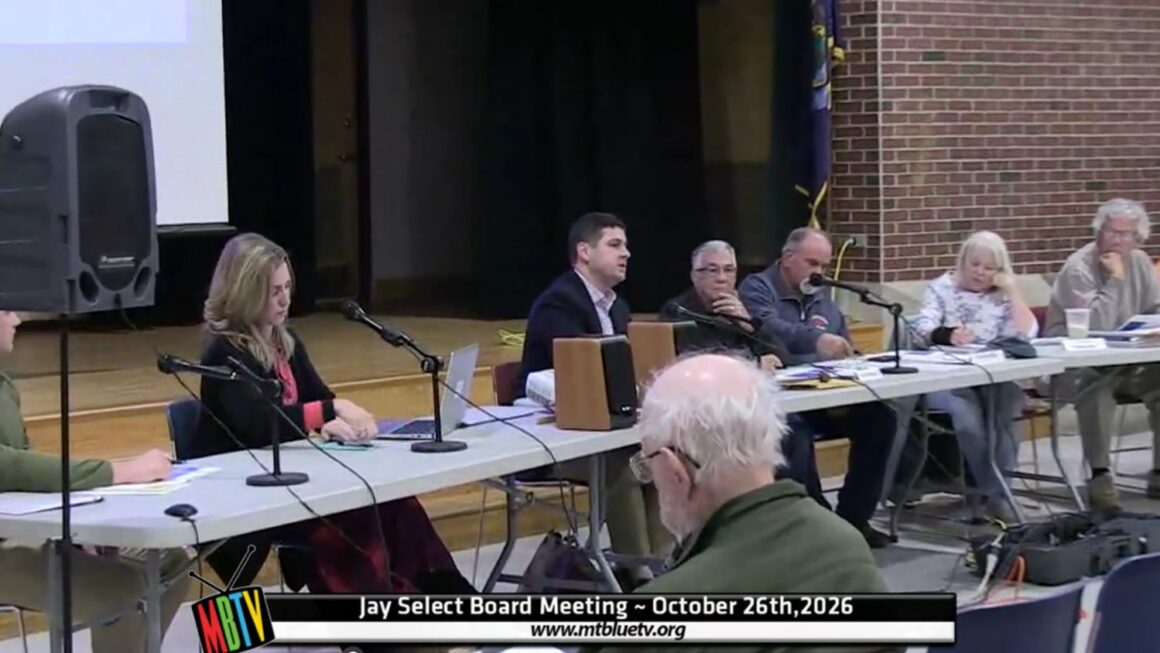
JAY — The Jay Select Board learned at an Oct. 26 workshop that financing a major solar energy development would require a tax increment financing agreement between the town and Walden Renewables, with limited state oversight.
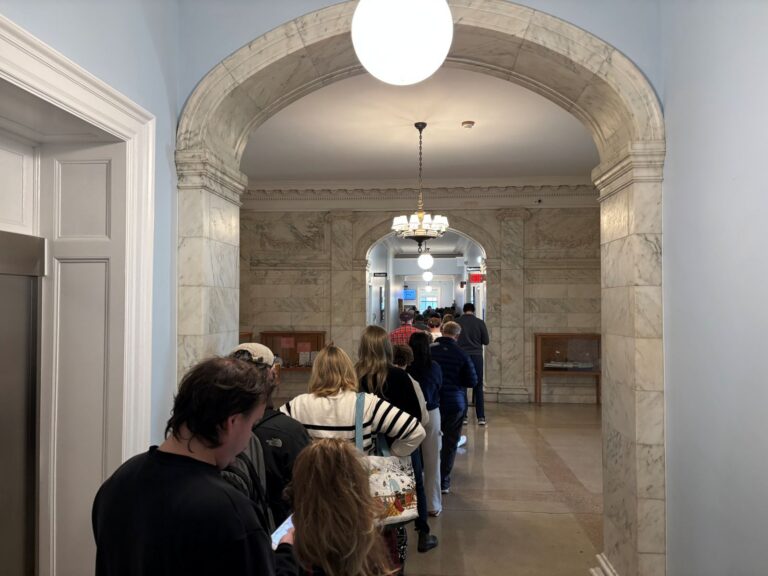
Alyssa Tibbetts of Tibbetts Law in Scarborough, representing Walden Renewables, told the board and 25 people at the workshop that establishing tax increment financing, or a TIF, involves “a considerable amount of process.”
Walden Renewables is the company hoping to develop a 150-megawatt solar farm on six sites in Jay. The sites could cover up to 1,600 acres, with solar panels on 900 acres. Walden has said it would seek a TIF to develop the project. The company originally proposed a farm of 2,500 acres.
Dale Knapp, Walden’s head of development in New England, told the board Sept. 14 that the size of the proposed farm will “probably get chopped in half again.”
The Oct. 26 workshop dealt only with tax increment financing. A second workshop set for Nov. 9 will cover the environmental effects of the project, featuring a speaker from the Maine Department of Environmental Protection.
Officials have not yet set the time and place for that meeting. Before then, voters will decide the fate of a proposed 180-day moratorium on solar development during the Nov. 3 referendum.
The Maine Department of Economic and Community Development, or DECD, which reviews all TIF agreements, defines a TIF as “a flexible finance tool used by municipalities … to leverage new property taxes generated by a specific project … within a defined geographic district.”
Under a TIF, new tax revenue “may be used to finance public or private projects for a(n) … allowable period of time,” which usually spans 20 to 30 years.
Those taxes flow into a dedicated TIF fund — separate from the town’s annual operating budget — to pay for project development and retire bonds or other debt used to finance the project. Upfront public financing makes TIFs a common draw for developers.
Local government handles most of the work. According to DECD, a TIF “is locally driven. The municipality … defines the district size, determines the amount of new taxes to be captured (set aside for designated uses), identifies allowable public and private projects along with the term, with the whole proposal requiring local political approval.”
In her presentation, Tibbetts laid out a five-step process, with the first four steps relying heavily on local government involvement.
The first step is to “identify and designate a district within a municipality,” she said, to establish where the TIF will apply.
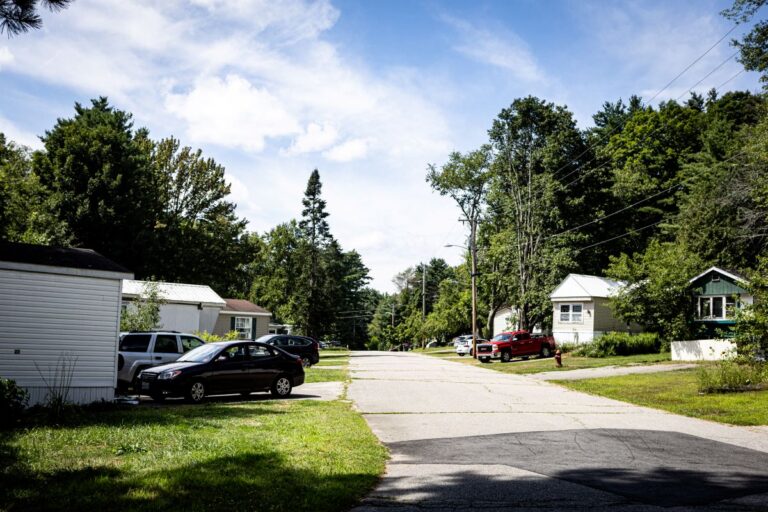
The Jay district could include the six sites Walden identified. The four largest sit along Main Street (Routes 4 and 17) on the north slope of Jay Hill, along Canton Mountain Road near the Canton town line, astride Alden Hill Road at the former Androscoggin Mill, and along Spruce Mountain Road at the mill site. Two smaller sites lie north of the Canton Mountain Road location and between the two mill sites.
Phil Saucier, a lawyer with Bernstein Shur representing the town, said a single TIF district cannot occupy more than 2 percent of a town’s land area. Total TIF districts combined cannot exceed 5 percent of a town’s acreage or 5 percent of its assessed property valuation.
Nate Colannino, a developer for Walden, said the current plan calls for placing solar panels on 900 acres. Because Jay covers 49.2 square miles, 2 percent of the town’s land area equals 630 acres. As a result, Walden and the town would need at least two TIF districts to cover the project.
The second step requires creating a development program, Tibbetts said. That plan would outline allowable uses for the captured incremental tax revenue. Saucier offered examples of municipal infrastructure, such as constructing a town hall or building recreational trails.
Responding to a question from Selectwoman Lee Ann Dalessandro, Tibbetts said Jay could use TIF funds to hire a full-time economic developer to pursue new projects and help rebuild the local economy following the closure of the town’s two paper mills.
With the development plan in hand, the board would conduct a public hearing as the third step, Tibbetts said.
After the public hearing comes step four.
“Ultimately,” Tibbetts said, “it needs to be approved by the legislative body, and that would be the town meeting.”
The final step requires state oversight.
“Applications have to be reviewed by the state, by the Department of Economic and Community Development,” she said. “Although these are local projects, the state has oversight to ensure that the (project) is consistent with state statute.”
Jay conducts its town meetings by referendum.
DECD does not participate in planning the development; like a local planning board, the agency only verifies that a proposal meets state TIF criteria.
Town Manager Shiloh LaFreniere described the expected process to the board Oct. 13.
“Typically, what would happen,” she said, “is the tax assessor, myself and the town attorney would sit down with two of the board members and Walden … go through it all, find out the details and how it would benefit the town.”
In its regular meeting following the 59-minute hearing, the board unanimously accepted a $20,441 grant from the Maine Bureau of Highway Safety. The town is expected to direct $9,331 toward curbing impaired driving and $11,110 toward “speed and aggressive driving enforcement.” The grant requires no municipal match.
Police Chief Joseph Sage told the board the money must cover staff members’ hourly pay and be spent by Sept. 15, 2027.
“That’s not any problem,” he said, adding that Jay has received the grant before “and it has helped.”
The board also voted unanimously to designate Jay resident Kathleen Casper Reed as its real estate representative. Reed, a licensed Maine real estate agent with The Maine Real Estate Experience of Auburn, holds a master’s degree in education and a law degree.
Jay has agreed to pay 3 percent of the gross sale price for any town property Reed sells.
Under recent legislation, municipalities selling property for unpaid taxes may keep only the back taxes, liens and court costs, with the remaining proceeds going to the former owner.
LaFreniere also reminded the board that absentee ballots must be returned by 8 p.m. Nov. 3. The deadline to request or pick up an absentee ballot is Oct. 29. The U.S. Postal Service recommended mailing ballots by Oct. 27 to ensure timely arrival.