


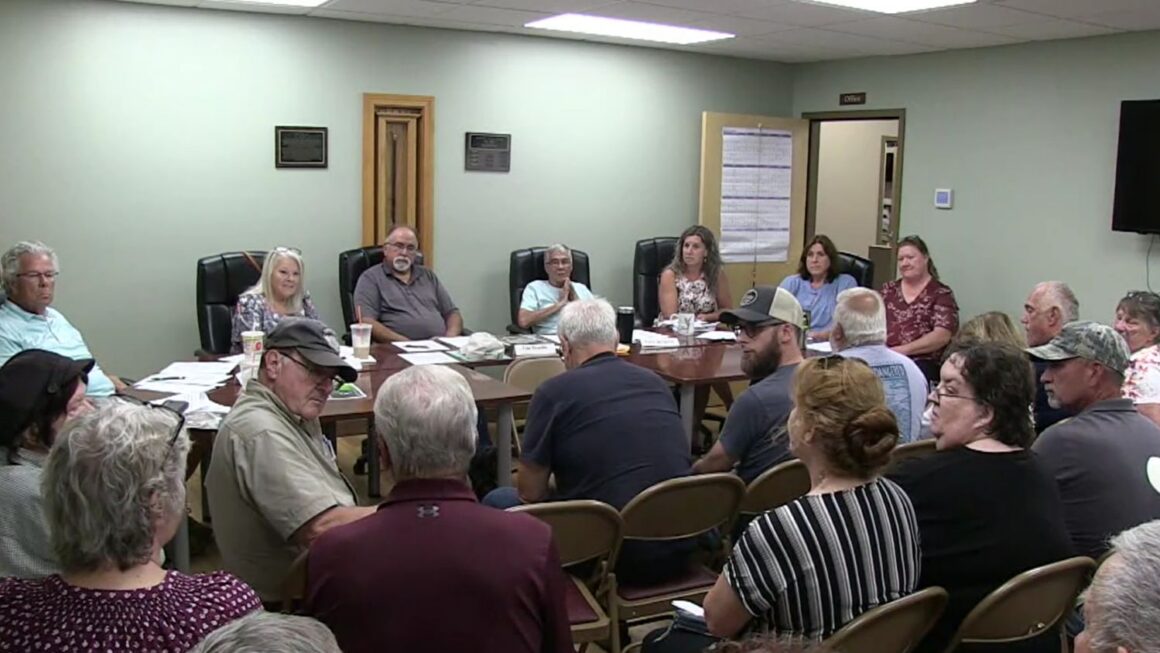
JAY — Residents filled a Jay Select Board meeting Monday night to raise the first public opposition to what could become Maine’s largest solar farm.
Those who spoke generally urged caution about developing a large solar farm, but no one asked the board to take specific action.
Two speakers suggested imposing a moratorium on solar development while the town studies potential impacts.
One speaker said a moratorium petition is already in the works.
On Feb. 9, Walden Renewables of Portland presented an outline for a solar operation across several sites in Jay, including part of the former Androscoggin Mill property.
Dale Knapp, head of development in New England for Walden Renewables, said most of the land would be leased, and some might be owned by Walden.
For its Jay project, Walden is operating as Perennial Jay Solar LLC of Hallowell. The company also runs solar farms in Leeds and Wells in Maine and in Antrim and Farmington in New Hampshire.
At the start of Monday’s meeting, 37 people crowded into the meeting room, which has 34 chairs. Most arrived with questions or concerns about the proposed solar farm.
Clint Brooks of Belmont Drive urged the town to move slowly.
“There are not a lot of do-overs in life,” he said.
Brooks told the board and audience that years ago, spreading sludge from Jay’s paper mills onto farmland was considered an environmentally sound way to handle mill waste. Then, he said, Maine learned about PFAS — per‑ and polyfluoroalkyl substances, often called “forever chemicals.”
Now, hundreds of acres of Maine farmland are contaminated with PFAS because no one understood the consequences of sludge spreading, he said.
“Let’s not be guilty of not knowing the downside about solar panels,” Brooks said.
Brooks has long been active in civic affairs in Jay. He served 12 years on the Jay School Committee and the Regional School Unit 73 board of directors, and previously owned and operated The Beef Barn at Bean’s Corner.
He said he is working on a moratorium petition.
Town Manager Shiloh LaFreniere said she would determine the timeline for placing such a measure on the ballot for the Nov. 3 election.
Most of the opposition focused on two areas: how the land would be restored after a solar farm shuts down, and plans for an array on about 140 acres on Jay Hill, where the Jay Hill Drive-In Theatre operated from 1953 through 1977.
Knapp said the company’s plan to install more than 20 acres of solar panels places the project under strict and detailed state regulation. Smaller solar farms are regulated only at the town level.
Walden is evaluating about 2,500 acres in Jay for potential installation of solar panels on 800 to 900 acres. It is conducting site reviews to determine which leased tracts are usable. The entire project could take three to four years, Knapp told the Select Board in February.
He said the arrays in Jay could generate up to 150 megawatts, roughly the amount once produced by the former Androscoggin Mill. That output could power 30,000 to 100,000 homes, Monitor Local reported Feb. 14.
“Our kids and grandkids are going to have to clean this up when the panels are done,” a woman in the audience said.
Knapp said state regulations require that “when the farm is done, the company takes it away.” He said developers must include their decommissioning plan in the proposal before the project can begin.
He added that solar panel efficiency declines by about 0.5 to 1 percent a year, meaning panels typically remain useful for 25 to 40 years. Many can be reused for projects that require less power once their primary lifespan ends.
The old Jay Hill Drive‑In Theatre site is west of Main Street on the north slope of Jay Hill. Some residents of Belmont Drive were notified by an engineering company that the site was under consideration because their properties fall within 1,000 feet of it.
Much of the land is wooded and would need to be clear‑cut for the solar farm, Knapp said.
Brooks said his father used to graze 30 head of beef cattle on that hill.
“If you asked anyone on Jay Hill, ‘Would (you) rather have solar panels or beef cattle on that hill?’ they’d say, ‘Beef cattle,’” Brooks said.
But Darryl Couture, who favors the solar development, said, “My wife’s family paid taxes on that property for 50 years, since the drive-in closed. Should we hang on to it and get nothing out of it?”
Couture added, “No one objected to clear-cutting to feed the (paper) mills. But the mills are gone.”
Couture said after the meeting that he and his wife have added a small parcel to the drive-in acreage and have signed a 30-year lease with Walden Renewables for the solar project.
Before leaving the meeting to go to work, Brooks said, “I hope we can reach a compromise.”
Knapp said Perennial Jay Solar would continue to update the Select Board and would hold public meetings to discuss the project.
“We want to be transparent,” he said.
In other matters, the Select Board approved using up to $70,000 from the joint reserve account to modify two tanks that hold sludge at the sewer plant. The tanks need better aeration to forestall sludge buildup between cleanouts.
Sewer Superintendent Mark Holt said one of the tanks could be modified this fall and the other during the winter. Each project would require blocking out a time period because the installation cannot be paused and resumed partway through.
The board voted 4‑0 to transfer the money. Selectman Gary McGrane had stepped out of the meeting briefly when the vote was taken.
The board also moved $9,500 from the joint reserve account to replace a switch on a device that monitors flow and alerts sewer crews when heavy runoff might overflow the tanks. The vote was 5‑0.
Holt told the Select Board he is seeking proposals for a propane furnace for the plant. The oil furnace needs about $10,000 in repairs, so the time may be right to replace it with a propane unit.
Holt said he would report his findings to the board at its meeting Aug. 24. He said a propane burner could save the town about $13,000 a year.
LaFreniere said the town has locked in a propane price of $1.689 per gallon with Superior Plus Propane, formerly known as Downeast Energy, for three years.
This story was updated August 12 to add additional context and comments from Darryl Couture.