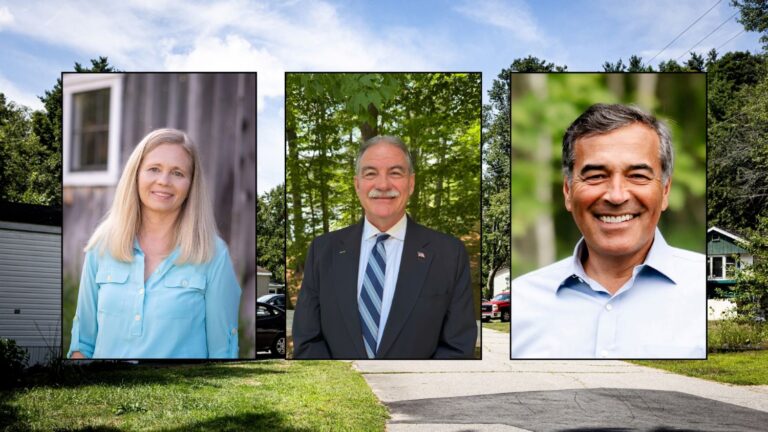




LUBEC — The Lubec Board of Selectmen is moving forward with a plan to ask land trusts and other nonprofit landowners to make voluntary contributions to help offset lost property tax revenue.
The board discussed the issue at last week’s meeting as part of a broader conversation about how tax‑exempt properties affect the town’s tax base.
Selectman Dan Daley noted that some nonprofits already contribute to the town’s finances and infrastructure.
He pointed to Maine Coast Heritage Trust’s construction of the boat ramp at Bailey’s Mistake and the support the organization provided to the town of Whiting in repairing its dam.
“This is not to cast (nonprofits and land trusts) in a dark light,” Daley said, “but we’re squeezing out people in Lubec that have been here for generations, and it’s irresponsible of us not to address it.”
The board estimated that the town is forgoing about $800,000 in property taxes each year because of various exemptions and easements. The estimate is based on a report prepared by Marc Perry, the town’s tax assessor.
The properties in Perry’s analysis include “open spaces,” which state tax code defines as land used for parks for public benefit, scenic resources, game management and wildlife habitat. Open spaces can qualify for an easement of up to 95 percent, depending on the public benefit and level of protection it provides.
Perry also included in his analysis land set aside for tree growth and conservation, as well as fully tax‑exempt properties owned by Lubec’s churches, the health center, the American Legion, the state of Maine, the federal government and the town itself.
Under state law, land trusts have been categorically exempt from paying property taxes since a 2014 Maine Supreme Judicial Court decision that found they qualify as “benevolent and charitable institutions” providing public benefit.
Some land trusts with property in Lubec, like Downeast Coastal Conservancy, Maine Coast Heritage Trust, or MCHT, and The Nature Conservancy, nevertheless choose to keep their property designated as “open spaces,” and therefore taxable, as a way of giving back to the town.
According to Perry’s report, Cobscook Shores is the only land trust in Lubec that does not do this.
Cobscook Shores does have one property designated as “open space,” but Perry said he suspects this is only because it is a recent purchase and the company has not yet had time to apply for a full exemption.
MCHT pushed back on the implication that it does not contribute.
Amanda Devine, MCHT’s senior director of stewardship, said she recognizes the seriousness of the concerns being raised but was “a little surprised” to read about the Board of Selectmen’s discussion, noting that MCHT pays taxes under the open‑space category and has a long history of collaborating with the town.
Aside from the boat launch mentioned by Daley, MCHT has helped the town write grants and provided matching funds for the Safe Harbor project, and contributed $15,000 in 2015 toward communications equipment for Lubec’s marine safety program.
MCHT also contracts locally for construction and for maintenance of roads, parking areas, and trail systems.
“Our payments in lieu of taxes are often greater than what we would pay” in property taxes, Devine said, adding that the organization tries to be a good “citizen” in the communities where it owns land.
She said MCHT keeps its land in the open spaces designation because the town made it clear that it did not want the organization to be tax‑exempt. Devine noted that these same conversations have been happening in Maine — and in Lubec — for a long time.
She pointed to a 1994 story in The Quoddy Tides — “Maine Coast Heritage Trust tax reduction stirs controversy” — that dates to one of MCHT’s first purchases in Lubec, the Boot Head Preserve.
Another Quoddy Tides story on land trusts’ tax contributions appeared in 2019 under the headline “Local officials concerned about conserved land’s impact on taxes.”
Devine said MCHT only moves to acquire land when it believes there is community support for a project, and keeping places available to locals — whether for recreation or for work — is a top priority.
“Access to natural resources for working people” is central to MCHT’s mission in Maine, she said. “We try to walk the walk of community‑centered conservation.”
Perry’s report shows that, aside from property owned by Lubec and the state, the largest property owner in town is Cobscook Shores.
The company holds 24 properties totaling 36,500 feet of waterfront and nearly 600 acres. Perry estimated that the holdings cost the town nearly $70,000 in revenue compared with what the land might generate if it were privately owned and taxed as waterfront.
Cobscook Shores did not respond to a request for comment.
The benefits these nonprofit holdings provide to their communities can be difficult to quantify. The Board of Selectmen expressed interest in finding out how much tourist traffic the trail systems might generate, but there is also the value to local residents of having places set aside for recreation and working‑waterfront access — benefits for which it is nearly impossible to assign a dollar figure.
There is also local employment to consider. Cobscook Shores uses both local contractors and out‑of‑town crews to build and maintain its trail system in Washington County.
The discussion also touched on broader statewide debates over nonprofit taxation.
Payments in lieu of taxes, or PILOTs, have often come up as Maine towns and cities of all sizes struggle to make ends meet. In 2021, state Rep. Will Tuell, R‑East Machias, proposed a bill that would have allowed municipalities to charge fees to nonprofit landowners on a case‑by‑case basis with voter approval. Tuell’s measure failed to pass, but towns can still ask for voluntary contributions.
The board and audience members discussed using outstanding property tax bills as a measure of how residents are managing their tax obligations.
Last year, The Maine Monitor published an analysis of the Maine towns and cities most burdened by property taxes, comparing municipalities’ median property tax bills with their median income.
Lubec ranked on the higher end for Washington County, with about 4.2 percent of a typical homeowner’s income going to property taxes. That compares with roughly 2.9 percent in Eastport and Cutler.
Dennysville and Beals appeared to be the hardest hit in the county, each at about 5.7 percent.
The board voted to write a letter to land trusts and nonprofit landowners asking them to make voluntary contributions. Board of Selectmen Chair Carol Dennison and Daley offered to bring a draft to the next meeting, scheduled for April 8 at the Town Office.
The board again discussed the future of the red house near the historical society, reviewing six bids that Town Administrator Suzette Francis gathered for the roof repair. The board voted to contract with Lubec‑based Redbeard’s Roofing N’ Carpentry for $14,773. The cost will be covered by the town’s maintenance fund.
That decision led to a brief discussion about whether the town could favor local contractors over out‑of‑town businesses. Selectman Mark Kelley, who previously served on the Rockport Select Board, said he had heard of towns adopting policies that allow a locally owned business to be favored if its bid comes within 5 percent of the lowest offer.
The town purchased the red house at 123 Main St. with $300,000 in federal funding as part of the Safe Harbor project. The town bought the property primarily for the land, which will be used to stage construction equipment, though the building could eventually serve as an office for the marine patrol.
The town could also choose to rent or sell the building. Dennison said federal funding rules mean those options will not be available until the Safe Harbor project is complete.
Disclosure: Freelance writer Ethan Bien is employed by Bear & Owl Tree Care, which is a contractor for Cobscook Shores.