


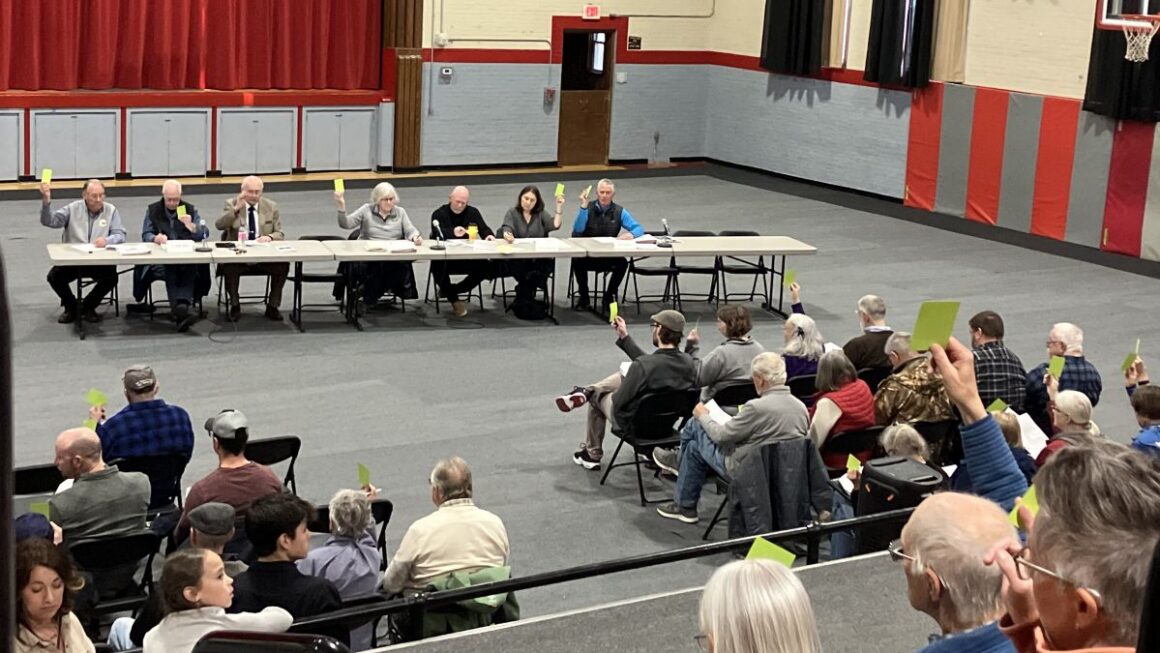
FARMINGTON — The Select Board voted unanimously Tuesday to place a proposed mobile home park rent stabilization ordinance on the Nov. 3 ballot after residents submitted a citizen petition.
As discussed in July, the eight-page ordinance would allow landlords to raise lot rents once a year, capping increases at 3 percent for occupied lots and 5 percent for vacant lots.
Larger increases would require park owners to petition a new Rent Stabilization Board and prove the hike is “extraordinary, necessary, reasonable and not due to deferred maintenance.”
To justify a higher increase, park owners would have to present three years of rental income and operating expense data, along with a list of capital improvements made in the past five years. Violators would face a $100 daily penalty.
Vice Chair Richard Morton ran Tuesday’s meeting in Chair Matthew Smith’s absence. He said the board’s discussion was limited to whether the ordinance should appear on the Nov. 3 ballot, not its merits.
Supporters at the July meeting said the ordinance would give mobile home owners who lease their lots protection from rising rents.
Park owners argued it would discourage local investment and impose overly burdensome reporting requirements.
Town officials, who did not bring the petition forward, questioned how the town would support a Rent Stabilization Board.
Town Manager Erica LaCroix said Tuesday that the board’s vote to place the proposed ordinance on the ballot was a formality.
“Now that the petition has been submitted with the required signatures, which have been validated by the clerk, this is a formality,” LaCroix said. “We can’t actually deny it.”
Town Clerk Diane Dunham wrote in a memorandum that she received a petition with 362 signatures from registered voters — more than needed to put the ordinance before residents.
State law allows petitioners to request a vote either at a town meeting or by secret ballot.
Supporters of the Municipal Lot Rent Stabilization Ordinance chose the secret ballot option, meaning the Nov. 3 election is expected to include a question asking voters whether they want to enact the ordinance.
LaCroix said the town could face legal challenges whether it moved forward with a November vote or not. The Manufactured Housing Association of Maine, or MHAM, which opposes sending the ordinance to voters on Nov. 3, has a lawsuit prepared.
MHAM Executive Director Julie Smith said the nonprofit, which represents manufactured housing communities and related businesses, believes Farmington does not need to place the petitioned ordinance on the ballot.
She said MHAM identified two issues with the ordinance’s inclusion. First, the group contends organizers did not present a copy of the ordinance to at least some residents who signed the petition. Smith submitted a sworn affidavit from a voter who said they were not shown the ordinance.
Smith also argued that MHAM’s lawyer believes the board has discretion to reject a petition if the proposed action is illegal, citing case law from other Maine towns. She said the ordinance contains constitutional and other legal problems and exceeds the town’s municipal authority.
“Maine precedent recognizes circumstances in which municipal officials may examine more than the mathematical number of signatures before advancing a petition,” Smith said, reading from a prepared statement. “The legal sufficiency of the petition and the legality of the requested municipal action can matter.”
LaCroix said elements of the proposed ordinance conflict with some town policies, including committee residency requirements, and with legal norms such as a retroactive start date of July 14, 2026. But she said the ordinance is not “illegal.”
“There is nothing illegal in the ordinance that’s being put forward,” LaCroix said. “So we can’t deny it on those grounds.”
Lorri Nandrea, a field organizer with the Maine Labor Climate Council, a coalition of labor unions that supports organizing mobile home park residents, pushed back on Smith’s allegations that the petition process was flawed.
“This process had 100 percent integrity. The ordinance was stapled to every petition with the signature pages,” Nandrea said. “I hope you will respect (the signers’) will and let the voters of Farmington decide on this ordinance.”
LaCroix said the board should follow the advice of the town’s attorney, who has extensive experience in municipal law and would defend the town if it were sued. She noted that MHAM had a lawsuit prepared.
The town’s central issue is that challenging the ordinance’s inclusion before the November election would be complex and therefore costly.
LaCroix said the town’s attorney advised allowing the ordinance to go to a vote while continuing to address related concerns. She said that was the least risky option.
Farmington officials are continuing to investigate the petition issue. Because the signatures are not accompanied by telephone numbers, verifying them will take time.
LaCroix asked anyone who signed the petition but was not presented with the ordinance to contact the town clerk.
If it is later determined that organizers did not lawfully gather enough signatures to place the proposed ordinance on the ballot, the board could invalidate it.
LaCroix said town officials are also preparing to schedule a special town meeting Nov. 10. If the ordinance passes, that meeting could provide an opportunity to adjust it to bring it into compliance with town policy and state law.
For example, the ordinance creates a Rent Stabilization Board consisting of five members, a “majority” of whom would be Farmington residents. However, all board and committee appointees in Farmington are residents.
The ordinance also cites a retroactive start date of July 14, 2026, rather than the date it was passed. LaCroix noted that ran counter to how laws typically work.
Julie Smith questioned whether voters would be able to make an informed decision, given the timeline and method of enactment.
“I don’t see a reason for pushing this through,” she said. “You can put it on the next ballot.”
She pointed to an example from New Jersey in which a town had to pay legal fees related to action taken on a citizen initiative. Allowing the process to go forward, she argued, exposed Farmington to similar risk.
Select Board member Dennis O’Neil noted that the town typically considers ordinances developed at the committee level or brought forward by residents for enactment at a town meeting.
While proceeding directly to a secret ballot shortened his preferred process, O’Neil said he would rely on the town attorney’s view of the law rather than MHAM’s.
“I feel that we have to go by what our attorney has given us,” O’Neil said. “They’re the ones we have the most confidence in.”
As the board weighed the differing legal interpretations, some members also focused on the practical fallout of the vote itself.
“It’s going to cost us one way or the other and a lot of people are going to be upset,” Select Board member Scott Landry Jr. said. “I’m willing to wait and see how it turns out and then take our next steps.”
The last two times that ordinances were proposed through citizen petitions, they were defeated at town meetings. Efforts to enact a local food sovereignty ordinance in March and to lower marijuana cultivation fees in May were rejected overwhelmingly after proponents failed to attend the meeting and support them.
This time, Morton noted, those in favor and those opposed to the mobile home park rental ordinance had time to make their cases to residents.
One opportunity to do that will be at a public hearing planned before the Nov. 3 vote.
The hearing has yet to be scheduled, but it will likely take place at the Farmington Community Center due to the interest in the issue.