



SALEM TOWNSHIP — An architectural firm hired by Maine School Administrative District 58 presented options Tuesday evening to reconfigure the district’s facilities.
Tyler Barter, an architect with Oak Point Associates of Biddeford, presented three options the firm developed after meeting with administrators, touring schools and reviewing data on student populations, space and maintenance needs.
He said the process focused on improving facilities for the district’s students.
“One of the major challenges is that we know there’s a lot of need, not a lot of dollars,” Barter said. “So we’re looking at projects that are going to be student-focused.”
Two of Oak Point’s three options would keep Kingfield Elementary School, Day Mountain Regional Middle School in Strong and Mt. Abram High School in Salem Township open. The third would close three schools and build a facility for students from prekindergarten through eighth grade on the Mt. Abram High School campus.
The options did not include a two-campus model, which some school board members raised after the presentation.
“I think it’s very interesting to see what the data proves out,” Director Ashley Hopwood Farrar of Kingfield, who is also an architect, said. “I fully thought that we’d have to go down to two buildings.”
Kingfield and Strong residents are scheduled to vote Nov. 3 on whether to withdraw from the district. At meetings in both towns, many who support withdrawal have cited protecting their local school from closure as their main reason.
All three options Oak Point presented would close Phillips Elementary School. Compared with the schools in Kingfield and Strong, Phillips has less extra space and more pressing structural needs, including replacement windows, masonry repairs and ventilation and electrical upgrades.
An Oak Point civil engineer said nearby slopes and wetlands would complicate expansion of the 33,000-square-foot school and its parking lot, requiring additional earthwork.
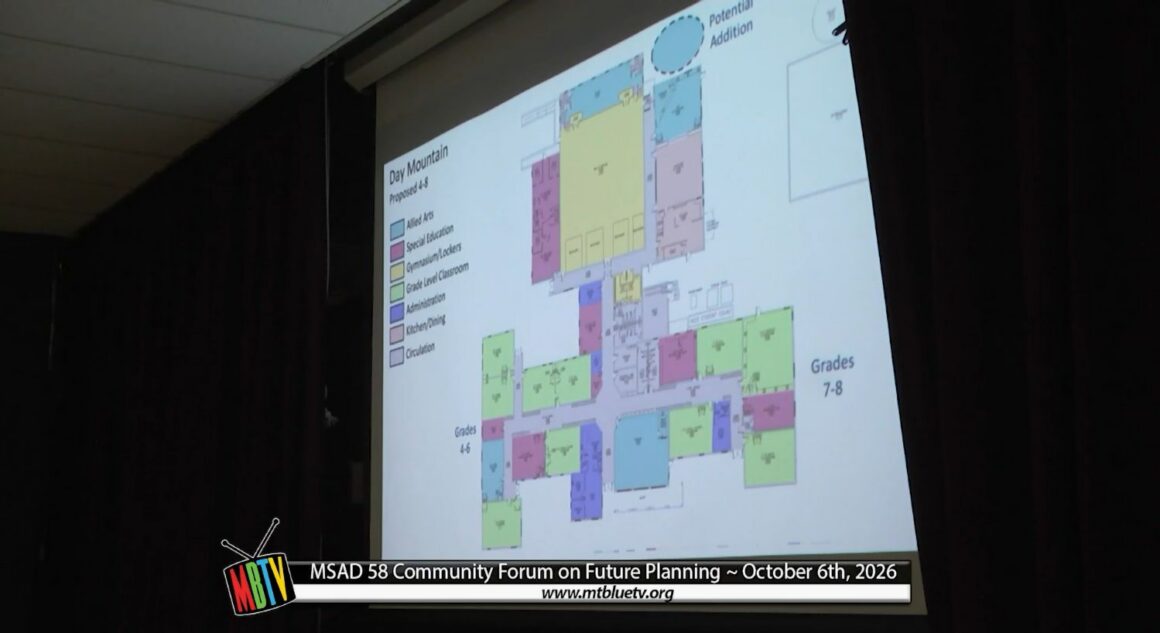
Oak Point’s first option would place students in prekindergarten through third grade at Kingfield Elementary School, students in fourth through eighth grade at Day Mountain Regional Middle School and high school students at Mt. Abram High School.
Kingfield Elementary School is a 35,000-square-foot building that serves 85 students.
Barter said the school’s relatively low enrollment leaves room for two additional classrooms.
Prekindergarten and first grade students would occupy one wing, with second and third grade students in the other. Moving Phillips Elementary School students to Kingfield would also bring their teachers and support staff under one roof.
Kingfield Elementary School has storage areas that could be repurposed and room to expand on its site, unlike Phillips.
“This seems like a good opportunity for some districtwide solutions,” Barter said.
Day Mountain Regional Middle School in Strong is well suited to serve middle school students, Barter said. Its two-wing design separates older and younger students, and the building could accommodate two fourth grade classrooms.
Nearby property lines and Valley Brook limit expansion at the school, but Oak Point identified a small area behind the cafeteria for a possible addition.
Mt. Abram would remain a high school, which Barter said was “working really well.” Strategic renovations could make room for alternative education students now taught in outbuildings. Under this option, the district would move its central office from Phillips Elementary School to the high school campus.
Option 2 would place students in prekindergarten through fourth grade at Kingfield Elementary School, which would need a small addition to accommodate them. The school would also house the district’s central office. The district would renovate Day Mountain Regional Middle School and Mt. Abram High School, primarily to bring the buildings up to modern standards.
Option 3 would build a new school for students in prekindergarten through eighth grade next to the Mt. Abram High School campus, the site with the most room to expand into a nearby wooded area. Barter said the option would provide a long-term solution for education and maintenance but would cost the most.
Asked about costs, Barter said it was too early to provide estimates. He rated Option 1 at one dollar sign, Option 2 at 2.5 dollar signs and Option 3 at nearly four dollar signs.
Barter said Option 1 would require little renovation work. Much of the expense would go toward system upgrades the district will need to make in the next few years.
The district’s schools face similar long-term maintenance needs. Over the next 20 years, Phillips Elementary School would require $7.1 million in work, Kingfield Elementary School $6.1 million, Day Mountain Regional Middle School $6.4 million and Mt. Abram High School $12 million. Bureau Veritas developed the estimates in 2024, Barter said, and inflation will increase the costs.
Several people who commented on the presentation noted that the options did not include a two-campus model, which the board has discussed previously.
Barter said that approach would require building a middle school at the Mt. Abram High School site, potentially making it too expensive for the district.
He added that every option would carry costs, but the state’s revolving renovation fund could help cover some of the district’s maintenance expenses.
Closing Phillips Elementary would let the district stop heating and powering the building, creating an opportunity for immediate savings, Barter said.
The town of Phillips has also begun the withdrawal process, but it is effectively waiting until Strong and Kingfield residents vote in November.
Asked how town withdrawals could affect the district’s options, Barter said the district could still provide general classroom space but might struggle to fund shared spaces such as music rooms, art rooms and gymnasiums.
“You’re going to be able to hit those general classroom spaces,” he said, “but where it starts to become really challenging, I think, is how you address music, art, gymnasium, all of those shared spaces that right now you’re spreading that cost out among multiple schools.”
Superintendent Laura Columbia said the district would need to make plans quickly after the November votes. She said Oak Point’s work would be useful regardless of the outcome.
“The great thing is that we have this data,” Columbia said. “And if we need to do a different school district come July 1, 2027, we have people that are going to help us.”
Those who spoke during the meeting’s public comment period generally praised Oak Point’s data-driven approach to evaluating the district’s facilities.
“Us as a school board and the admin team don’t have the bandwidth to do all of the work that you guys have done. And this is what we wanted. This is what we have been wanting for so long,” Hopwood Farrar said. “I love this presentation.”
Oak Point is scheduled to meet next week with the MSAD 58 board of directors. Barter said the board could consider options beyond the three presented Tuesday.
Residents can submit comments on the presentation to the architects at [Show Email].
Mt. Blue Community Access TV recorded the meeting.