


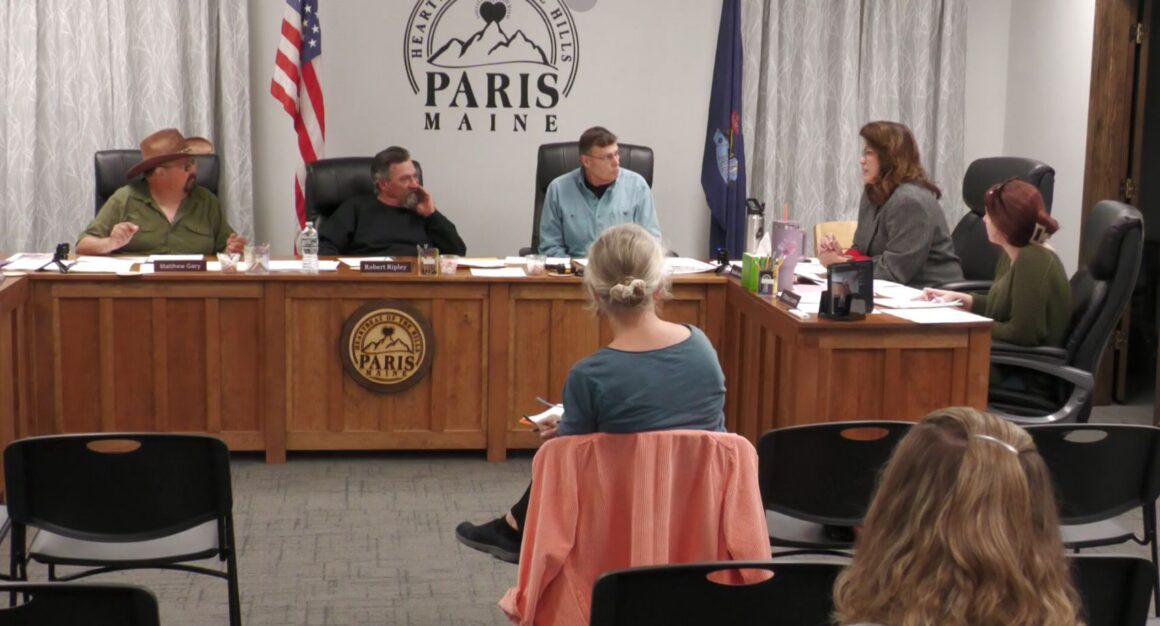
PARIS — When the Paris Select Board took up warrant articles for a special November town meeting, discussion veered to whether the board should reallocate salary approved for an unfilled position to other employees.
Select Board members voted against the reallocation, citing concerns about overriding the wage levels voters approved at June’s annual town meeting.
With one member absent, four board members unanimously voted to forward two proposed ordinances to voters: one for a 180-day moratorium on data center construction in Paris and a second prohibiting convicted sex offenders from living within 750 feet of a school or public area where children play.
Officials scheduled an Oct. 26 public hearing and a Nov. 17 special town meeting, where voters are expected to consider adoption of both proposals.
Copies of both documents are available at the Paris Town Office.
While setting the special town meeting agenda, the Select Board split over whether to send voters two additional financial items: approving an extra $200,000 for the Norway-Paris Solid Waste facility and reallocating the vacant highway director’s salary to staff members taking on expanded duties.
“I have trouble with adding and asking for money,” Select Board member Robert Ripley said. “It’s going to be $200,000 plus $30,000 from the highway department.”
Ripley noted that voters approved the original solid waste budget June 15 and expressed discomfort with letting the small turnout typical of a special town meeting decide on such a large sum.
At the June 2026 annual town meeting, Paris voters approved $402,000 for the Norway-Paris Solid Waste facility, while Norway voters approved $602,000. Three budget revisions for the facility ultimately prompted a review of the interlocal agreement governing the shared operation.
“I actually applaud the town of Paris and the taxpayers and the voters for realizing that something needed to be done,” Select Board Chair Robert Federico said. “And it was drastic. It’s a lot of money that was unaccounted for. So did it get everybody’s attention? I believe it certainly did get attention.”
During the initial solid waste budget review, the Select Board discovered that Norway-Paris Solid Waste had gone without an audit for at least seven years, Paris Town Clerk Tiffany Leahy said.
In response, officials ordered a standard financial audit and an in-depth forensic audit, while calling for a joint committee to review the governing interlocal agreement.
Paris and Norway each appointed two Select Board members and their respective town managers to the new panel, which plans to hold its inaugural meeting next month.
The Select Board expects to receive the forensic audit results within 30 days. Members estimated that the standard audit and actual expenses for the current fiscal year will be ready by February.
In a 3-1 vote, board members decided against asking voters for an additional $200,000 for Norway-Paris Solid Waste.
“I don’t want to commit any (more) tax dollars” until officials know more details, Federico said.
Town Manager Natalie Andrews presented a second proposal: moving voter-approved payroll funds between departments, which raised similar concerns about altering the June budget.
Andrews advocated reallocating $80,000 from the vacant highway director position to raise pay for employees taking on additional duties and to offer a more competitive salary for recruiting a new police chief.
Federico opposed “taking money the taxpayers voted for the highway department and using it for other departments,” even if “the purpose for the money may be a good.”
The timing of Andrews’ request sparked debate among board members.
“Why wasn’t that done during the budget process?” Ripley asked.
Board member Matthew Gary offered a different perspective.
“I think part of the business of government is juggling money around when you need it in different spots,” he said.
Gary also expressed concern about employee retention and morale.
“I think one thing that this town needs to focus on is paying our people accordingly for retention,” he said.
While agreeing on the high quality of town staff members, Federico viewed the process and timing differently.
“Come back to us with a budget for the next year for these changes,” Federico told Andrews. ”Until then, you budgeted for this. We gave you what you budgeted for. I don’t see why we should change four months into our fiscal year.”
Federico stressed that his decision was not a reflection on individual staff members.
“What I mean is that we should be budgeting for this once a year,” Federico said.
The board voted 3-1 against Andrews’ request.
The regularly scheduled Nov. 17 Select Board meeting is set to follow the special town meeting.
Leslie Goode is a Community Reporting Fellow receiving training through the Journalism New England Career Lab to do civic reporting that provides people in towns across New England with the information they need to be engaged in their community.