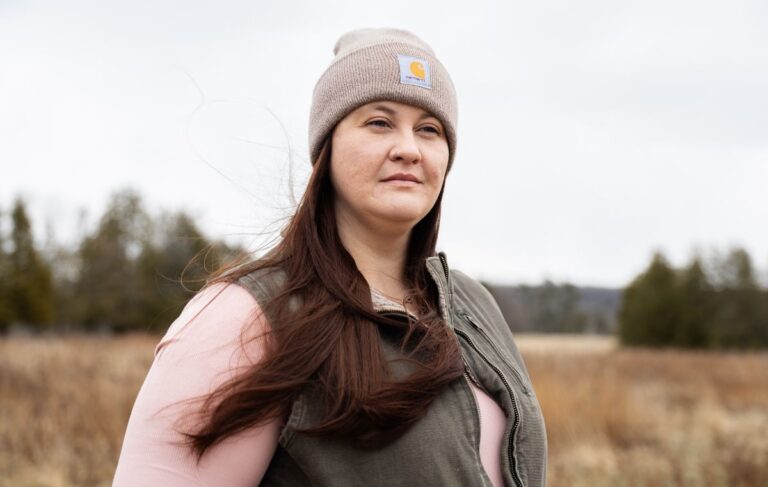




It was more than a year ago that Maine regulators approved final changes to Maine’s 2017 mining law, capping a yearlong process that was designed to clear the way for the development of a lithium-rich deposit in the western part of the state.
So far, the overhaul has done little, if anything, to inspire Mary and Gary Freeman, the owners of the land in Newry where the deposit was discovered in 2021, to move forward with a small-scale spodumene mining operation.
Mary Freeman told The Maine Monitor in an email that the project remains “on hold.”
“Unless the price of spodumene soars, the costs to remove it under current regulation is prohibitive,” she said. “The mining regulations in Maine are not designed to promote environmentally safe extraction but rather to ban mining.”
Last year’s rules-change, which the legislature, Gov. Janet Mills and state regulators all signed off on, allows for would-be developers of certain metallic minerals, including spodumene, to apply for an exemption from the state’s strict mining rules, so long as they are able to prove that extracting the ore would not pollute the environment or release materials that could harm human health. Those rules limit operations to open pits no larger than 5 acres at a time and require long-term water quality monitoring.
To date, Maine’s Department of Environmental Protection has not received an application for such an exemption anywhere in the state, according to Michael Clark, DEP’s mining coordinator.
“There hasn’t been any activity or contact by potential applicants,” he said.
Spodumene is a crystalline ore and a key source of lithium, a highly sought after metal used in batteries, electric vehicles and electronics. The Freemans’ 2021 discovery — one of the only known hard-rock sources of lithium in the country, estimated to be worth $1.5 billion in 2020, when it was first described — came as the United States was getting serious about finding ways to boost its domestic supply of lithium and other critical minerals, in order to curb its dependence on foreign imports.
When the new mining rules took effect last year, the Freemans’ told The Monitor that they planned to move ahead with an exemption application. To avoid a more rigorous permitting process, they planned to extract the spodumene ore and ship it out of state for processing.
Explaining why the project remains on pause, Mary Freeman expressed frustration with some of the new requirements for an exemption, some of which she said are either undefined and “financially infeasible.”
“There is a new requirement to test for PFAS,” she said, referring to the family of toxic so-called “forever chemicals” that the state of Maine has taken numerous steps in recent years to address. “This is not a single test because there are thousands of chemicals in this category.”
Freeman says she asked DEP which PFAS chemicals she is required to test for and was told “all of them.” When she asked for a full list, she got no response, she said.
“These chemicals were introduced beginning in the 1940s and International Paper owned this land until we bought it,” she said. “It was only used for forestry and has no land fills, etc.”
Clark, the DEP mining coordinator, said he recalls a conversation with the Freemans about PFAS testing requirements awhile back and that he planned to look into whether there are any loops that were left unclosed.
Freeman contends that the recently enacted rules, much like the prior existing mining regulations, are “designed to discourage mining in Maine rather than to promote environmentally conscious mining.”
Luke Frankel, a staff scientist at the Natural Resources Council of Maine, a conservation group that supported last year’s changes to the Maine Metallic Mineral Mining Act, said the state has taken an appropriately cautious approach to mineral development, learning from past mistakes and in the case of spodumene, finding a reasonable middle ground.
“These minerals will be needed for the energy transition, there’s no question about that, whenever that happens,” but it is critical for Maine to have stringent rules on the books to ensure the protection of the environment and public health, he said.
“Maine is a wetter state than Australia or even Nevada, where most of the lithium mining happens in the U.S.,” he said. “The climate, the geology, everything is completely different. The reason why the laws are so strict here is because a lot of the environmental risks are a lot greater.”