



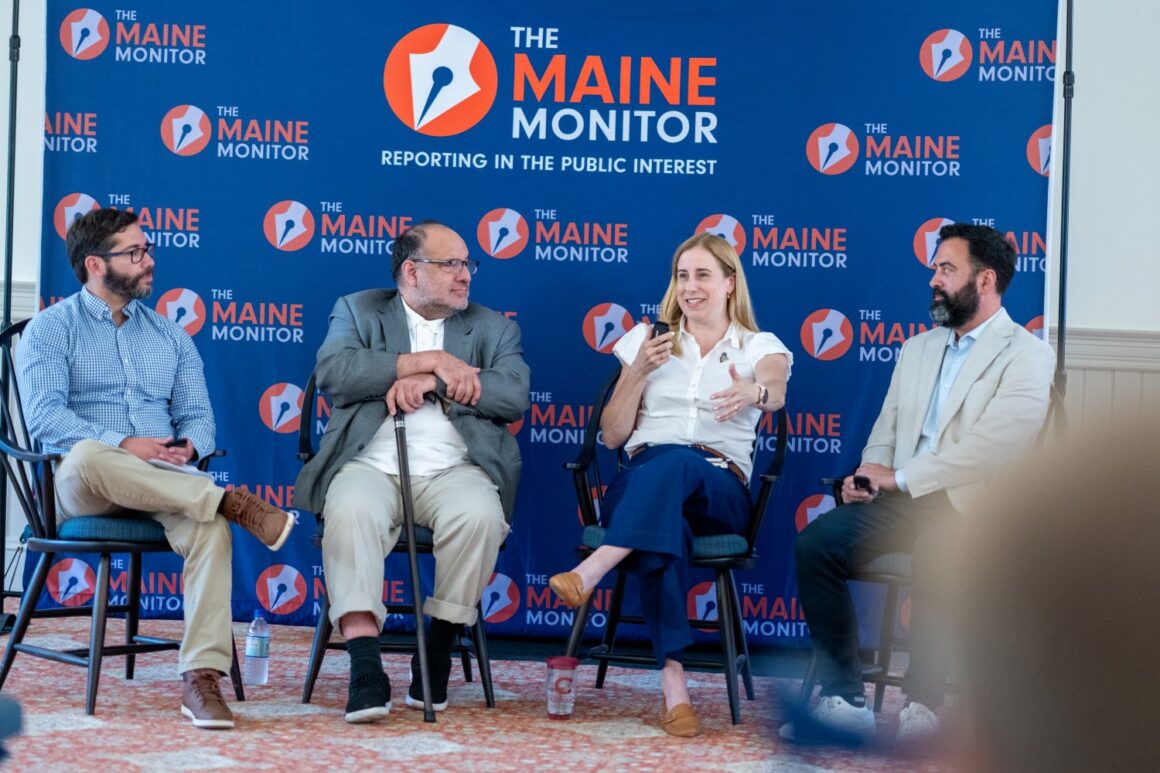
On Wednesday evening, The Maine Monitor brought together a panel on ranked-choice voting at the University of New England’s Portland campus as part of its ongoing series of Monitor Talks.
During the event, moderated by The Maine Monitor’s elections and government reporter Matt Junker, panelists examined the ranked-choice voting strategies that came into play in Maine’s recent primary, debated whether the process makes candidates and campaigns more inclined to keep things civil, and looked at potential improvements the state could make to expedite the timeline for tabulating results.
The panelists were Ron Schmidt, a political science professor at the University of Southern Maine; Chrissy Hart, the executive director of Democracy Maine; and Aaron Chadbourne, who was a policy advisor to former Gov. Paul LePage and now works in real estate.
For Hart — whose organization Democracy Maine encompasses the League of Women Voters of Maine, Maine Citizens for Clean Elections and Maine Students Vote — the goal of ranked-choice voting, or RCV, is to “ensure that candidates who are elected to office are elected with a broad consensus, the broadest possible swath,” she said at the event. That was on display in Maine’s recent primaries for governor, she said.
“What we saw in this primary election was that RCV was incredibly useful in both the Republican and Democratic gubernatorial primaries,” Hart said. ”It made them competitive, it made them interesting, it made them collegial, and it resulted in two candidates who had a significant majority share of the votes.”
Chadbourne, who was working in the LePage administration when Maine voters approved ranked-choice voting via referendum, said he was “a bit agnostic” as to whether ranked-choice voting is better or worse than other voting systems in theory. For him, the big issue is that some people still don’t understand exactly how ranked-choice voting works.
“Whatever form of voting system we choose, and how we choose to self-govern, the most important aspect is that it’s well understood, people understand their rights, their options, and how to actually participate,” Chadbourne said.
Schmidt, the USM professor, said that it will take more time to fully understand the effect Maine’s adoption of ranked-choice voting has had on the way campaigns are run and the way voters approach the process. But the recent primaries for governor highlighted something he said he is always trying to teach his students, who sometimes say they don’t see their politics reflected in either of the major political parties.
“I try to emphasize to what degree our parties really are big, complex, coalition-based organizations. And how there are lots of people who call themselves Democrats or Republicans who disagree with lots of other Democrats and Republicans,” he said. “And how if you disagree with the head of your ticket, there’s still a lot of room for you within the relationships inside these parties to articulate what you care about.”
You can watch the full discussion here: