


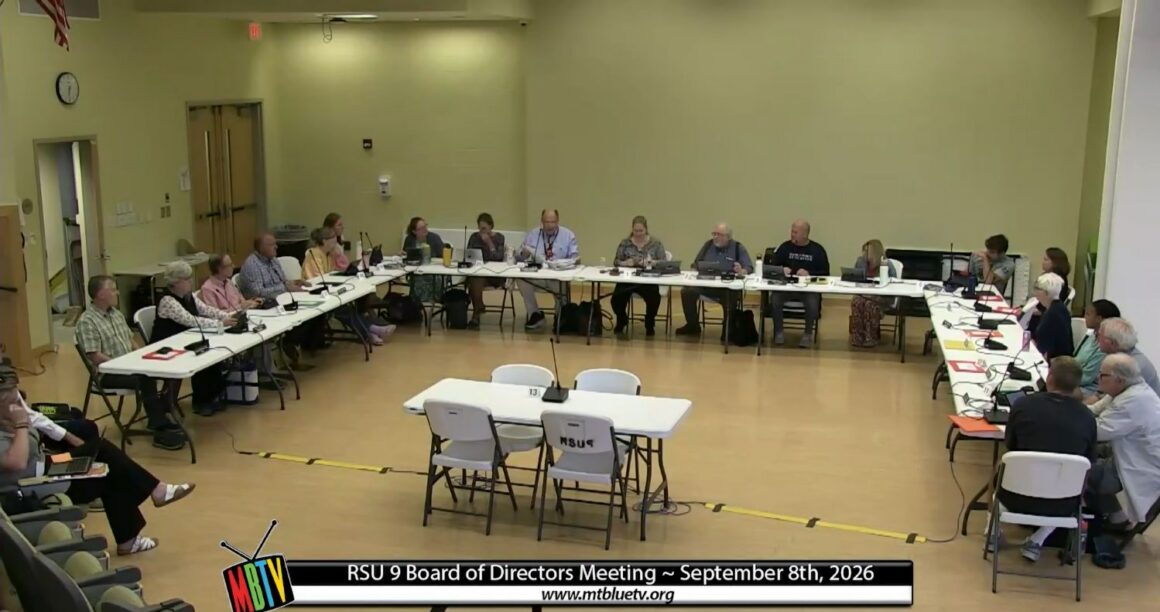
FARMINGTON — Regional School Unit 9 administrators warned Tuesday that changes to a federal program that supports school technology could cost the district money and complicate how it accesses the internet.
Administrators are still calculating the potential financial impact, but RSU 9 Superintendent Christian Elkington said any change to or elimination of the federal E‑Rate program would significantly affect the district.
“To say I’m really worried about this would be an understatement,” he said.
E‑Rate grew out of the Telecommunications Act of 1996, which passed with bipartisan support. The Federal Communications Commission created the program the next year to help schools and libraries pay for internet access, using funding collected from telecommunications companies.
Since 1998, E‑Rate has reimbursed schools for 20 to 90 percent of eligible costs, and over the past five years, it has distributed more than $13 billion nationwide.
Administrators said that level of support now appears at risk.
“E‑Rate is currently being heavily reviewed by the federal government,” Kevin Bremner, the technology director in RSU 9, told the district’s board of directors. “It’s a program we have utilized for many years. We get a lot of funds through that program.”
In 2024, the U.S. Court of Appeals for the Fifth Circuit ruled that the fund supporting E‑Rate was unconstitutional.
The U.S. Supreme Court later reversed that decision, but administrators said signs point to the current federal administration wanting to scale back or eliminate the program.
“You can kind of see the progression,” Bremner said. “They’re hammering on that program pretty hard, and it makes me nervous for the future.”
The FCC is reviewing the E‑Rate program and is accepting public comment. Proposed changes range from restricting funds to certain districts and tightening regulations to shutting the program down entirely.
“In establishing the program in 1996, Congress was addressing a specific problem: limited access to advanced telecommunications and internet services in schools and libraries,” the FCC wrote in its proposed rule. “Given the substantial expansion of broadband access in schools and libraries over the last three decades, we seek comment on whether and to what extent the E‑Rate program has fulfilled that mission and whether continued funding is consistent with Congress’s original objective.”
Whenever the district purchases network infrastructure, whether replacing old equipment, rewiring a school building or covering annual needs such as licensing fees and firewalls, it can submit those costs to E‑Rate for reimbursement. Otherwise, local taxpayers would bear the full expense.
Elkington said E‑Rate generates between $20,000 and $80,000 per year for RSU 9, depending on the district’s needs. Administrators are compiling data from the past five years to give the board a clearer picture.
Bremner said E‑Rate’s impact on RSU 9 – also known as Mt. Blue Regional School District – extends well beyond reimbursement.
The program also helps fund Networkmaine, a consortium within the University of Maine System created in 2009 by UMS, the Maine State Library, the state Department of Education and other partners.
Among its services, Networkmaine provides no‑cost internet to qualifying Maine schools and libraries, supported by E‑Rate funding.
Beyond being free to the district, Networkmaine adds significant security features, Bremner said. It maintains a fully staffed network operations center, allowing RSU 9 employees to call for help and get support quickly.
The district also uses a Networkmaine‑provided product to comply with the Children’s Internet Protection Act, which requires schools and libraries to adopt internet safety policies and enforce them with filtering technology.
If Networkmaine could no longer provide those services, Bremner said the solution would be far more complicated than contracting with a local provider. The district would need to purchase and operate its own security and support systems.
“It makes it difficult to know the cost if we had to go at it ourselves and get those services from somebody other than Networkmaine because of all the added value it provides,” Bremner said. “But I do know it would be a significant cost to the district.”
E‑Rate is still accepting applications as if funding will be available next year, and the public comment period runs through October.
Elkington said reaching out to Maine’s congressional delegation is essential.
“I think it’s most important that we talk to our legislators, our representatives and our senators,” he said. “That’s the only place that is going to save this money, with our two senators and two representatives from the state of Maine.”
Elkington said there have also been discussions about cutting Title I, the federal program that supports low‑income students. The House Appropriations Committee has proposed a 10 percent reduction, or nearly $2 billion.
RSU 9 receives about $1 million in Title I funding each year, he said, and spends most of it on intervention services that help students struggling in areas such as reading and math.
“Any severe cuts will definitely hamper us,” Elkington said.