



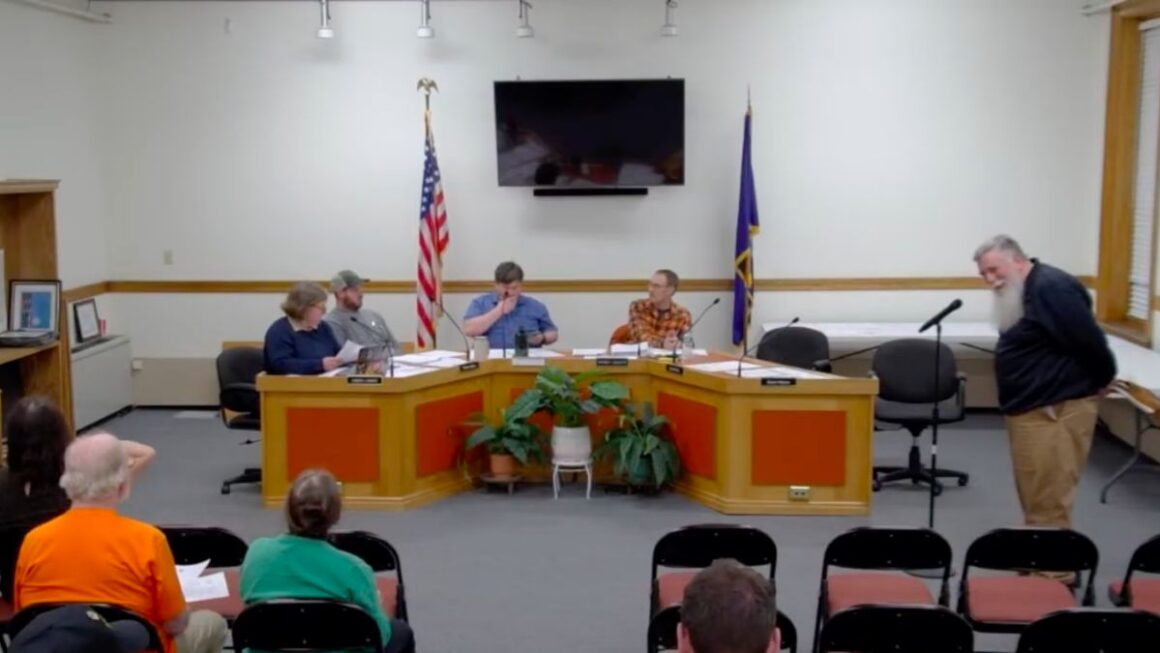
SKOWHEGAN — The Skowhegan Select Board — with all five members present — again voted to deny a tax increment financing request for $13,000 in emergency repairs at the downtown law firm Merrill, Hyde, Fortier & Youney.
Last month, with only three members present, the Select Board denied the application, saying it prefers to reserve TIF funds for municipal projects. The law firm’s building is privately owned.
At last Tuesday’s meeting, lawyer John Youney, president of the firm at 95 Water St., told the board the request meets the standards in the town’s TIF contract and guidelines, which voters approved and later reaffirmed at the annual town meeting.
“We believe the $13,000 is reasonable,” he said. “We meet the metric of the committee 100 percent.”
Youney said powerful storms in the winter of 2024-25 damaged the wall, but the firm’s insurer denied coverage, arguing a storm could not have caused the failure. Brick fragments have fallen onto the roof of neighboring Key Appliance at 101 Water St., he said, though scaffolding and plywood now protect the building and support repair work.
He called the board’s decision to deny the TIF request “not ethical or moral.”
“Thank you for the discussion,” he said. “I just hope that next time you go to move goal posts, you do that before you have an application in front of you. This is patently unfair to the citizens and the inhabitants of Skowhegan to move the goal posts like this.”
The board voted 3-2 to reject the request, a split that reflected disagreement over how TIF funds should be used rather than whether the application meets the current guidelines in the town’s contract with the state. Chair Whitney Cunliffe, Vice Chair Kevin Nelson and Selectman Ethan Liberty voted no. Selectmen Amber Lambke and Elijah Soll voted yes.
The Downtown TIF Advisory Committee, which Lambke chairs, had unanimously recommended approving the law firm’s application.
Lambke recommended postponing the advisory committee’s May 4 meeting until the Select Board holds a TIF educational workshop. The committee has six applications ready for review, according to Economic and Community Development Director Bryan Belliveau.
“Because it’s holding up the process now,” Lambke said, urging the board to schedule the workshop as soon as possible.
Cunliffe outlined his broader concerns about the Downtown Omnibus TIF — one of four TIF districts in town — saying the town needs clearer conditions for grants, including matching funds, recapture provisions and holding periods so “the business owner has real skin in the game.”
“When too much value is pulled into a TIF, that’s value that’s no longer helping pay the everyday costs of running a town,” he said. “If we’re not careful, this is going to work against the progress we’re trying to make.”
Cunliffe urged the board to be more “deliberate” in approving TIF applications, citing the town’s financial instability, its inability to borrow money and its backlog of audits.
Under Maine law, a TIF district allows a municipality to capture property tax revenue from new development in a designated area and place it in a special fund for infrastructure and economic development. When a major development increases a town’s overall property value, the town pays more in county taxes and receives less in state revenue through education subsidies and revenue sharing.
Sheltering the new tax revenue for up to 30 years removes it from those calculations. As a result, the town can reinvest the money without losing state funds or facing higher county taxes.
“I can’t continue to support applications under the current process,” Cunliffe said.
Lambke countered that the law firm’s request falls “squarely within the state contract” governing how Skowhegan has agreed to use its TIF funds.
“This board might like more stringent guidance, or match, or skin in the game proven at the time of applications. That can be taken up by the TIF advisory committee,” Lambke said, calling that approach “good group process.”
“We are moving the goalposts on applicants in an unfair way, unlike other applicants who applied under the same guidelines,” she said.
The Select Board first denied Merrill, Hyde, Fortier & Youney’s application at the board’s April 14 meeting, when only three members were present.
“I have placed this back on the agenda because I believe applications like this should be reviewed and decided by a full board,” Cunliffe said.
Nelson, who again voted against the grant, acknowledged that the application meets all requirements but said the board still has final authority over TIF approvals.
“We would be changing precedents tonight if we do something other than approve this TIF grant,” he said. “I’m just stating the facts.”
At the start of the meeting, Lambke noted that disagreement is inevitable.
“We’re going to grapple with difficult issues and we’re not always going to agree,” she said. “And 99 percent of the time this board reaches consensus decision-making together and every once in a while we will not. That’s OK, and it’s normal.”
The Select Board’s next meeting is scheduled for 5:30 p.m. Tuesday, May 12.