


MACHIAS — For the second time in as many meetings, the Washington County Commission’s budget process has been criticized by Budget Advisory Committee members.
Committee Chairman Brian Schuth told members he read state statutes governing counties’ budgeting process for the first time this year, even though — as he pointed out — it’s his third year serving on the committee.
“I’m ashamed to admit it’s the first time I did, but I have,” he said, and did so specifically to learn what the commission’s role is and what the Budget Advisory Committee’s role is in that process after many members of the budget committee expressed disappointment over how the $17 million budget was presented.
“Namely,” he said, “that we were presented with an estimate plus two wish lists, and it was unclear exactly what the commissioners, as a body, felt.”
The draft budget represents a $3.7 million increase year-over-year, or nearly 30 percent.
By state law, commissioners are required to submit a budget estimate to the budget committee no later than 90 days before the end of the fiscal year, which they have done. Commissioners are also required to hold a public hearing on that budget, also 90 days before the end of the fiscal year, which was done during the commission’s meeting on Sept. 10, but Schuth questioned whether that was done properly.
A public hearing was scheduled at the start of that commission meeting, but Schuth recalls that it was more of a “meeting” than a hearing.
“The meeting we attended, that was the public hearing, but it wasn’t really a public hearing in my opinion, as far as I know. And, correct me if I’m wrong, but there was nothing presented to the public to discuss at the public hearing,” he said.
“I would expect a public hearing to have a document that had been presented and the public gets to comment on it,” he said, careful to make it clear he wasn’t making any accusations of wrongdoing. “What I’m pointing out is, I think it’s the intent of the statute for the commissioners who have done the work of providing an estimate and getting public input before that comes to us, and that has apparently not happened.”
He said that missing element has put the budget committee in what he called an “awkward” position, but “nevertheless, our job at this point is we are given a grand total of 45 days to make recommendations on that estimate.”
With that time constraint, Schuth said it’s “unrealistic for us to be expected to go, you know, line by line or deduct $100 here and $1,000 there on a line in any intelligent fashion,” so they will rely on department heads to be detailed about what they need.
Harry “Sonny” Beal Jr. of Columbia agreed. “We’re not here to micromanage them. We’re here to listen to what they need,” he said. “I want to make sure what we’re voting for.”
Some of the items included on wish lists submitted by Commissioners David Burns and Billy Howard after the Sept. 10 meeting strayed into policy decisions, Schuth said, reminding committee members it is not their role to decide policy.
The committee very briefly talked about whether it should start work with the draft budget in hand, or revert to the 2026 budget as a starting point. Members ultimately agreed to start with the 2027 draft budget, and began with the Regional Communications Center.
RCC Director Josh Rolfe began his presentation by explaining that some of the 2027 budget lines look different this year because some costs were moved to other departments, including computer maintenance and internet expenses. His requested budget reflects a 4.9 percent increase year-over-year, or a $66,846 increase, with staffing being the largest expense.
According to Rolfe, the budget brings back one staff position that was cut for 2026, bringing the department back to what he called “fully staffed.”
His request for part-time wages at $20,000 and overtime costs at $80,000 are the same as budgeted this year, with slight increases for mileage, miles and lodging, almost all of which are connected to training.
There is a sharp increase in the electricity line item, requested at $18,000 this year over $10,515 last year, which Rolfe explained reflects anticipated increases for electricity not just at the communications center, but at all of the Regional Communication Center’s tower sites, which are equipped with power and generator backup.
During his presentation, Rolfe mentioned that, between Jan. 1 and Aug. 30, the communications center elected not to fill 123 day shifts by reducing usual staffing on those days, saving about $60,000 in wages, “and we still managed to answer every call. Everything got done appropriately,” he said, “but that’s not sustainable.”
He said the department “did this to try to keep the county afloat because of the cuts that were made last year, and we can’t keep doing it” because it’s too hard on staff to cover those absences by taking more calls than is typical.
Rep. Tiffany Strout supported Rolfe’s position on this.
Pointing to the deaths of three people in Roque Bluffs over the weekend, Strout said dispatchers are affected by that kind of trauma.
“They have to be able to have time to process that themselves,” she said, and “if that means they get to have an extra shift off and we have to cover that, that’s the least we can do to make sure they show up for other shifts.”
Ben Edwards, committee vice chairman and vice chairman of the Machias Board of Selectmen, pressed Rolfe on staffing, especially because the department managed without filling those 123 shifts, saying the committee is obliged to quantify all costs in all departments so it can make smart decisions.
An employee of the communication center then stepped forward and asked if he could read aloud a letter written by Operational Supervisor Dennis Perry, which the committee agreed to hear.
In that letter, Perry wrote “It’s very disheartening to hear wanting to cut more and more in an atmosphere where we are already strapped. Unfortunately, some of the folks that want to make cuts have absolutely no idea what they’re talking about.”
They don’t know what it takes to do this job, he wrote. “No one calls 911 or any of our non-emergency lines because they’re having a good day. For example, we deal with callers who are watching their family members get assaulted, watching them die, watching their homes burn down, serious automobile crashes, and in some instances during the winter months, we get calls from people complaining about the roads.”
Pointing out that some of these calls can last 40 minutes or longer, and that dispatchers are also often called to court, leaving the department short, Perry wrote, “No one is knocking down the door to help us. We are it. We can’t do more with less.”
Rolfe’s presentation ended without the committee making any suggestions for cuts, after which Chief Deputy Mike Crabtree was asked to present the Sheriff’s Office budget.
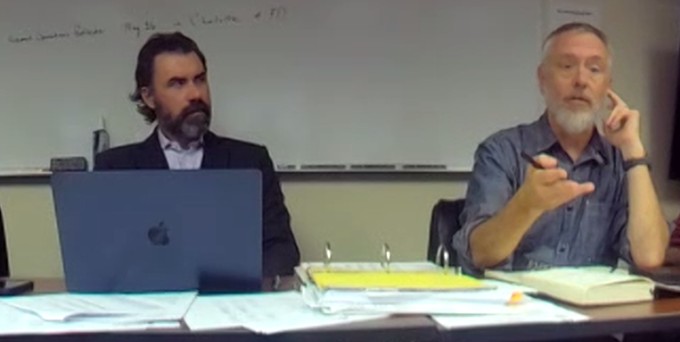
Before presenting his budget, which represents a 51 percent increase, or $1,338,887 year-over-year, Crabtree said he and his staff recognize the financial challenge facing the county and work diligently to manage resources effectively.
“It is worth remembering that the men and women of the Sheriff’s Office are taxpayers in Washington County as well, and they care deeply about the physical health and safety of our community,” he said.
However, Crabtree continued, “the past year has brought significant strain, public criticism, and unsubstantiated claims regarding department management, which created unnecessary hardship for our personnel.” He urged that, moving forward, “we must focus on collaborative, constructive solutions, and prioritize long-term stability over short-term cuts.”
He further urged the committee not to make a flat percent reduction in funding, but to evaluate and specify cuts by line items.
The largest budget line is for wages, including adding back three full-time patrol positions that were cut in 2026, representing an increase of $456,063, for a total expenditure of $2.2 million.
Requested overtime costs are also higher at $242,000, reflecting a $22,000 increase for overtime that would be incurred by three additional officers. If those officers are not hired, Crabtree estimated the increase in overtime could be $89,000 year-over-year.
Budget Committee member Crystal Gallina, who is the finance director in Calais, pinned Crabtree down on his request to purchase 11 new cruisers, budgeted at $660,000 plus another $220,000 to equip the vehicles.
“But,” she said, “at the same time you’ve also increased the repairs and vehicle maintenance by $55,000. If you’ve got 11 new cruisers, would you really need that much extra in repairs?”
The amount for vehicle maintenance requested is $100,000.
Crabtree said “depending on what happens, things may have to be adjusted,” and that the higher maintenance costs might be necessary if the department doesn’t get new vehicles, and could go down if it does.
The Sheriff’s Office vehicle fleet has been the frequent target of suggested cuts by commissioners, and Crabtree pointed out that one of the department’s spare vehicles has 180,000 miles on it, supporting the need to purchase, or perhaps lease, new vehicles.
“They wear out. Cars wear out. It’s not safe after a certain mileage to keep trying to do this, right?” he said. “Almost everything we do on a daily basis is to limit liability and mitigate risk, so we take all of that into account in almost all the decisions we make every day.”
Gallina asked Crabtree what bare minimum for new cruisers could he live with. “Well, you have to think we needed five or six last year and we got one. We’ll still need the rest of those.”
And, if the three requested patrol positions are filled, the department will need cars for those employees as well.
Gallina said she appreciated the need for vehicles, but “I’m just, again, looking for reasonableness and what can the people in this county also afford.”
Crabtree mentioned that he’s talked to a vendor about the possibility of leasing cruisers, and the vendor was willing to make a presentation to the budget committee on costs. That presentation will be held Oct. 20.
As with the communications center budget, some of the budget items the Sheriff’s Office has typically paid for have been moved to other departments, including record management, computer and furniture costs.
At a special meeting of the Washington County Commission on Monday, following a three-hour executive session, commissioners passed a resolution on the budget committee process, directing the county administrator, finance director and treasurer of the finance department to attend budget committee meetings and support the committee in its review so that recommendations can be brought back to the commission by Nov. 16, 2026.
The next budget committee meeting will be 9 a.m. on Tuesday, Sept. 29. Members will take up requests from departments of finance and administration.