



MACHIAS — Washington County commissioners voted Wednesday against supporting a bill set for a public hearing next week that would allow government entities — like Washington County — to declare bankruptcy.
The bill, L.D. 2009, was submitted in December as an emergency measure by Sen. Marianne Moore, a Republican who represents Washington County. It is co-sponsored by House Minority Leader Billy Bob Faulkingham, R-Winter Harbor, and Republican Reps. Matthew McIntyre of Lowell, William Tuell of East Machias and Joseph Underwood of Presque Isle.
The bill, which is scheduled to be heard before the Legislature’s Committee on State and Local Government at 11 a.m. Jan. 21, would authorize counties and municipalities to file for federal bankruptcy “upon exhausting all reasonable alternatives to avoid bankruptcy, a determination by the state auditor that the county or municipality is insolvent and approval by the county commissioners or municipal officers.”
Grace Falzarano, Washington County’s provisional treasurer, told commissioners Wednesday that bank officials warned the county’s future borrowing could be affected if the bill passes and the county considers bankruptcy.
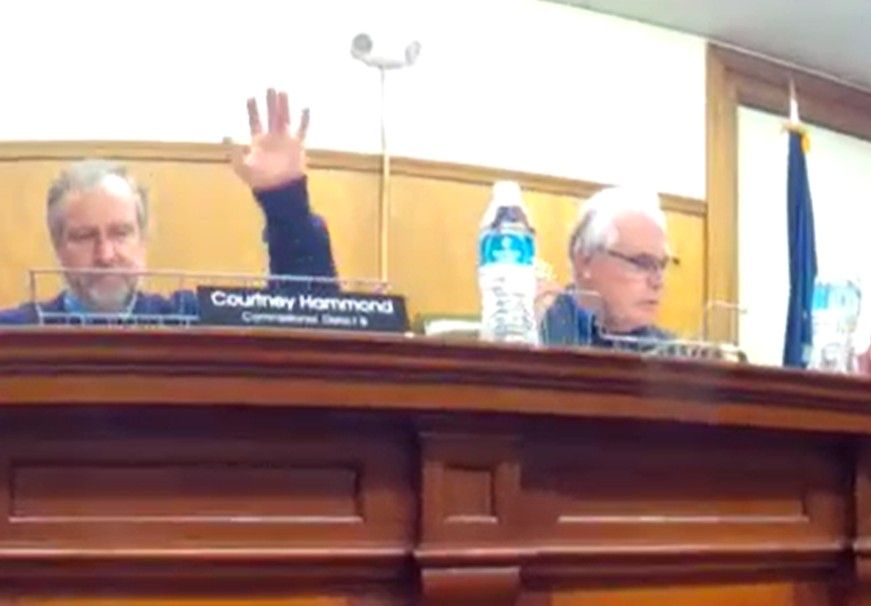
Commissioner Courtney Hammond said he could not support the bill as written. He added that if it focused on bankruptcy protections rather than outright bankruptcy, he might feel differently.
Commissioner David Burns noted that Washington County is not the only county government in Maine facing serious budget shortfalls.
“People shouldn’t even be thinking we’re bankrupt,” he said. “We should be managing our money.”
Commissioners seemed to agree that bankruptcy might be an option only if a natural disaster or other crisis “obliterated” county government and left residents unable to pay taxes. By consensus, they said anything short of that should be managed through strict budgeting and careful spending.
“The last thing I want is to go against anything Sen. Moore put in,” said Burns, who spent eight years in the Legislature.
He added that a bankruptcy filing would not help the county recover from years of financial mismanagement and overspending if it jeopardizes banking relationships and future borrowing.
“We’re in a situation where we want to make sure we get results on the TAN (tax anticipation note) and go forward,” Burns said, with more strict attention paid to spending in 2026.
The bill notes that “counties and municipalities are in increasingly difficult financial circumstances due to factors including rapidly rising property valuations and a sharp increase in the cost of living,” with emergency language that would activate the bill into law as soon as the legislation is passed “as immediately necessary for the preservation of the public peace, health and safety.”
Commissioners said they would rather concentrate on repaying the county’s 2025 tax anticipation note and preparing to borrow for 2026 than consider bankruptcy.
As of Friday afternoon, no written testimony had been filed for or against the bill. Falzarano said the county is getting closer to paying off the 2025 TAN through surplus funds, commitments from municipalities that agreed to prepay and billing plans for municipalities and the Wabanaki Nation that declined to prepay.
She said commissioners might want to consider paying $500,000 on the 2025 TAN now to get ahead of it. Commissioners decided not to act until a special meeting at 10 a.m. Jan. 29, which is expected to focus on a full accounting of that note.
The county must pay its $8 million 2025 TAN debt to Machias Savings Bank by Feb. 20 before it can borrow again for 2026.
In other matters, commissioners:
- Heard from Heron Weston, supervisor for the county’s unorganized territories, who said he will hold regular office hours from 8 a.m. to 4 p.m. on Tuesdays and Thursdays in 2026. In the past, Weston had not posted regular hours and found that residents wanted a consistent schedule to conduct business.
- Revised their vote of Dec. 17 to limit employees to the state mileage reimbursement rate of 56 cents per mile, opting instead to return to the federally allowed 70 cents per mile. The change applied only to the commissioners and the county manager and was viewed as unequal to employees whose contracts or policies require the higher reimbursement rate.
- Clarified that any expenses over and above line-item operational expenses that are not budgeted must first be approved by commissioners, no matter the amount of expenditure.
- Approved a recommendation to reserve 2% of the county budget in the overlay account as compared to the 0.5% reserved in 2025, and approved keeping the interest rate charged to municipalities that are late in making tax payments to 5%, as in 2025.
- Approved a plan to offer most employees a choice between receiving a monthly $30 cellphone stipend or using a county-provided phone, which would be provided at a $30 cost per month through AT&T. Employees had been offered a $50 phone stipend. Members of the Washington County Sheriff’s Office who already have county-issued phones will retain those phones and are not eligible for a stipend.
- Approved the same board appointments for all members of all boards as in 2025, and named Hammond as the secondary member of the Maine County Commissioners Risk Pool Board.
At the start of the meeting, Burns offered a blanket apology to those he offended in 2025.
He said he knows he upset people during tense budget talks, but he “never meant to be personal with anybody.” Burns also acknowledged it was a difficult year for employees. He said he hoped 2026 will be better for everyone.
“I hope we can move ahead,” he said.
At the close of the meeting, Hammond said the public had been courteous and respectful at the town meetings he attended in recent months to explain the county’s 2025 debt.
“Not happy,” he said, “and I just want to thank all those towns that were as cordial and considerate as they were, being the situation we’re in.”