



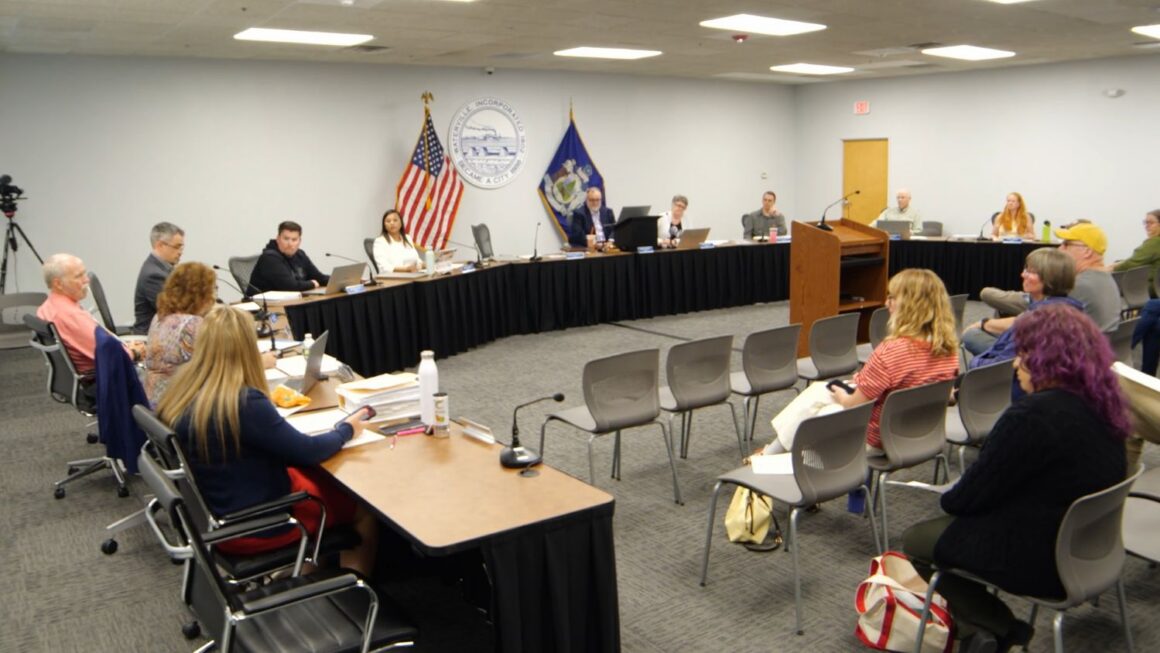
WATERVILLE — The Waterville City Council held the first reading Tuesday of the proposed municipal and school operating budgets for the coming fiscal year, ultimately rejecting the amended municipal budget and sending city officials back to make deeper cuts.
City Manager Nick Cloutier first presented the preliminary fiscal 2027 budget in March, reporting a 25 percent net increase in municipal operations. In a memorandum to councilors, Cloutier wrote that the major cost drivers include a $1.9 million increase in personnel costs tied to contractual wage obligations and staffing decisions; rising debt service as the city shifts from interest‑only payments to combined principal and interest on existing bonds; a projected $500,000 decrease in state revenue sharing; a 15 percent increase in Waterville’s county assessment; and continued reliance on the city’s fund balance to offset the tax levy. The initial proposal called for a $2.7 million drawdown from that fund.
At the time, Cloutier said department heads were working to identify at least $1 million in cuts, which would reduce the overall increase to less than 13.68 percent.
In a memorandum to city officials, Mayor Michael Morris outlined what he called the city’s “unsustainable budget” and proposed “immediate, realistic steps to begin correcting our course.”
Those steps included limiting the fund balance draw to $1.7 million, the same amount used in fiscal 2026; conducting a comprehensive expenditure and staffing review to identify redundancies; and reevaluating the city’s reserve accounts.
“We cannot continue to use the fund balance as an end run against deficit spending,” Morris wrote.
At the beginning of Tuesday’s meeting, Cloutier said department heads took these messages to heart and recognized the need to scale back spending, perhaps even beyond the $200,000 councilors had directed staff members to trim after a budget workshop last month.
Cloutier said the most recent recommendations would achieve savings while maintaining workforce stability and avoiding layoffs. While the proposed reductions totaled more than $283,000, about $71,000 of that amount came from tax increment financing funds, which do not immediately reduce the net budget paid by taxpayers.
“This is a particularly difficult budget year,” Cloutier said.
Cloutier also presented councilors with a nine‑page memorandum outlining several options for cutting the budget. In the memorandum, he wrote: “Recommendations were developed in coordination with department leadership, balancing fiscal constraints with operational realities. At this stage, efficiency must be understood in practical terms: The City must carefully determine how to ‘do less, with less,’ while preserving essential services.”
Much of the discussion centered on whether vacant positions should remain full time, be converted to part time or be eliminated entirely.
The first position discussed was a vacant role in community and economic development. Cloutier recommended reducing the position from full time to part time, generating an estimated $71,459 in savings through tax increment financing, or TIF, funds.
According to the memorandum, the recommendation “represents a balanced approach based on mixed feedback and builds on successful part‑time and partnership‑based efforts that have been utilized to date in 2026.”
It was also noted that while the TIF funds would not immediately reduce the tax levy, they would remain available for future eligible projects, including infrastructure improvements.
Councilors expressed differing opinions on the position.
“If we’re concerned about the city staff increasing, then I would say that this position should not be filled,” City Council Chair Brandon Gilley, D‑Ward 1, said.
Morris questioned the effectiveness of a part‑time position, saying, “I don’t know that a part‑time economic development person does anything for the city of Waterville.”
Councilors ultimately rejected Cloutier’s recommendation, voting 5‑1 to keep the position full time, with Gilley opposed.
Councilors next discussed three vacant positions that Cloutier recommended converting from full time to part time: an executive assistant, a code enforcement administrative assistant and a customer service representative.
The shift would save an estimated $151,754 in non-TIF funds, which are regular city dollars that are not restricted to projects within tax increment financing districts.
The executive assistant position would support the city manager by answering telephones, assisting walk-in visitors, supporting communication efforts and coordinating with other departments.
Discussion then turned to the code enforcement administrative assistant position. Duties include scheduling and managing the apartment inspection program, handling resident inquiries, processing permit payments and maintaining records.
Daniel Bradstreet, Waterville’s director of code enforcement and local health officer, questioned whether the work could realistically be completed in 20 hours per week. A motion to keep the position full time failed, with only two councilors voting in favor.
The council also debated converting a vacant customer service representative position to part time.
City Clerk Patti Dubois said the position is important for assisting residents and helping manage city services, including marriage ceremonies.
“This isn’t a super busy election in June, but I’m already worried about November,” Dubois said. “You can barely take a break or go to the bathroom.”
A motion to keep the position full time ended in a 3‑3 tie. Morris cast the deciding vote, leaving the position part time in accordance with Cloutier’s recommendation.
Councilors next considered eliminating a vacant equipment operator position in the Public Works Department. Officials noted the department has three vacant positions, all of which have remained unfilled for about a year or more.
“This goes to show how difficult it is to find city staff, even with a pay increase,” Councilor Rebecca Green, D-Ward 4, said.
Eliminating the position would save an estimated $84,817 in non-TIF funds.
The council approved that recommendation.
The council then discussed a vacant patrol officer position in the Police Department. Police Chief Bill Bonney urged councilors not to eliminate any police positions.
“If we don’t fill this position, I will have to bring the community resource officer back to patrol,” Bonney said.
The department is already facing staffing challenges, he said, with a few employees expected to be out on maternity or medical leave soon.
Councilors ultimately voted to keep the patrol officer position full time.
Discussion later shifted to the city’s undesignated fund balance.
Earlier budget recommendations included increasing the use of the undesignated fund balance from $1.75 million to $2 million, with the additional $250,000 used to reduce the net budget tax levy. The proposal was described as a short‑term way to provide tax relief using previously collected taxpayer funds.
Morris said he would prefer to use the money for projects already underway.
“I’m looking to utilize this account to knock off or to enhance projects we already have in the works,” he said.
Green disagreed, saying: “We haven’t historically used any of the money we borrow from the fund. I think we should use it to offset any tax increase.”
Gilley moved to remove the additional $250,000 from the budget. The vote ended in a 3‑3 tie, with Morris casting the deciding vote against using the additional fund balance. As a result, the $250,000 was removed from the budget proposal.
Following the vote, Councilor Scott Beale, D‑Ward 6, said, “I would like to ask the city manager to go back in and find another $250,000 in cuts.”
With the changes made during the meeting, officials estimated that the overall taxpayer increase would be 6.3 percent, raising taxes on a home valued at the city’s median by about $241 a year.
“It can’t be 6 percent year on year,” Beale said, questioning the sustainability of the increase.
Despite approving some of the proposed reductions, councilors continued to express concern about the overall budget and the projected tax increase.
Before councilors voted on the first reading of the budget, several residents spoke during the meeting’s public comment period.
Former Mayor Karen Heck suggested the city consider alternatives to adding staff, saying: “Contracting versus hiring is a consideration. We have to look at increasing revenue.”
One Ward 4 resident urged councilors to think carefully about the city’s long‑term financial future.
“If we’re going to get to a sustainable thing,” he said, “we have to think long and hard about this stuff.”
A Ward 2 resident encouraged city councilors to reject the proposal and continue reviewing the numbers.
Councilors then voted on the amended budget package, rejecting the budget unanimously.
“We are back to square one,” Morris said after the vote.
Councilor Flavia DeBrito, D‑Ward 2, said, “I’m not comfortable with this budget.”
The City Council is expected to continue discussions during the proposed budget’s second reading Tuesday, June 16.
Residents have continued to be vocal about the need to trim the budget.
During the council’s May 18 meeting, a resident said he was glad the city was trimming back.
“It would be one thing if the city was constantly getting better and better and the taxes were going sky high if this was the cleanest and safest city. But it’s not,” he said. “And we got dudes hanging out on Main Street in encampments … little old ladies trying to get to their knitting class who are getting harangued by junkies and vagrants. We gotta clean it up.”
Another resident questioned budget priorities, saying, “If we don’t have trash cans at our public playgrounds but we have $180 million for downtown development, who are we catering to here?”
Freelance writer Charley DiAdamo contributed to this report.