


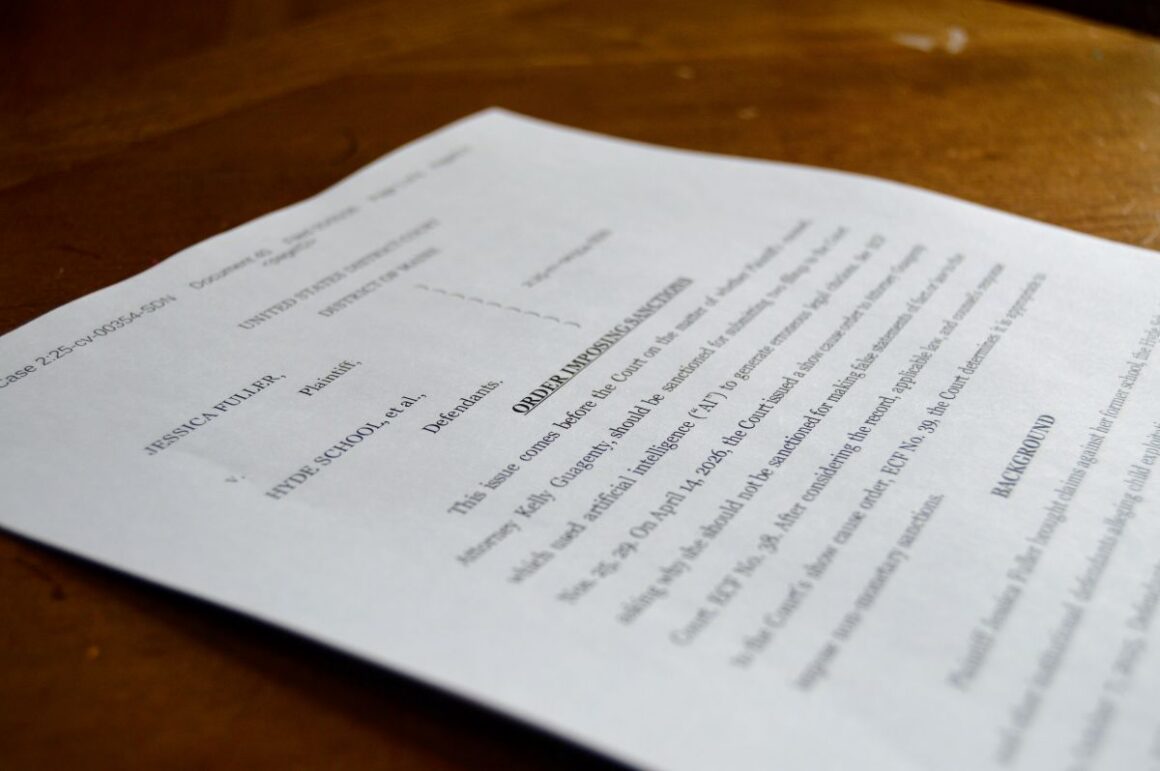
An attorney working on a case alleging physical and psychological abuse and forced labor trafficking at the Hyde School in Bath was sanctioned this week by a federal judge for using artificial intelligence in a court filing, leading to citation errors. The judge ordered her to attend a course on AI and to create procedures aimed at preventing future mistakes, but the underlying civil case will continue.
The case before the U.S. District Court in Portland is the latest example of how artificial intelligence is transforming the legal field and raising ethical questions.
Kelly Guagenty, a partner at the Massachusetts firm Justice Law Collaborative, is representing a former attendee of the Bath boarding school in a federal lawsuit alleging that students were subjected to forced labor and abuse for “decades,” a claim the school denies. In a filing arguing against dismissal of the case last November, Guagenty failed to do a line-by-line verification and included mischaracterizations of case law, an improper quotation and a misattribution.
In her May 5 ruling, U.S. District Judge Stacey D. Neumann noted that Guagenty “accepted responsibility for the errors in her filings and expressed genuine remorse,” and therefore did not issue any fines or penalties beyond asking that she attend the continuing education course and put new guardrails in place at her firm.
In a statement to The Maine Monitor, Guagenty wrote that she has devoted her career to representing survivors of institutional abuse, and that the court’s decision was “fair and appropriate.”
“I appreciate that the court recognized my spotless disciplinary record, and I’m embracing the opportunity to correct this error and to move forward on behalf of my client,” Guagenty wrote.
Lawyers are responsible for submitting accurate filings per the Maine Rules of Professional Conduct even when they opt to use AI, and some courts outside of Maine have begun requiring attorneys to disclose AI use, NPR reported last month. Maine courts do not. The state’s rules of professional conduct, adopted by the Maine Supreme Judicial Court, don’t explicitly mention AI at all.
Other states such as California have created guidelines requiring lawyers to be diligent, communicate when they use AI, and not charge clients for the time saved by using AI tools.
Rachel Okun, a personal injury lawyer and president of the Maine Bar Association, said lawyers have an ethical obligation to understand current technology and use it to be more efficient for clients. She has used AI for marketing and website development, but not for drafting briefs.
The Maine Board of Overseers of the Bar has not yet adopted guidelines that focus explicitly on AI use, Okun said, but Maine lawyers are required to “remain current” on technology, which she said includes AI. The American Bar Association recommends that lawyers have a “reasonable understanding of the benefits and risks.” Relying on AI to generate drafts without independently verifying the text “could violate the duty to provide competent representation,” the association wrote in a 2024 opinion.
As AI use has become more common, Okun said the Maine Bar Association has held regular continuing legal education courses to help Maine lawyers understand how the technology could change their practice. This summer, the association will host continuing legal education courses on basic AI use, AI impersonation and trademark law, and using AI during the discovery process.
“Eventually, not using AI in any capacity would be like a lawyer in previous years not using a computer at all,” Okun said. “We have to be able to use the technology that’s available to us to be more efficient for our clients.”
Damien Charlotin, a researcher at HEC Paris Business School in France, has tracked nearly 1,400 citations worldwide issued against lawyers for errors caused by AI use since April 2023. The vast majority have been in the U.S., and three in five have come from pro se litigants, or people who represent themselves, according to a database he maintains.
The database includes three other cases in Maine, all of which involved defendants who represented themselves rather than hiring attorneys and used AI to help draft briefs, leading to errors with citations.
Technology has the potential to help with meaningful legal work, but practicing lawyers have an obligation to make ethical decisions and use tools competently, said Cat Moon, a professor of practice of law at Vanderbilt Law School in Tennessee and founding co-director of the school’s AI Law Lab. Often when lawyers use generative AI and fail to catch inaccuracies, Moon said, it comes from a misplaced sense of confidence and understanding of what AI can and can’t do.
“They have a false belief that this tool can do that work for them accurately,” Moon said. “That is what I call cosplaying fluency without literacy.”
In a December filing, attorneys for Hyde School wrote that the plaintiffs’ November brief referenced two cases that could not be located and a third that was mischaracterized. Elsewhere, the brief “grossly” misquoted a Maine law, the attorneys wrote.
In Guagenty’s April declaration taking responsibility for the errors, she wrote that family pressures had prevented her from doing her typical line-by-line verification process. Several people in the firm work on each brief, and Guagenty could not identify who specifically used AI in the briefs at issue, though she wrote that the firm “does not routinely rely on AI tools.”
To address the problem, Guagenty wrote, she added two partners from her firm to review all filings in the case, retained new local counsel in Maine, reinforced firm-wide citation verification protocols, created a new policy requiring disclosure of AI use in drafting, and signed up for a continuing legal education program on AI and emerging technology.