



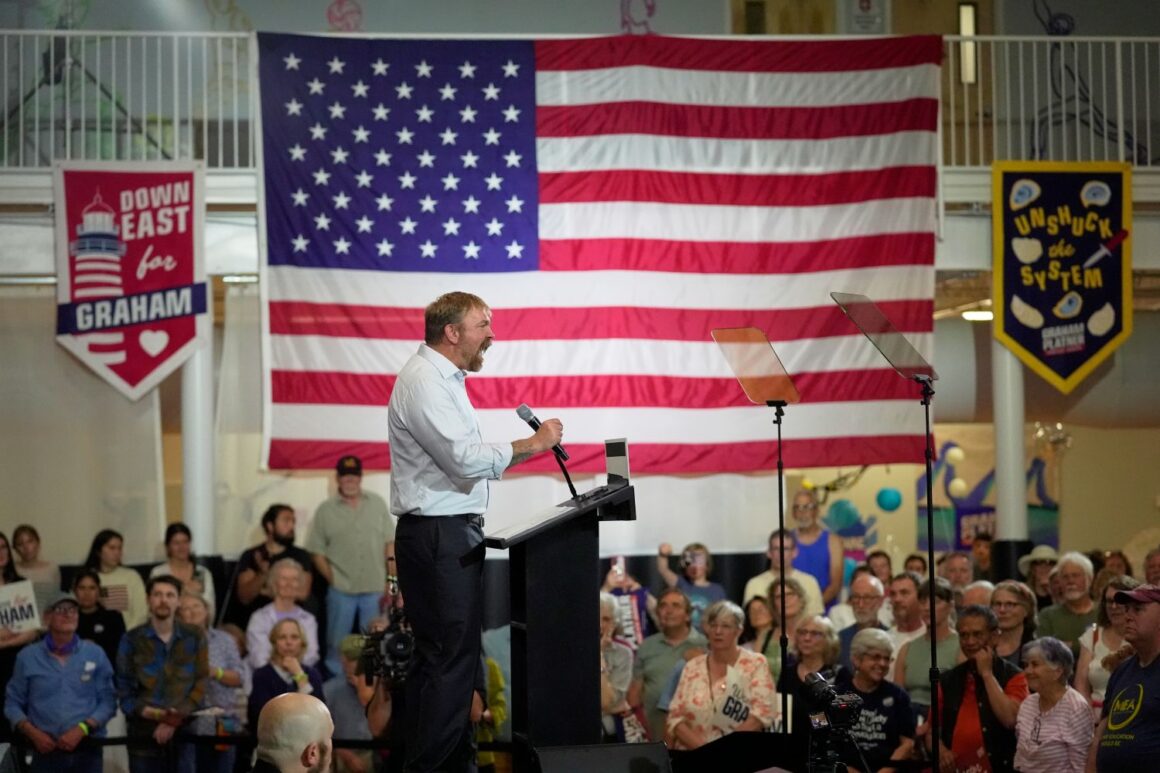
In the month since Maine’s June 9 primary election, 15 candidates have officially withdrawn from their races across the state. Graham Platner intends to join them on that list.
Platner, the embattled Democratic U.S. Senate nominee, announced in a video message on Wednesday evening that he is suspending his campaign operations.
After weathering a series of scandals and allegations during his meteoric political rise over the past year, Platner faced a mountain of calls to step down earlier this week after an ex-girlfriend said in a Politico story on Monday that he had raped her while she believed he was “almost blackout drunk.” He denied the rape allegation but acknowledged the political reality of the moment after state and national Democrats withdrew their support and resources en masse.
“We’re not doing it because of the allegations, we’re doing it because of the structures that are being taken away from us by those in power,” Platner said in his video.
Platner’s announcement did not constitute an official withdrawal. He still must sign and submit a written notice with the Maine secretary of state’s office by 5 p.m. on Monday. He had not done so as of Thursday morning, according to a secretary of state spokesperson.
Platner said he intends to file this paperwork, but sent a message to state Democrats about how he thinks they should choose his replacement.
“The process needs to assure that what comes next is reflective of the Mainers on June 9 who turned out and showed that they are desperate for a different kind of politics,” he said in his video. “It needs to be driven not from backrooms but by the will of the people.”
State law sets a clear timeline for this process, requiring the next nominee to be decided by July 27, but leaves the specifics up to the party. At a time of significant anti-establishment sentiment that helped propel Platner to an easy primary win over current two-term Gov. Janet Mills, voters and potential replacement candidates alike have argued that the process shouldn’t amount to a coronation from party insiders.
Shortly before Platner’s announcement Wednesday evening, Maine Democratic Party leaders said they plan to hold a nominating convention to select the new nominee and promised to announce more details soon.
That convention could include 500 delegates elected proportionately from each of Maine’s 16 counties, along with 100 state committee members, the Bangor Daily News reported on Wednesday.
“Today, the Maine Democratic Party held a meeting with over 100 state committee members who voted to hold a nominating convention to choose a new nominee if there is a vacancy to fill,” said the Wednesday statement from party chair Charlie Dingman, vice chair Imke Schessler and executive director Devon Murphy-Anderson. “We will announce the full timeline, details for how the nomination process will move forward, information about how to participate, and requirements for candidates soon. We will keep the public informed throughout the process — transparency is of the utmost importance.”
Typically, each Maine election cycle features a handful of candidates who withdraw from races for lower levels of government, and the nomination process is handled with little fanfare by the respective state party or even one of its regional or local arms.
But there is nothing typical about the current situation, which involves a statewide race with national implications that could determine which party controls the U.S. Senate.
Kate McBrien, the chief deputy and chief of staff for the Maine secretary of state’s office, said she looked through state records and, while her review shouldn’t be considered definitive, she couldn’t find another instance where a Maine candidate for federal office withdrew between the primary and general elections.
What the law says
Maine statute related to general election vacancies is clear on the required timing of candidate withdrawal and the subsequent party nomination of a replacement. The law is vague, however, when it comes to the actual process of choosing a new nominee.
Under state law, a candidate has to formally withdraw by the second Monday in July — in this case, next Monday, July 13 — and the relevant political committee needs to choose a new nominee by the fourth Monday in July. That means Democrats would need to stand up a nomination process and produce a new choice by Monday, July 27.
While the statute, which dates back to the early 1960s according to research by Maine’s Law and Legislative Reference Library, is crystal clear about the timing, it largely leaves the nuts and bolts of the selection process up to political parties.
“The law does not state in any way how a party has to pick someone. It’s completely up to them,” McBrien told The Maine Monitor on Wednesday. “The law just states what deadlines have to be met in order for a candidate to officially withdraw and to notify the elections office, and what is the deadline for a party to pick someone else to fill the slot.”
McBrien emphasized that there is no flexibility in terms of the timing for Platner to file the withdrawal paperwork.
“If he contacts us at 5:10 on Monday, we can’t accept it,” she said.
Platner would be the 16th candidate to officially withdraw in Maine since the June 9 primary. Nine Republicans and six Democrats, almost all in State House races and one in a county race, have dropped out in the month since the primary. This often happens in state legislative races, sometimes when a candidate appears as a placeholder candidate during the primary and is replaced by someone else for the general election.
When these replacements happen after the primary, the parties have to submit a form to the secretary of state’s office that includes information about the new nominee and the method by which they are chosen. But according to McBrien, that required information about the method of selection can be very brief, and doesn’t offer much detail about how state Democrats might proceed in replacing Platner.
“There is no roadmap,” McBrien said.
And while there are still questions about how this all could play out, there is no ambiguity about one element: The state cannot conduct some sort of official pop-up election for voters to directly chose Platner’s replacement.
“There’s lots of rules and laws around running an election at the state level, and deadlines of when material has to be sent in and when ballots are printed and made available, and absentee voting and all that kind of stuff,” McBrien explained. “And none of that is allowed for this instance.”
That means the secretary of state’s office wouldn’t be involved in the process to select a new nominee except to accept a replacement and add the nominee’s name to the ballot, McBrien said. The process is noteworthy in this election given current Secretary of State Shenna Bellows has been among those speculated as a potential replacement for Platner.
“We accept a form, and we note what name should be printed on a ballot,” McBrien said.
“That’s it.”
‘Finger on the scale’
In the uncertainty of this week’s events, a rift quickly emerged between the Maine Democratic Party and Platner’s campaign over some of these process questions.
“Unfortunately, Graham Platner’s team has repeatedly reached out to us in an attempt to put their thumb on the scale of what this process looks like,” Murphy-Anderson, the party executive director, said in a Tuesday night video. “We have repeatedly reiterated to Graham Platner’s team that they have no role in determining our next Democratic nominee for the U.S. Senate, nor in determining what this process looks like.”
Murphy-Anderson said Platner needed to drop out so Democrats could focus on the race against incumbent Republican Sen. Susan Collins.
The Platner campaign disputed the party’s version of events in a statement released on behalf of an unnamed campaign spokesperson.
“The Platner campaign has reached out to the party to try and understand what this process would look like. At no point has the campaign tried to ‘put its finger on the scale,’” the Platner campaign said in the statement provided to The Monitor on Wednesday. “Over 150,000 Mainers voted for this movement, and over 15,000 Mainers volunteered their time and energy to it. While Graham wouldn’t want to be a part of the process, he would want to make sure the voters and volunteers make this decision — not the political establishment.”
Potential replacements
Even before Platner made his announcement, Democrats began jockeying to be the next nominee — many of them recent primary candidates who didn’t win the nomination for governor or Maine’s 2nd Congressional district.
Former state Senate president Troy Jackson quickly declared his candidacy on Wednesday night after Platner’s announcement. He had filed paperwork with the Federal Election Commission to create an exploratory committee earlier in the week. Jackson finished third in the recent Democratic primary for governor and, like Platner, had picked up the endorsement of U.S. Sen. Bernie Sanders.
Jordan Wood, the third-place finisher in the primary for Maine’s 2nd Congressional District, followed suit Thursday morning by announcing his own Senate campaign. Wood initially ran in the Senate primary before switching over to the House race last November.
Paige Loud, who previously ran for the 2nd District seat, has also filed paperwork for an exploratory committee and said she is prepared to run for the Senate seat.
Dr. Nirav Shah, the runner up in the primary for governor, announced his Senate candidacy in a video on Thursday morning.
Others who have signaled interest include Dan Kleban, who withdrew early from the Senate primary; state Rep. Valli Geiger of Rockland; and David Costello, who came in third in the Senate primary behind Platner and Mills.
Earlier in the week, Shah called for there to be debates and town halls as part of the process to select Platner’s replacement.
“What matters more than anything right now is that the process to select the nominee be as open and transparent as possible,” Shah said on Tuesday.