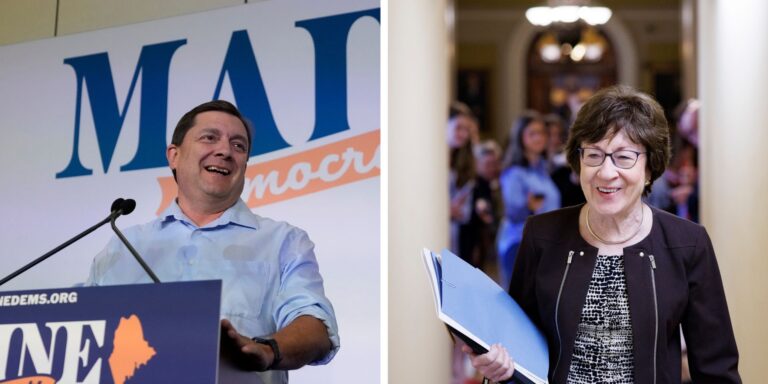



In 2020, in one of the most expensive U.S. Senate races in Maine’s history, every published election poll showed Democrat Sara Gideon, the former speaker of the Maine House of Representatives, beating incumbent Republican U.S. Sen. Susan Collins. Gideon’s lead appeared consistent — until Election Day, when she lost to Collins by nine points.
This was not the only race where the polls have been off the mark in recent years. In 2016, pollsters famously underestimated support for then-candidate Donald Trump; in 2020, polling errors were the highest in decades and were widespread across national and local races, according to a report by the American Association for Public Opinion Research.
“Polling has been in a bit of a crisis,” said Amy Fried, a professor emerita of political science at the University of Maine.
Public opinion experts, pollsters and campaigners alike are cognizant of the inherently imperfect nature of polling. Conducting an election poll is more difficult than it used to be — fewer people today pick up the phone for unknown numbers, and even fewer agree to answer survey questions.
Traditional, over-the-phone polling is not only more expensive, it is becoming less reliable as a method of random sampling to find a representative pool of respondents. Instead, some public polling centers collecting data about Maine’s races, including the University of New Hampshire Survey Center and the Center for Public Opinion at the University of Massachusetts Lowell, are turning to digital survey panels that come with monetary incentives and undergo heavy statistical adjustments in order to be considered representative.
Election pollsters must also confront the particular hurdle of predicting who will show up to vote. This problem is compounded in Maine, where same-day voter registration and a large pool of unenrolled voters who can vote in primary elections make it hard to forecast voter turnout. Ranked-choice voting further complicates pollsters’ ability to get an accurate picture of public sentiment.
This year’s U.S. Senate race between Collins and Democrat Graham Platner is heating up, with two polls released last week — one from Fox News, and the other a collaboration between the New York Times, Siena University and the Portland Press Herald — showing Platner three points behind and two points ahead, respectively. On Monday, June 29, the Times/Siena poll announced updates to its weighting formula that marked the most significant methodological changes made in the decade the surveys have been run. They are not alone: pollsters who cover Maine are tweaking their research designs, experimenting with new ways of reaching people and reassessing who they predict will turn out to vote on Election Day in an attempt to avoid repeating mistakes made in 2020.
There have always been “a lot of ways to mess polling up,” said Mark Brewer, a political science professor at the University of Maine. “Today I think there’s a lot more ways it could go wrong.”
The likely voter problem
When the Colby Polling Initiative published its final poll just a week before the election in 2020, it showed Gideon with a 3.2 point lead above Collins and a 3.3 percent margin of error, which meant either candidate’s support could be 3.3 points higher or lower. With the margin of error larger than the points between the two candidates, the poll suggested a dead heat.
But on Election Day, Collins clinched a decisive 9-point lead. This ended up being the last poll of its kind the school published, with professors and administrators choosing not to revive the project this year in part because polling is too controversial, said Dan Shea, a professor of government at Colby who was among those leading the initiative.
Looking back at the 2020 Senate race, Shea attributed the disparity between poll results and the election’s final tally to one of polling’s most challenging components: sampling the people who are actually going to vote.
Figuring out who is a “likely voter” has long vexed election pollsters. The problem can’t simply be solved by sampling from already-registered voters. People who are registered and say they are going to vote may not end up doing so, while others — registered or not — may not intend to vote and ultimately do so. High-turnout elections, when voters who have not come out in recent elections show up, can be particularly confounding. Maine is also one of 17 states, plus Washington, D.C., that allows same-day voter registration, which means all residents of Maine must be considered possible voters.
In Maine, roughly a third of the state is not enrolled in a political party. This makes anticipating who will cast a vote — especially in Maine’s semi-open primary elections, in which unenrolled voters may choose which party they want to cast a ballot for — even more difficult.
“Even if [independent voters] say they have an opinion,” said Fried, of UMaine, “they might be more likely to drop out and just decide not to vote if they’re uncertain.”
Surveying likely voters, too, has its challenges, as they “often aren’t really paying attention until the very end,” said Sean McKinley, a project director for the University of New Hampshire Survey Center, which has been conducting midterm election polls in Maine this year.
Poll respondents tend to be overconfident that they’ll vote, McKinley said, so surveys often begin with a series of questions meant to deduce whether the person answering the poll will end up casting a ballot.
The UMass Lowell Center for Public Opinion, which conducted its first Maine Senate race poll in May, asked respondents not only whether they were going to vote in November, but how often they’ve voted in other midterm elections and how closely they are following news about the race.
In calculating final results, the center weighted the answers of highly likely voters more heavily than unlikely voters. UMass Lowell survey research director John Cluverius said that his team spends significant time weighting and processing data once it has been collected.
Pollsters typically also make adjustments based on population demographics, which can allow course correction if they under-survey a certain group. UMass Lowell adjusted their results to match national gender, age, race and education demographics of 2024 presidential voters.
The UNH Survey Center, which published the results of its polls on the Maine races for Senate and governor in May, similarly weights for demographics and by past elections, asking respondents how they voted in the most recent presidential election and adjusting the weighting to match Maine’s voting distribution in 2024.
While weighting responses can help pollsters adjust for holes in their population of respondents, it can also end up skewing results. According to Shea, adjusting based on past election data particularly underestimates young voters. Cluverius said polls also struggle to accurately capture last-minute surges of voters who, at the time of polling, “are not even sure they’re going to vote, but are motivated to vote for one candidate over the other.”
“There’s tremendous enthusiasm — excitement — about politics these days, especially among people that never used to pay much attention,” said Shea.
Polling for ranked-choice races
In Maine, ranked-choice voting also complicates the polling process. Maine is one of only two states that uses ranked-choice voting for some statewide races, and its 2026 primaries saw an unprecedented number of races move to ranked-choice voting tabulation.
Even if the polls accurately capture the candidate who is leading overall in the first round — as they did for Nirav Shah in the Democratic primary for governor — it is hard to measure how voters’ second- and third-choice picks could influence races in which no one comes away with more than 50 percent of the vote initially.
Fried, of UMaine, said that ranked-choice polling is challenging because pollsters must extrapolate results based on subgroups of their sample who have ranked several different candidates in a particular order. The small groupings lead to large margins of error — the amount of uncertainty around the results — and less reliable forecasts.
Dan Jenkins, a Democratic campaign manager who previously ran Jared Golden’s campaign for Congress, said that polling agencies have gotten better at navigating ranked-choice voting, but it still makes potential outcomes harder to determine.
After UNH published its May poll looking at Maine’s primaries for governor and U.S. Senate, researchers at Cornell got to work testing a new method for analyzing the results to predict how ranked-choice tabulation could play out. Lead researcher David Liu and his team applied a statistical model to find patterns of support between the eliminated candidate and others in the race.
The researchers then simulated the results of the Democratic gubernatorial primary a thousand times — using UNH’s poll data to generate different possible voting populations — and counted up the number of simulations won by each candidate.
Liu said the techniques his team are using are “not super hard,” yet they remain uncommon in political polling. Pollsters publish data on how people will vote, but when a ranked-choice race is tight, he said, this data may not capture the full story.
In the Cornell analysis, Nirav Shah won more than 97 percent of the simulated Democratic primaries.
After Hannah Pingree was announced as the Democratic nominee, Liu said that the UNH polling data used in Cornell’s analysis was collected before and during the period when Pingree, Shenna Bellows and Troy Jackson cross-endorsed each other, and wrote in an email to The Maine Monitor that those endorsements appeared to have diverted votes away from Shah.
‘A big and deeply complicated country’
UMass Lowell and UNH have nonpartisan funding to run their polls independently, but polls can also be commissioned by campaign teams. Campaigns hire survey firms to conduct internal polls to see who is leading, gauge how people are reacting to news about a race and test different messages to see which language is most effective.
“Campaigns look at that data, and it helps them to determine what issues are best to focus on and what tactics might be the most successful,” said David Farmer, a political consultant who served as deputy chief of staff for former Gov. John Baldacci.
Republican strategist Lauren LePage — who managed Benjamin Midgley’s campaign for governor — said campaigns poll as often as they can, depending on their budget. Campaigns pay tens of thousands of dollars per poll. This election season, Platner’s campaign has spent at least $208,300 on polls, and Collins’ team has spent at least $124,000, according to Federal Election Commission data.
Campaign managers said voters should look at internal poll results with a grain of salt. When internal poll results are published, the campaign has a reason for it — and a story they’re trying to sell. Jenkins said campaigns use poll evidence of close races, for instance, to rake in more donations.
“It’s to signal to donors that: ‘this race is close, we have a chance to win,’” he said.
Public polls can also affect a race. When the Colby Polling Initiative published its U.S. Senate race poll in October 2020, it showed Gideon and Collins as close or closer than other polls had represented. Shea recalled that the result led to an influx of last-minute donations to Gideon, and said the sudden cash backfired, arousing the sentiment that “Mainers can’t be bought.”
The results of polls can change the behavior of campaign staff and supporters, Farmer said. One side might become complacent, while the other might gain manpower as volunteers feel called to action.
Undecided voters might end up supporting the candidate leading in the polls, Cluverius said, because “especially in a primary, people like voting for a winner.” But the actual effect polls have on voters is likely minimal, he added, especially in a ranked-choice voting system where voters aren’t penalized for ranking an unlikely candidate as their first choice.
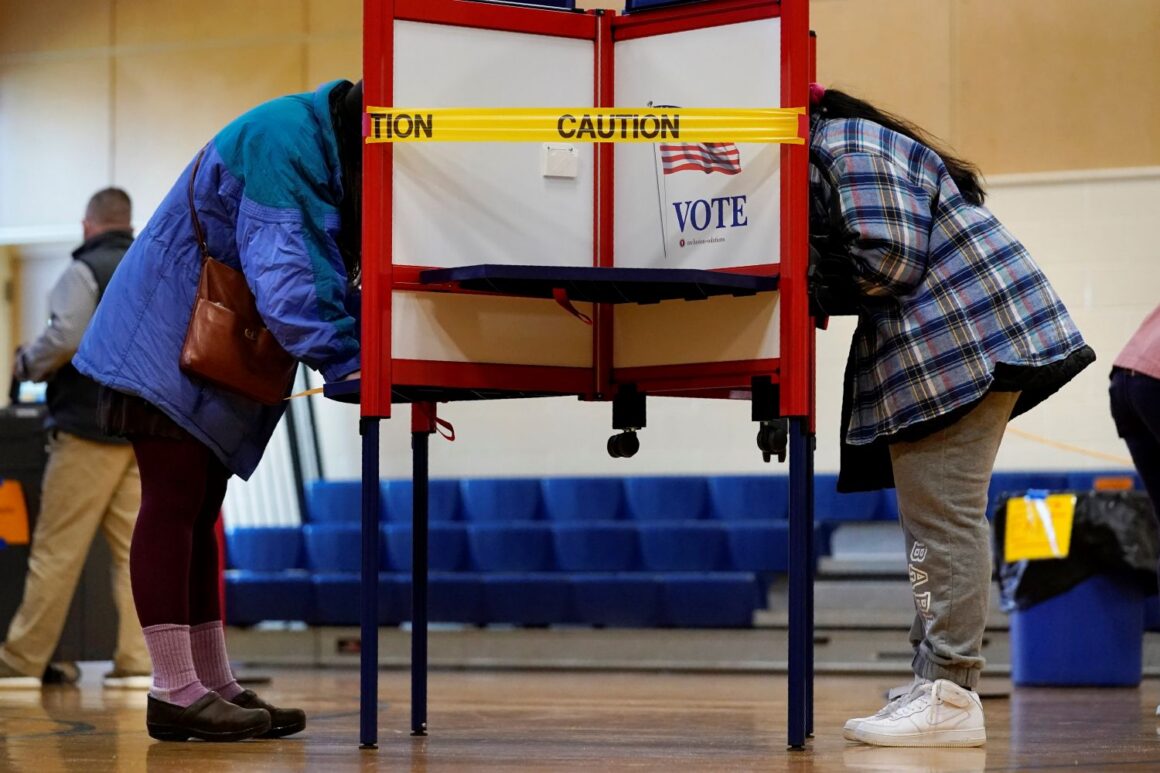
At poll stations on June 9, over 30 voters surveyed by The Monitor said they don’t look at the polls, or otherwise try not to let them affect their vote.
“I do read about them and I do look for them, but they don’t change how I vote. I go by what I’m reading on the candidates and my own gut feeling,” said Nancy Crosen, a registered Democrat from Standish.
Eloise MacArthur, who voted in the Republican primaries in Lisbon, says that she only occasionally takes note of the polls. “I don’t trust them anyway,” she added. “They usually lie.”
Even if poll results aren’t top of mind for Maine voters as they fill out their ballots, pollsters, campaign managers and political science professors generally agreed on the importance of polling. Polls, said Cluverius, of UMass, inform people about the realities of the world around them, allowing everyone from activists to public officials to be more informed about the opinions of those they claim to represent.
“This is an imperfect methodology, but it’s the best one we have,” he said. “We’re a big and deeply complicated country, and if I can shed some light on how big and deeply complicated we are, I think I’ve done my job.”
Ida B. Wells reporting intern Abi Brissett contributed reporting.
Update 7/6/2026: This story has been updated to note that participants in survey panels receive different kinds of monetary incentives. At the UNH Survey Center, participants are entered into a drawing, not given a direct payment.