


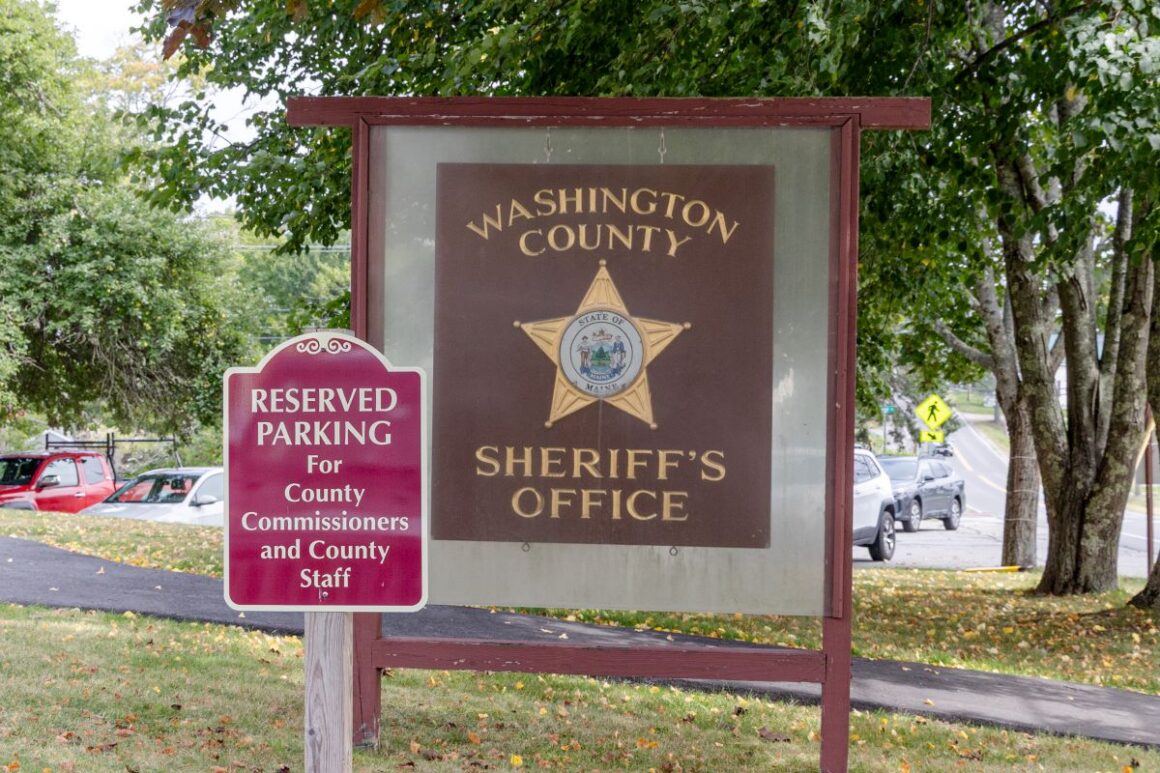
MACHIAS — The Washington County Sheriff’s Office has retained attorneys who are challenging the county’s 2027 budget process, asserting that commissioners failed to follow state law when turning the draft budget over to the Budget Advisory Committee on Sept. 10.
The attorneys are also seeking three years of records concerning Sheriff’s Office budget requests and expenditures, personnel schedules and county vehicle use.
The request for documents, made under Maine’s Freedom of Access Act, or FOAA, includes all emails, texts and other communications on officials’ government-issued and private computers and phones.
The broad request touched off an anxious conversation Tuesday among members of the county’s Budget Advisory Committee over whether the Sheriff’s Office might be investigating committee members, leading to a committee vote requesting county-provided legal representation for each member.
Budget Advisory Committee Vice Chairman Ben Edwards was the only committee member named in the FOAA request, alongside the county commissioners and members of the treasurer’s office. Other committee members, however, said they believed shared communications could include them in the response.
Committee Chairman Brian Schuth said it bothered him to see more taxpayer funds spent on “dueling attorneys” so soon after the county spent nearly $10,000 to settle a wrongful termination lawsuit filed by County Manager Renée Gray. He reminded committee members that both he and Edwards “expressed concerns before the beginning of this (budget) process that we might become a football or a focus for fights that are not ours.”
“I am concerned about being pulled into a continuing mess that started months ago,” Schuth said, adding that while he defends the right of the Sheriff’s Office to request public documents, he “would not respond to a FOAA request from a lawyer without talking with a lawyer, particularly if it concerns anything that might be in a personal device of mine.”
Edwards said he also wants legal representation and sent a letter asking commissioners to allocate legal costs for that purpose. He expressed hope that his request would appear on the agenda for a special commission meeting scheduled for Oct. 28.
The agenda for that meeting, circulated Monday, does not list Edwards’ request, though an executive session is scheduled at the start.
Budget Advisory Committee members asked Chief Deputy Mike Crabtree for insight into why the Sheriff’s Office is seeking the records. Crabtree said he could not provide much detail, adding: “Obviously, the sheriff is concerned about some of the things that have taken place procedurally concerning the commissioners and how things have been done and how things have not been done. It’s unfortunate, I think, that the budget committee is wrapped up in this a little bit.”
Crabtree assured committee members that none of them are under investigation.
Attorney David Joyce of Brann & Isaacson filed the FOAA request on behalf of the Sheriff’s Office. He seeks all public records sent to, received by or in the possession of Commissioners David Burns, Billy Howard and Courtney Hammond; Vice Chairman Ben Edwards; and the treasurer’s office staff regarding the 2025, 2026 and 2027 county budgets.
The request also covers all Sheriff’s Office expenditures, personnel records and official vehicle information from that same period.
The records include all emails, text messages and other written or electronic communications, whether sent or received on government-issued or personal devices, including laptop computers and cellphones.
Joyce made clear the request covers all patrol and investigative units within the Sheriff’s Office, the Washington County Jail, the Regional Communications Center and any personnel under the sheriff’s command.
Tuesday’s meeting was scheduled to continue work on 2027 budget requests, but was sidetracked by the FOAA request and a letter from attorney Michael Carey. The letter claims commissioners failed to follow state law when they forwarded a draft budget to the advisory committee without first voting on their own budget estimate.
In the letter, sent to commissioners, Schuth and budget committee members, Carey asserted that the committee’s work since Sept. 15 is “only preliminary because the Washington County Commission has not yet fulfilled its legal responsibility to begin the budget development process.” Specifically, Carey wrote, commissioners failed to hold a formal vote on their budget estimate.
The untouched draft budget represents $17.1 million in spending, a $3.7 million, or 27.6 percent, increase over last year’s final budget.
Without cuts, property taxes must cover $15 million of that total, which is $3.4 million more than last year.
In late August, the commission split on whether to make cuts to that draft. Burns opposed sending the budget forward as written, joining Howard in suggesting cuts focused largely on the Sheriff’s Office, but the board reached no consensus to review the budget line by line.
Following a brief public hearing Sept. 10 that drew no comment, commissioners forwarded full department requests to the Budget Advisory Committee, instructing members to make cuts, but offering no guidance on what to trim.
At the time, Burns urged Schuth to weigh taxpayer costs against core priorities, asking the committee to consider “which of those are necessary to provide” among the array of current county services.
After that meeting, Burns and Howard sent what Schuth later called “wish lists” to the Budget Advisory Committee containing their individual suggestions for cuts. Several suggestions involved ideas commissioners had previously raised but never implemented, such as purchasing fewer cruisers than Sheriff Barry Curtis requested and reducing K‑9 program costs.
During the Budget Advisory Committee’s first meeting, members faulted commissioners for passing the budget along without making their own suggested cuts.
Schuth said he was frustrated that commissioners disavowed the draft budget for a second consecutive year, yet sent it to the committee, making its job harder.
According to Carey’s letter, state law requires the commission to act as a unified board rather than as individuals, which the attorney said Burns and Howard did when submitting their “wish lists.”
“I understand that individual commissioners have submitted questions or objectives to the Budget Advisory Committee. However, individual commissioners’ public comments do not replace the county commission’s statutory duty to take action to start the budget process,” Carey wrote.
Carey also questioned whether the commission is “sticking to its limited duties in law enforcement,” and whether commissioners are interfering with Curtis’ responsibilities as a constitutional officer, including his authority over department resources.
Commissioners Burns and Howard and key Sheriff’s Office officials, including Crabtree; Joshua Rolfe, deputy director of the Regional Communications Center; and Jail Administrator Capt. Rich Rolfe, have clashed over spending for months, particularly regarding overtime costs, leading to several tense exchanges at commission meetings.
In his letter, Carey noted that even though the Sheriff’s Office views the budget process as flawed, Curtis and Crabtree have participated out of respect for committee members and plan to remain involved.
“However,” Carey wrote, “the good faith of the participants in the process does not replace the County Commission’s statutory duty to provide the Budget Advisory Committee with its budget estimate, by formal vote.”
He urged commissioners to issue that formal vote “as soon as possible.”
More than three hours into Tuesday’s meeting, after reviewing Carey’s letter, the Budget Advisory Committee briefly considered pausing its work until commissioners vote on a budget estimate. Ultimately, members voted to continue reviewing the budget, but said they will withhold final recommendations until “county commissioners have voted on and provided us with their recommendations.”
That means the budget could return to the commission without any changes.
State law requires county commissions to submit a budget estimate to the advisory committee at least 90 days before the fiscal year ends. The committee must then review the estimate and submit its recommendations back to commissioners at least 45 days before year-end, setting the deadline for Nov. 16.
Commissioners must act on the budget at least 15 days before the fiscal year ends. If they want to change the advisory committee’s recommendations, commissioners must hold a joint meeting with the committee to negotiate a final budget.
If commissioners fail to approve the negotiated budget, state law authorizes the committee to adopt a final budget. Commissioners can alter that budget only by a majority vote, which the advisory committee can then override with a two-thirds vote of its membership.
If officials fail to approve a budget by Jan. 1, the county will run on an interim budget capped at 80 percent of the 2026 budget until adopting a new one.
In other matters Tuesday, Rob Davis of Enterprise presented a full-equity lease proposal with cost estimates to phase in a 25-vehicle fleet for the Sheriff’s Office at five vehicles per year. Some committee members resisted, arguing that leasing could ultimately cost more than buying vehicles outright. The committee took no action.
The committee also reviewed budget requests from Nick Landrum of The Computer Guy in East Machias, the county’s contracted information technology administrator. Landrum requested $461,600, which is double last year’s amount, though officials noted the increase is administrative.
The change reflects IT expenses previously scattered across individual department budgets that were consolidated to align with updated county accounting practices.
Heron Weston, supervisor of the unorganized territory, outlined expenses driving costs in the UT. The committee took no action.
The committee’s next meeting is scheduled for 9 a.m. Tuesday, Oct. 27, to review requested budgets for insurance, employee benefits and debt service.